
AC Fan Motor Replacement: Cost & Warning Signs
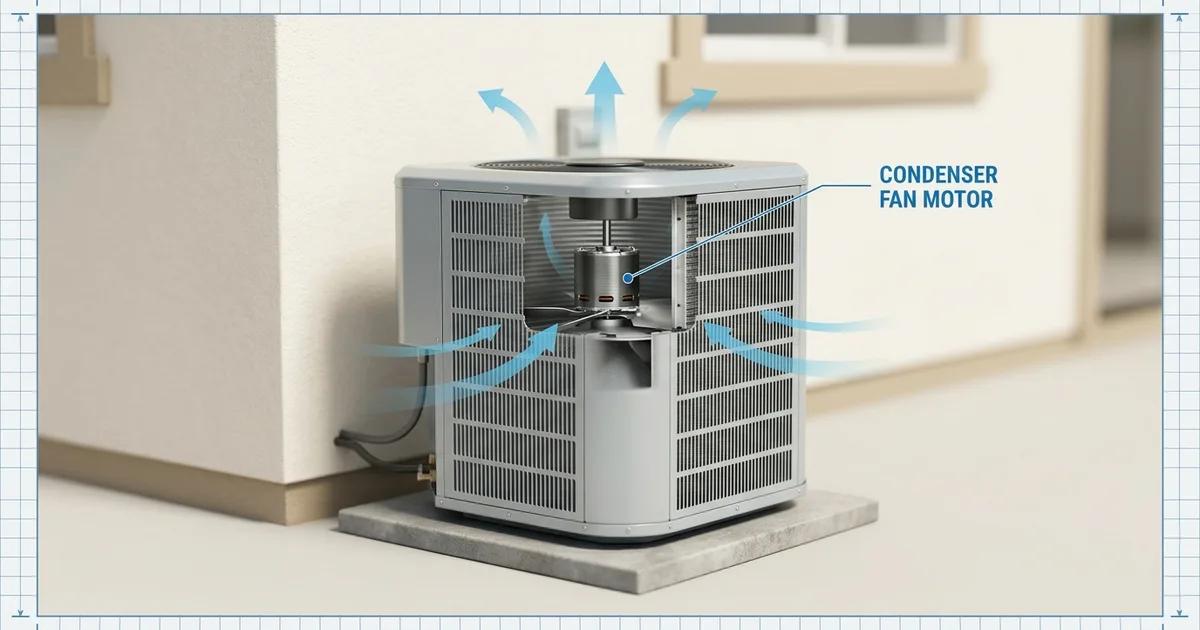
You walk outside to check your AC. The unit is on — you can hear it humming — but the fan blade on top of the condenser isn't moving. Or it stopped spinning mid-afternoon on a 105-degree Sacramento day and the house is already warming up. Either way, that outdoor fan motor is telling you something needs attention.
AC fan motor replacement is one of the more manageable HVAC repairs a Sacramento homeowner can face. Unlike a failed compressor, a failed condenser fan motor doesn't automatically mean a new system. But the window to act is short: a stopped fan drives up refrigerant pressures, stresses the compressor, and can turn a $300–$475 fix into an $800–$3,000 compressor job in a matter of days.
We're A-CLASS Heating and Air, a family-owned Sacramento HVAC contractor since 2016. This guide covers what a condenser fan motor actually does, the five warning signs worth knowing, what repairs cost in 2026, and the capacitor vs. motor question most homeowners get backwards.
Key Takeaways
- AC fan motor replacement costs $200–$700 installed in Sacramento (HomeAdvisor, June 2026)
- A humming unit with a stationary fan usually means a failed capacitor ($120–$475) — not a failed motor — but a field test confirms which one
- Bearing failures cause 50–70% of all motor failures, per IEEE industry benchmarks (2024)
- HVAC capacitors hold 370–600 volts after power is cut — a key reason this repair belongs with a licensed technician
- Sacramento's extreme summers push fan motors to the shorter end of their 10–15 year lifespan
How Much Does AC Fan Motor Replacement Cost?
In Sacramento, AC fan motor replacement runs $200–$700 installed, with most straightforward residential jobs landing in the $350–$550 range (HomeAdvisor, June 2026). That range covers a standard condenser fan motor on a split-system central AC unit. The part itself costs $60–$400 depending on whether you use an OEM motor or a compatible aftermarket unit; labor runs $100–$250 per hour, and the job typically takes one to four hours.
Two variables push costs higher in Sacramento specifically. First, July and August demand-surge pricing: when every HVAC technician in the Valley is booked solid, emergency and same-day calls carry a premium. Second, a smart technician will also replace the run capacitor at the same time — it costs $10–$100 for the part and avoids a return visit if the capacitor (which stressed the motor in the first place) fails soon after. Bundling motor and capacitor together typically runs $400–$800.
Cost Comparison: Fan Motor vs. Ignoring the Problem
The table below shows why acting fast matters.
| Repair | Low Cost | High Cost | Source |
|---|---|---|---|
| Run capacitor only | $120 | $475 | Today's Homeowner, May 2025 |
| Condenser fan motor only | $200 | $700 | HomeAdvisor, June 2026 |
| Motor + capacitor bundled | $400 | $800 | Synthesized from above |
| Compressor replacement | $800 | $3,000 | HomeAdvisor, June 2026 |
| Full AC system replacement | $3,500 | $10,000 | HomeAdvisor, June 2026 |
A failed fan motor that keeps the compressor running without proper cooling airflow can destroy that compressor within days of a Sacramento heat wave. Fixing the motor promptly costs a fraction of that downstream repair.
What Are the Warning Signs of a Failing AC Fan Motor?
In Sacramento summers, the most common first symptom is an outdoor unit that shuts off after a few hours of running — usually in the early afternoon when the temperature peaks — while the indoor air handler keeps blowing. That pattern tells you the outdoor section overheated and tripped its thermal protection. A stopped or sluggish condenser fan is the reason heat has nowhere to go.
Five warning signs show up consistently before full motor failure:
1. The outdoor fan isn't spinning while the unit hums.
You hear a low electrical hum from the condenser cabinet, but the fan blade is stationary. This is the single most diagnostic symptom. It often points to a failed capacitor, but a seized motor produces the same picture.
2. Grinding, squealing, or rattling from the outdoor unit.
These noises signal bearing wear — the most common mechanical cause of fan motor failure. Grinding is the most urgent. Metal-on-metal contact means the bearings are already failing and the motor is not far behind.
3. The AC cools fine in the morning but quits mid-afternoon.
Sacramento's afternoon highs reach 105°F–115°F in July. Without adequate fan airflow, refrigerant pressures spike and the unit's thermal protection cuts the compressor. If this pattern repeats over several days, the fan motor is a primary suspect.
4. Warm or room-temperature air from the supply vents.
The indoor blower runs, but the air doesn't feel cold. The refrigerant is circulating but never properly sheds heat through the condenser coil — because the fan that's supposed to pull air across that coil has slowed or stopped.
5. A burning smell or a breaker that trips and won't stay reset.
Motor winding insulation breaking down produces a distinctive electrical burning smell. A shorted motor draws excessive current and will trip the breaker repeatedly. Treat either of these as a stop-operation warning — shut the system off and call for service.
Is It the Motor or the Capacitor?
This is the question that saves — or costs — Sacramento homeowners several hundred dollars. A humming, non-spinning condenser fan points to one of two failures, and they don't cost the same.
The capacitor is the more common first failure. Run capacitors degrade from heat cycling. They provide the starting torque the motor needs to spin up. A weak or failed capacitor can no longer do that job, so the motor hums but can't move. Capacitor replacement runs $120–$475 and takes under an hour.
The motor itself is the less common but costlier failure. Worn bearings, winding insulation breakdown from sustained heat exposure, or a bent fan blade that put the shaft off-balance — these kill motors. Motor replacement runs $200–$700.
According to IEEE industry benchmarks, bearing failures account for 50–70% of all electric motor failures (Industrial Monitor Direct, citing IEEE data, 2024). The DOE's Advanced Manufacturing Office puts the bearing-failure share at roughly two-thirds (DOE AMO, 2014). In Sacramento's heat, bearing wear accelerates because modern sealed motors have no lubrication ports — bearings run dry until they fail.
The Field Test (For Observation Only)
A technician will often perform a simple diagnostic before reaching for a multimeter:
- Confirm power is off at the disconnect and breaker.
- Using a long, non-conductive stick — never a hand near an energized unit — give the fan blade a slow, gentle push through the grille.
- If the fan starts and keeps spinning on its own (even sluggishly), the capacitor is the primary suspect.
- If the fan won't move, grinds, locks, or the motor smells burnt, motor failure is likely.
- A multimeter test confirms: measure the capacitor's microfarad rating (must be within ±6% of the labeled spec) and the motor winding resistance (an open circuit or a short to the metal casing confirms winding failure).
Both components can fail at the same time. A motor that ran for weeks or months with a weakened capacitor may have accumulated enough heat damage to need replacement too — which is why a technician who finds a failed capacitor will often recommend replacing the motor at the same time if the system is over eight years old.
Why DIY AC Fan Motor Replacement Carries Real Risk
Let's be straightforward about this. The motor swap itself isn't the dangerous part. The danger is the capacitor — a component the size of a soup can that sits right next to the fan motor in the condenser cabinet.
HVAC run and start capacitors are rated for 370–440 volts and can retain a charge of 370–600 volts even after you cut the breaker (HVAC PRO Sales, 2024). Virginia Tech's Environmental Health and Safety program classifies anything above 50 volts as a shock hazard requiring the same handling as live equipment (Virginia Tech EHS, institutional guidance). The built-in bleeder resistors that are supposed to drain the capacitor can fail silently — so "power off" doesn't mean "safe to touch."
The UC Berkeley Office of Environment, Health & Safety documented a case where a capacitor charged from a 208-volt supply stored 5 kilovolts and 200 milliamps. It discharged through a repair worker's hands. The worker was hospitalized overnight (UC Berkeley EHS, 2005).
Occupational data from the Electrical Safety Foundation International (compiled from Bureau of Labor Statistics fatality records for 2011–2024) shows that HVAC mechanics have an electrical fatality rate of 0.98 per 100,000 workers — nine times the all-occupations average of 0.11 (ESFI/BLS, 2024). These are trained professionals with proper discharge tools. That statistic isn't meant to alarm — it's meant to put the risk in context.
If you're an experienced electrician or HVAC tech who understands the safe discharge procedure — resistor across terminals, confirmed zero voltage with a multimeter — you can manage this job safely. For most homeowners, the risk-to-savings ratio doesn't favor DIY on this particular repair.
For a full breakdown of what's involved in AC system repairs in Sacramento, including what to expect during a diagnostic visit, see our service page.
How Long Do AC Condenser Fan Motors Last?
Most residential condenser fan motors last 10–15 years under average conditions, with well-maintained motors in mild climates reaching 20 years. In Sacramento's climate, expect the shorter end of that range.
Three factors cut motor lifespan in the Sacramento market:
Extreme summer heat. When outdoor temperatures run 105°F–115°F for weeks, fan motors run longer cycles and at higher operating temperatures. Heat is the primary accelerant of bearing wear and winding insulation breakdown.
No lubrication ports on modern motors. Older motors had oil ports that let technicians lubricate bearings annually. Most motors installed in the last 15 years have sealed, permanently lubricated bearings — which means when the lubrication runs dry, the only option is replacement.
Dirty condenser coils. Cottonwood seeds in spring, dust from Sacramento's hot, dry summers, and debris accumulation all restrict airflow through the condenser. The fan motor works harder to move air through a clogged coil, and the motor runs hotter than designed.
A well-timed annual tune-up — coil cleaning, refrigerant level check, capacitor reading, and motor amperage draw check — extends motor life and catches a weakening capacitor before it damages the motor. Most Sacramento HVAC contractors offer spring tune-ups ($80–$150) precisely because the window between "capacitor is weak" and "motor is dead" can be just a few weeks in June heat.
When Replacement Makes More Sense Than Repair
Motor replacement is usually the right call when:
- The motor is over 10 years old and is already showing wear
- The system is within 2–3 years of its expected 15–20 year lifespan
- The motor replacement cost exceeds 50% of what a new outdoor unit costs
- The existing motor is paired with a compressor that's already showing stress
That last point matters in Sacramento: a system that's been running without proper fan airflow for days or weeks may have damaged the compressor even if the compressor hasn't fully failed yet. A technician who catches elevated compressor temperatures or abnormal refrigerant pressures during the motor replacement service can head off a much larger repair.
What to Expect From an AC Fan Motor Replacement Service Call
Here's what a standard service call looks like when a Sacramento HVAC technician arrives for a suspected fan motor issue:
Diagnosis (15–30 minutes): Visual inspection of the outdoor unit, capacitor voltage and microfarad test, motor amperage draw measurement, and the push test if needed. A good technician will tell you what they found before recommending any parts.
Quote: You should get a written quote that breaks out the motor cost, capacitor cost (if applicable), and labor separately. Ask whether OEM or aftermarket parts are being used — OEM parts typically cost 30–50% more but come with proven compatibility.
Repair (1–3 hours): Power disconnect, safe capacitor discharge, motor removal, fan blade transfer to the new motor shaft, wiring connections, reinstallation, and a functional test. The technician should run the unit through a full cooling cycle before signing off.
Warranty: Most reputable Sacramento HVAC contractors warranty the part for one year and the labor for 30–90 days. Ask before work starts.
One thing to check: If the unit is still under manufacturer warranty, a failed motor or capacitor may be covered. Most residential AC equipment carries a 5- or 10-year parts warranty. The labor won't be covered, but the $60–$400 motor cost often is. Have your equipment's model and serial number ready when you call.
A-CLASS Heating and Air offers same-day and next-day diagnostics for fan motor failures throughout Sacramento and surrounding communities. Our technicians carry the most common fan motor sizes and run capacitors on every service vehicle, so most jobs are completed in a single visit. Call us at (916) 342-9108 or schedule a service call online — we give you a straight diagnosis and a written quote before any work begins.
Frequently Asked Questions
How much does it cost to replace an AC fan motor?
AC fan motor replacement costs $200 to $700 in Sacramento, with the national range running $200 to $700 installed according to HomeAdvisor (June 2026). The motor part itself runs $60 to $400 depending on brand and whether you use OEM or generic. Labor adds $100 to $250 per hour for one to four hours of work.
Can I replace an AC fan motor myself?
Technically possible for experienced DIYers, but the risk is real. HVAC capacitors hold 370 to 600 volts even after the breaker is off. HVAC mechanics have an electrical fatality rate nine times the national average according to ESFI and Bureau of Labor Statistics data. If you are not trained in capacitor discharge procedures, call a licensed HVAC technician.
What are the signs of a bad AC fan motor?
The five main signs are: the outdoor fan is not spinning while the unit hums, grinding or squealing noises from the outdoor unit, the AC shuts off mid-afternoon from overheating, warm air blows from vents despite the system running, and a burning smell or a repeatedly tripped breaker. Any one of these warrants a service call.
Is it the motor or the capacitor — how can I tell?
A humming outdoor unit with a stationary fan is the classic capacitor presentation. The field test: with power off, give the fan blade a slow push with a non-conductive stick. If it then runs on its own, the capacitor is the likely culprit at $120 to $475. If the fan refuses to spin, grinds, or smells burnt, the motor itself has failed at $200 to $700.
Sources cited in this article:
- HomeAdvisor, "How Much Does an AC Fan Motor Replacement Cost," updated June 17, 2026: https://www.homeadvisor.com/cost/heating-and-cooling/condenser-fan-motor-replacement/
- Today's Homeowner, "How Much Does It Cost To Replace A Condenser Fan Motor," updated May 22, 2025: https://todayshomeowner.com/hvac/cost/condenser-fan-motor-cost/
- RK Mechanical Air Services (Sacramento, C20 License #1064548), "AC Repair Cost in Sacramento," est. August 2024: https://rkmechanicalairservices.com/ac-repair-cost-in-sacramento/
- Electrical Safety Foundation International / Bureau of Labor Statistics, "Workplace Injury & Fatality Statistics," dataset covering 2011–2024: https://www.esfi.org/workplace-safety/workplace-injury-fatality-statistics/
- Virginia Tech Environmental Health and Safety, "Capacitors," institutional guidance: https://ehs.vt.edu/programs/occupational-safety/electrical-safety-in-research-operations/capacitors.html
- UC Berkeley Office of Environment, Health & Safety, "Injury Caused by High Voltage Capacitor Discharge," May 2005: https://ehs.berkeley.edu/news/injury-caused-high-voltage-capacitor-discharge
- HVAC PRO Sales, "How to Safely Discharge an HVAC Capacitor — Complete Guide," 2024: https://hvacprosales.com/blog/how-to-safely-discharge-an-hvac-capacitor-complete-guide/
- Industrial Monitor Direct, "Motor Bearing Failure Rates: IEEE Industry Benchmark Statistics," 2024: https://industrialmonitordirect.com/blogs/knowledgebase/motor-bearing-failure-rates-ieee-industry-benchmark-statistics
- U.S. Department of Energy Advanced Manufacturing Office, "Extend the Operating Life of Your Motor," 2014: https://www.energy.gov/sites/prod/files/2014/04/f15/extend_motor_operlife_motor_systemts3.pdf
Frequently Asked Questions
How much does it cost to replace an AC fan motor?
AC fan motor replacement costs $200 to $700 in Sacramento, with the national range running $200 to $700 installed according to HomeAdvisor (June 2026). The motor part itself runs $60 to $400 depending on brand and whether you use OEM or generic. Labor adds $100 to $250 per hour for one to four hours of work.
Can I replace an AC fan motor myself?
Technically possible for experienced DIYers, but the risk is real. HVAC capacitors hold 370 to 600 volts even after the breaker is off. HVAC mechanics have an electrical fatality rate nine times the national average according to ESFI and Bureau of Labor Statistics data. If you are not trained in capacitor discharge procedures, call a licensed HVAC technician.
What are the signs of a bad AC fan motor?
The five main signs are: the outdoor fan is not spinning while the unit hums, grinding or squealing noises from the outdoor unit, the AC shuts off mid-afternoon from overheating, warm air blows from vents despite the system running, and a burning smell or repeatedly tripped breaker. Any one of these warrants a service call.
Is it the motor or the capacitor — how can I tell?
A humming outdoor unit with a stationary fan is the classic capacitor presentation. The field test: with power off, give the fan blade a slow push with a non-conductive stick. If it then runs on its own, the capacitor is the likely culprit at $120 to $475. If the fan refuses to spin, grinds, or smells burnt, the motor itself has failed at $200 to $700.