
Sacramento duct diagnostics
Duct Repair Sacramento Homeowners Can Understand
At a glance
Duct repair Sacramento homeowners need often means fixing an existing leak, disconnect, crushed run, or loose vent connection. A-CLASS Heating and Air serves Sacramento County and parts of Placer and El Dorado counties. We inspect the air path, explain what is accessible, and separate a focused repair from a larger ductwork planning decision.
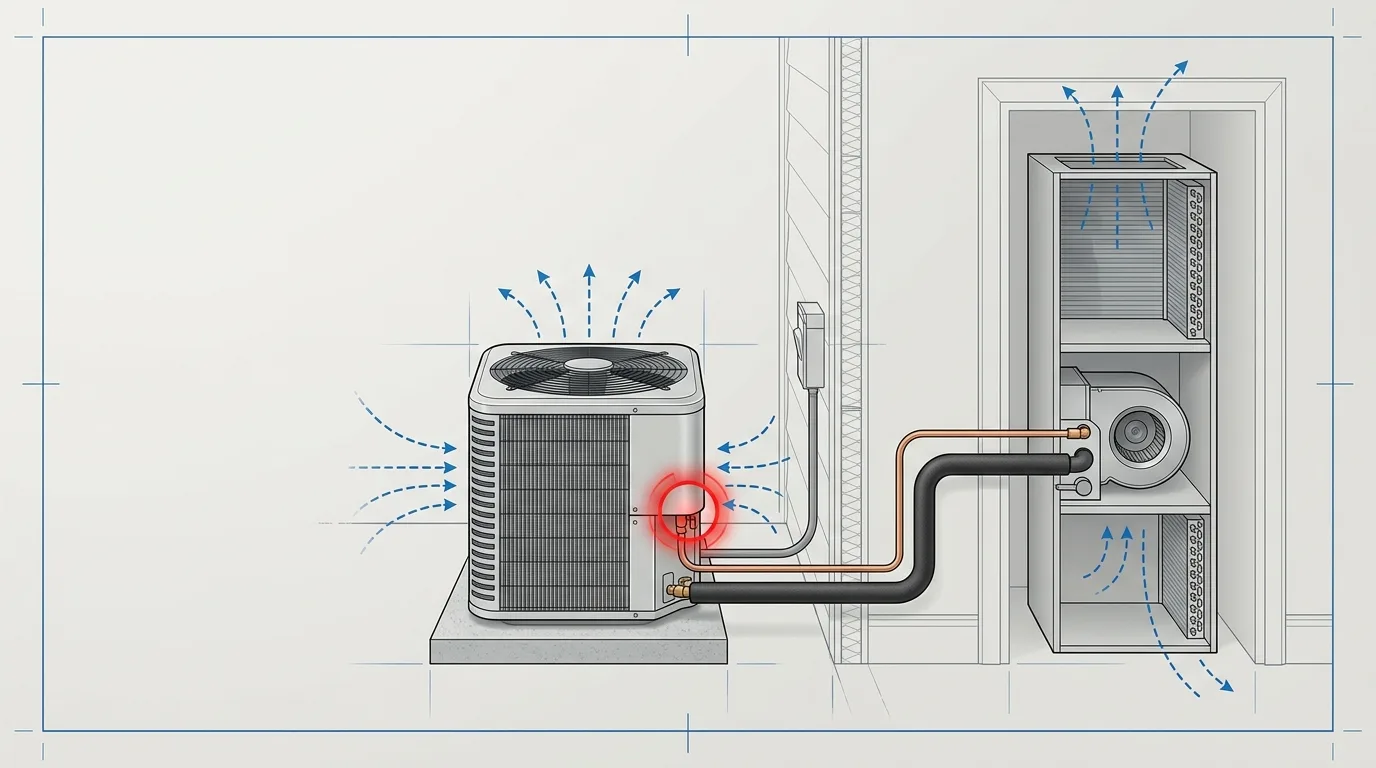
Duct repair Sacramento symptoms can point to
A room that stays warm in July may have more than one cause. The equipment may be struggling, yet an existing duct run may also be torn, pinched, sagging, or no longer joined at the boot. A supply duct is the path that carries conditioned air from the equipment to a room. When it loses its shape or connection, the room receives less of that air. A return path is the route that brings household air back to the system, so a return leak can pull in attic heat or dust. In our experience, the useful starting point is the room symptom and the accessible route behind it, not a guess based on a noisy grille. For example, a weak bedroom vent after attic work may call for a connection check before anyone blames the thermostat. Is the issue one room or the whole home? That distinction guides the next check.
What the symptom may mean
| What you notice | Likely duct cause | Repair path |
|---|---|---|
| Weak airflow in one room | Crushed flex duct, loose run, or blocked path | Inspect access, reconnect, reshape, or replace one damaged section |
| Attic smell or heat at a register | Leak or disconnect near a supply or return | Seal or reconnect the accessible leak |
| Heat gain across several rooms | Widespread damage, poor routing, or sizing limits | Plan new or replacement duct runs |
The table is a guide, not a remote diagnosis. Duct sealing means closing gaps at joints, boots, and accessible connections so delivered air stays in the intended path. A single separation can be a repair matter. Widespread brittle insulation, badly undersized trunks, or a layout that cannot serve the rooms needs a different conversation. We found that a visible tear can tempt people to treat every comfort complaint as a simple patch. However, several rooms with poor airflow may reveal a broader system issue. In that case, a whole-system diagnostic can help sort equipment airflow from duct damage. Repair focuses on what is already there; new runs and full replacement belong on the separate planning path.
Attic ducts face Sacramento heat
Sacramento attics can stay punishingly hot during 100°F-plus summer stretches, even when the evening Delta breeze cools the yard.Flex duct is insulated, bendable tubing, and in that space it deals with heat, tight turns, stored items, and foot traffic from later work. Our team found that flex duct often tells its story in the bends: a sharp kink can restrict airflow, while a low sag can hold a run out of shape. The U.S. Department of Energy explains that ducts in unconditioned spaces can lose energy through leaks and poor insulation, which is why the location of the damage matters as much as the room complaint (U.S. Department of Energy, 2026). Consider a run that feels fine in mild weather but fails during an August afternoon. The repair question is whether its connection, shape, insulation, or the system itself limits what reaches the room.
How an existing duct repair decision takes shape
A focused visit starts with the lived symptom: which rooms feel wrong, when it began, and whether the change followed attic work or equipment service. We then look at accessible supply runs, returns, boots, registers, and the connections that carry air between them. In our experience, a rattle may be a loose register, but it can also be moving duct or excess pressure at a small opening. The Environmental Protection Agency notes that sealed and insulated ducts can improve heating and cooling delivery when ducts run through unconditioned areas (ENERGY STAR, 2026). That supports a careful check, not a blanket promise. Our team found that clear access limits matter too; some ducts are easy to inspect, while others are behind finished surfaces. What can we see, and what does that evidence support?
- Room-by-room airflow and comfort symptoms
- Accessible connections, tears, and kinks
- Register, boot, and return-air observations
- Whether repair or larger planning fits the findings
Repair is different from cleaning or new ductwork
Duct repair fixes an existing physical problem in the air-distribution system. It may mean reconnecting a loose run, sealing an accessible leak, correcting a kink, or replacing a limited damaged section. It does not remove dust from inside ducts, and A-CLASS does not offer duct cleaning. It also does not turn a widespread sizing or layout problem into a small repair. For instance, a home with several weak rooms may have ducts that were never suited to the equipment or room layout. That finding belongs in a replacement-planning conversation. We found that this boundary helps homeowners compare paths without treating every duct concern as the same job. The California Energy Commission explains that California energy standards address duct sealing and verification in applicable projects, which is one reason a full ductwork scope needs its own review (California Energy Commission, 2026).
You do not need to enter an attic or pull apart a register to make the first call. Note the rooms involved, whether the problem is new or seasonal, and whether a vent sounds different when the system starts. A visible loose grille can be useful context, but it is not proof of a duct failure. If there is water near equipment, a burning smell, or a gas odor, stop using the system and follow the relevant safety guidance before seeking HVAC help. Otherwise, a repair review can start with the symptoms and the accessible parts of the air path. In our experience, that approach keeps a small connection repair from becoming a vague and unnecessary larger scope.
Clear limits, local service, and the next step
A-CLASS Heating and Air is family-owned and operated since 2016, based in Rancho Cordova, and serves Sacramento County plus parts of Placer and El Dorado counties. We are licensed and insured under CSLB License #1090886. Repair work means fixing existing duct and vent conditions when the findings support it. It does not mean duct cleaning, insulation work, or a promise that one patch will solve every comfort problem. For a new run, a full system replacement, or a major layout correction, use the ductwork planning page rather than expecting repair to cover that scope. Learn more about A-CLASS Heating and Air, or contact our team about the symptoms before scheduling. The bottom line: start with the air path you have, then choose the smallest honest next step.
Reviewed by Serghei Poleanschii, Founder & Manager, A-CLASS Heating and Air
Duct repair FAQs
What are signs that ducts need repair?
Signs include weak airflow in one room, a sudden change after attic work, rattling or whistling at a vent, visible sagging or tears, and rooms that stay uncomfortable while the system runs.
Can a duct leak make a Sacramento room feel hotter?
Yes. A leak or disconnection can release conditioned air before it reaches the room. It can also draw hot attic air into the return side, so the system must work harder without delivering the expected comfort.
Do all damaged ducts need full replacement?
No. A localized tear, loose connection, or crushed accessible section may be repaired. Full replacement becomes a planning discussion when damage, poor routing, or sizing problems affect much of the system.
Can duct repair stop a noisy vent?
Sometimes. A loose boot, moving duct, restriction, or small register opening can create noise. High system pressure or equipment airflow problems can also cause it, so the source needs to be checked before choosing a repair.
Do you provide air duct cleaning?
No. A-CLASS Heating and Air repairs existing HVAC ducts and vents but does not provide duct cleaning. If cleaning is your only goal, contact a qualified duct-cleaning specialist; if airflow or duct damage is the concern, we can assess the repair path.
More Sacramento Duct Repair Links
Related HVAC Services
Available in These Sacramento County Cities
HVAC Duct Vent Repair in Sacramento
Professional service in Sacramento
HVAC Duct Vent Repair in Elk Grove
Professional service in Elk Grove
HVAC Duct Vent Repair in Citrus Heights
Professional service in Citrus Heights
HVAC Duct Vent Repair in Folsom
Professional service in Folsom
HVAC Duct Vent Repair in Rancho Cordova
Professional service in Rancho Cordova
HVAC Duct Vent Repair in Carmichael
Professional service in Carmichael
Duct & Vent Repair: answers before you book
Straight answers on cost, timing and what actually needs fixing — written by our Sacramento technicians.
- Should You Repair or Replace Your AC? The Real MathRepair or replace your AC? Learn how age, repair frequency, R-22 refrigerant, and SEER2 efficiency all factor into the real math Sacramento homeowners need.
- How Much Does AC Repair Cost in Sacramento? (2026)AC repair in Sacramento runs $150–$3,500 depending on the part. See real 2026 price ranges for capacitors, refrigerant, coils, and compressors.
- AC Compressor Repair: Cost, Signs & When to ReplaceAC compressor repair costs $800-$2,300 on average. Learn the warning signs, when repair makes sense, and when to replace the whole unit.
- Sacramento HVAC Cost Guide (2026): Repairs, Installs & Service CallsReal Sacramento HVAC cost ranges for 2026: AC repairs $200-$1,500, new system installs $10K-$19K, service calls $75-$250. Honest numbers, no upsell.