
Placer County service from Rancho Cordova
HVAC Loomis CA: Small-Town System Guidance
At a glance — Placer County home comfort
The HVAC help Loomis homeowners need starts with a close look at the system and the home around it. A-CLASS Heating and Air serves this Placer County town from Rancho Cordova with heating, cooling, duct, ductless, and thermostat work. We are family-owned and operated since 2016, licensed and insured under CSLB #1090886, and offer urgent HVAC support when scheduling permits.
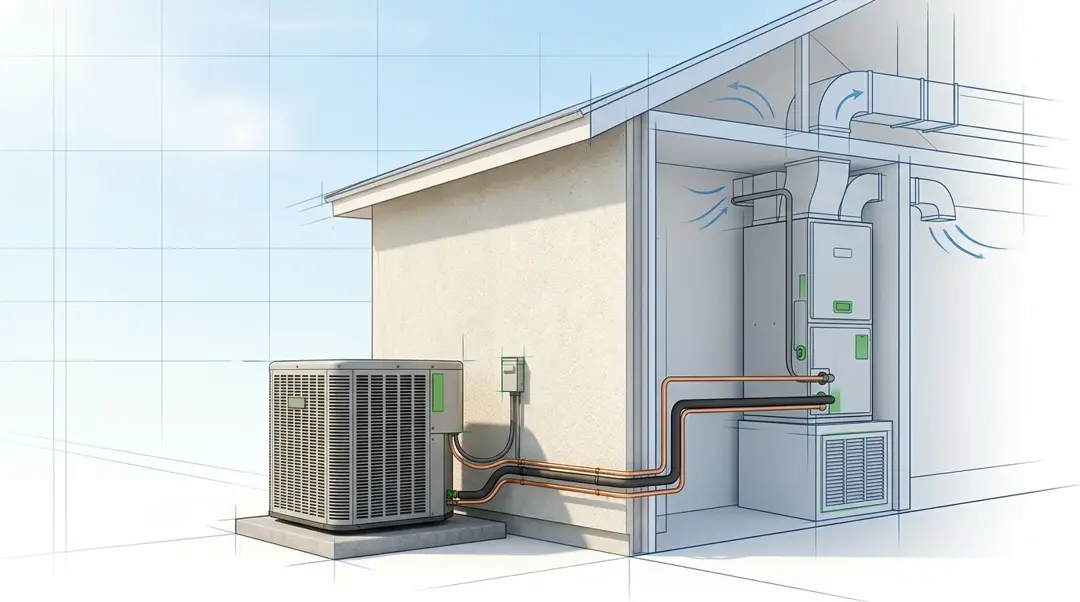
HVAC Loomis CA homes need for varied lots and systems
Loomis is an incorporated Placer County town with a long fruit-shipping history and a stated small-town character, according to the Town of Loomis history (Town of Loomis, 2026). That setting brings a mix of older homes, remodels, larger parcels, and newer custom construction. An addition may have changed how a home uses cooling without changing the original ducts. A detached space may have its own equipment question. Airflow balance is the way conditioned air is delivered and returned so rooms can stay closer in temperature. It is one useful starting point when an upstairs room, a remodeled wing, or a far bedroom feels different. We found that the best first conversation names the affected rooms, the equipment type, and whether the issue began after a home change.
Property access deserves the same practical attention as the equipment. Gates, long driveways, animals, landscaping, and detached buildings can affect how a visit is planned, though they do not decide the diagnosis. The business does not claim a Loomis office or promise service for every workshop, barn, or outbuilding. Instead, call with the address, the building that has the problem, and any access details. That gives the team a fair basis to confirm the request. For a broad view of covered communities, use the service-area directory. The Town's new-resident utility page lists PG&E, which supports the local utility context rather than assuming SMUD service (Town of Loomis, 2026).
Seasonal care can stay simple. Before warm weather, check the filter, set the thermostat, and make sure supply vents are open. Before heating season, note any new sounds or odd smells. Keep boxes, leaves, and stored items away from equipment where it is safe to do so. A clean filter does not fix every fault, but it gives the system room to move air. Small notes also help: write down the day the problem started, the rooms that feel wrong, and what the thermostat shows. Is the trouble only in the afternoon? Does it happen in heat mode, cool mode, or both? Those plain facts make the first HVAC conversation easier and keep attention on the home that needs help.
Summer heat, winter starts, and equipment clues
Summer cooling problems often show up as warm supply air, short cycling, frozen indoor coils, or a system that cannot keep distant rooms comfortable. A filter, thermostat setting, outdoor unit, refrigerant circuit, and ducts can each affect the result. Static pressure is the resistance air meets as it moves through the HVAC system and ductwork. High resistance can contribute to weak delivery and added strain, but it needs measurement rather than guesswork. Restricted airflow, for example, may come from a simple filter issue or from a larger duct design problem. For a cooling symptom, the AC repair service page explains the diagnosis path in more detail. Our team found that a symptom list is more useful when it includes when the issue occurs, which rooms are affected, and any recent control changes.
Heating deserves a separate check before a cold spell makes the issue urgent. A furnace, heat pump, thermostat, safety control, and airflow path work together, so a no-heat call can have more than one source. A heat pump is HVAC equipment that moves heat to cool a home or to warm it in heating mode. The U.S. Department of Energy explains that heat pumps move heat rather than generate it by burning fuel, a distinction that helps homeowners describe their systems accurately (U.S. Department of Energy, 2026). Consider whether the thermostat screen is active, whether air is moving, and whether the outdoor unit runs. Those details can guide the first call, while the heating repair guidance covers the appropriate HVAC next step.
A practical route for the Loomis home in front of you
A replacement discussion should follow the home assessment, especially where an older house has gained rooms, windows, or a new use for a converted area. Maintenance can also help reveal worn parts and airflow changes before the hottest days arrive. In our experience, a homeowner gets a better answer by describing comfort goals alongside the failure: quieter operation, better room-to-room comfort, reliable cooling, or a system that has stopped entirely. The HVAC maintenance page outlines routine care, while system-replacement conversations can include a free estimate after an on-site assessment. No price, rebate amount, or approval is promised on this page because each property and project can differ.
Start with what you can see and hear. Is a vent closed? Is the filter dark? Does the fan run but the air feel wrong? Did one room change after a door was shut or a rug was moved? Do not remove panels or try to fix wiring. A short list is enough. Note the time of day. Note the thermostat mode. Note if the system starts and stops. Note any sound that seems new. Then share those notes when you call. They do not replace a check of the system. They do give the HVAC visit a useful place to start. This is also a good time to point out a gate, pet, steep drive, or work area that needs care.
A home does not need the same answer as the one next door. One owner may want to keep a working system in good shape. Another may need help after a part fails. A third may be planning a full system change. Each path needs a look at the home, the equipment, and the goal. Ask what work is in scope. Ask what the system check will cover. Ask what choice fits the room use you have now. Good questions help keep a repair, tune-up, or replacement talk tied to real needs. The aim is to leave with facts about the HVAC system and a next step that makes sense for the property.
| Home situation | What to assess | Best next step |
|---|---|---|
| Older home or later addition | Duct path, returns, and room temperatures | Review maintenance guidance |
| Cooling blows warm air | Controls, airflow, coil, and outdoor equipment | Review AC repair guidance |
| Heating will not start | Thermostat, safety controls, and heating mode | Review heating repair guidance |
- Note the equipment type and any model information you can safely see.
- Write down which rooms feel different and when the issue began.
- Share gate, driveway, animal, or detached-building details during scheduling.
- Ask whether the requested work falls within the confirmed HVAC scope.
- Keep filters and thermostat settings available for the conversation.
Service boundaries make the next step more honest
A-CLASS Heating and Air provides HVAC work: heating, air conditioning, system repair and maintenance, ductwork, ductless equipment, and thermostats. The company does not offer plumbing, general electrical work, appliance repair, insulation, or duct cleaning. If an older Loomis property raises a non-HVAC wiring question, a qualified electrician is the right trade. If a project involves permits, exterior placement rules, or owner approvals, those requirements belong to the relevant authority or property owner. For instance, PG&E maintains energy-saving and rebate information, but program terms and eligibility must come from the utility, not from a service-page claim (PG&E, 2026). The bottom line is a focused diagnosis and a plainly stated scope.
Reviewed by Serghei Poleanschii, Founder & Manager, A-CLASS Heating and Air. Learn about the company's approach on the A-CLASS Heating and Air story, or contact the team to discuss a Loomis HVAC need.
What an HVAC repair costs in Loomis
A-CLASS Heating and Air publishes this repair guidance: many straightforward HVAC repairs are framed around $150 to $750, depending on the issue, the parts, access to the equipment, and the condition of the system. That range is guidance, not a quote and not a final invoice amount. Exact repair pricing is reviewed after an on-site diagnosis and before any approved work begins, and a repair can cost more when there are multiple failures, hard-to-source parts, refrigerant work, electrical issues, or safety concerns. Replacement is a separate conversation: you can request a free estimate, and a final replacement scope and price may need an in-home review. Call (916) 342-9108 to describe the problem and arrange a diagnostic visit.
Loomis HVAC questions
Do you serve homes in Loomis, CA?
Yes. A-CLASS Heating and Air serves Loomis from Rancho Cordova for residential heating, cooling, ductwork, ductless systems, thermostats, and related HVAC work. Call (916) 342-9108 to discuss the system and current scheduling.
How much does an HVAC repair cost in Loomis?
A-CLASS Heating and Air publishes this guidance: many straightforward HVAC repairs are framed around $150 to $750, depending on the issue, the parts, access to the equipment, and the condition of the system. That range is guidance, not a quote and not a final invoice amount. Exact pricing is reviewed after an on-site diagnosis and before any approved work begins. A system replacement is a separate conversation: you can request a free estimate, and a final replacement scope and price may need an in-home review of the home and equipment.
What HVAC issues are common in Loomis homes?
Older duct runs, uneven temperatures across additions, aging equipment, and access around larger lots are common topics to assess. A visit starts with the equipment, airflow, controls, and the part of the home that feels uncomfortable.
Can you help with an AC that is blowing warm air?
Yes. Warm air can come from several HVAC causes, so the next step is a cooling-specific diagnosis. Call to discuss the symptoms and current availability, or review the AC repair guidance before you call.
Do you offer free estimates for a new HVAC system?
Yes. Free estimates are available for any service. An on-site assessment helps match the recommendation to the home, existing equipment, and comfort goals.
Can you promise access to every barn, workshop, or outbuilding?
No. A-CLASS Heating and Air does not promise scope or access for every detached structure. Describe the building and equipment when you call so the team can confirm whether the requested HVAC work fits the visit.
Do you repair plumbing or perform general electrical work?
No. A-CLASS Heating and Air is an HVAC company. For non-HVAC plumbing or electrical work, contact the appropriate licensed trade; we can address HVAC equipment and its controls within our service scope.