
La Riviera service area
HVAC La Riviera CA: clear help for older homes
At a glance
HVAC La Riviera CA service from A-CLASS Heating and Air means scheduled help with cooling, heating, ducts, and thermostats for homes near the American River. We are family-owned, have served the Sacramento area since 2016, and are based in Rancho Cordova. Call (916) 342-9108 to discuss the concern and current scheduling.
HVAC La Riviera CA and layered older-home systems
La Riviera is an unincorporated Sacramento County community along the American River corridor, between Sacramento State and Rancho Cordova. Much of its housing includes established single-story homes from the 1960s and 1970s. That history can leave a house with an original duct layout, a later furnace or air conditioner, and controls added in another decade. Airflow balance is the even delivery of conditioned air to the rooms people use. A cool living room and a warm back bedroom may point to the path air takes, not one simple equipment fault. We found that a clear room-by-room description helps separate a steady pattern from a sudden change. Which rooms feel different, and at what time? Those details give a diagnostic visit a better starting point.
Older homes can also have additions, enclosed patios, replacement windows, or changed room use. Each change alters how the original system carries the load. Restricted return air, for example, can make a system run longer while a distant room stays uncomfortable. A visit for whole-system HVAC repair can begin with the symptom, then check controls, basic operation, airflow, and visible duct conditions. Our team found that a system age label alone does not explain the result. The layout, filter, return path, and attic conditions can matter as much as the unit. Room use often changes the cooling load. That is why the first useful question is often about the room and the pattern, rather than a quick choice between repair and replacement.
Heat, river-adjacent conditions, and SMUD service
Summer heat still reaches this river-adjacent area, even when an evening Delta breeze helps outdoors. Long hot stretches test AC equipment, attic duct runs, and filters. A return-air path is the route that brings indoor air back to the equipment to be cooled or heated again. A blocked grille, a closed interior door, or an undersized return can affect that cycle. In our experience, a clean filter and open grilles are safe basics to review before a visit. La Riviera is in SMUD electric territory; the utility's service territory map places the area within its coverage (SMUD, 2026). SMUD can answer current questions about its programs or electric service.
Smoke season brings a separate comfort concern. A higher-efficiency filter may help capture smaller particles, yet it can also create too much resistance for a system that was not designed for it. The EPA's guidance on air cleaners and filters in the home explains the role of filtration (U.S. Environmental Protection Agency, 2026). Consider asking whether the filter fits the cabinet correctly and whether the return can support it. A technician can assess those questions during planned HVAC maintenance. The goal is practical: protect indoor comfort without asking the equipment to fight against an unsuitable filter.
Match the symptom to the next HVAC step
A repair can make sense when testing identifies one clear issue and the rest of the system is working as expected. A replacement discussion may be useful when the findings, condition, and comfort goals all point there. A heat pump is equipment that moves heat to provide both heating and cooling. The U.S. Department of Energy describes how heat pump systems move heat rather than create it through combustion (U.S. Department of Energy, 2026). Before changing equipment, ask what the diagnosis found and whether duct, control, or electrical work affects the decision. Free estimates are available for any service. For repair needs, the recommendation follows the diagnosis.
| Home pattern | What may deserve a check | Routed next step |
|---|---|---|
| 1960s–70s single-story layout | Uneven rooms or older duct paths | Duct and vent repair review |
| System runs but cooling feels weak | Controls, filter, airflow, and operation | Air-conditioning diagnosis |
| Equipment decision after diagnosis | Condition, duct fit, and comfort goals | Replacement planning |
The same symptom can have different causes in two nearby homes. For instance, a thermostat issue can look like a cooling problem, while a duct restriction can look like weak equipment. A clear account of when the problem began, what rooms are affected, and what changed in the house makes the visit more useful. If heat is the concern, the heating repair service page explains the kind of checks that can follow. A-CLASS provides urgent HVAC support when available, but does not promise a response time. Call to discuss the situation and scheduling. The bottom line is that a plain diagnosis gives homeowners a better basis for deciding what to do next.
Ducts and controls deserve their own look
In a mid-century house, the equipment outside may be newer than the spaces that move air through the home. A supply run can pass through a warm attic, bend around framing, or serve a room whose use changed years after the home was built. A thermostat may also sit in a hallway that no longer reflects the warmest room. These conditions do not prove that a duct repair or thermostat change is needed. They do explain why testing should look beyond the unit. Homeowners can note whether closing a door changes a room, whether a register has weak flow, and whether the issue began after a change in the house. Those observations help frame a service conversation without guessing at the fix before the system is checked.
Some comfort problems are simple, and some involve several small factors at once. The useful work is to identify which factor has the greatest effect before changing equipment. A thermostat repair visit can examine control behavior, while duct and vent work can address a damaged or poorly connected section when that is the finding. Homeowners who are considering a system replacement can also ask how the existing ducts and returns will be evaluated. That question keeps the decision tied to the rooms and airflow, rather than only to equipment size. The California Energy Commission offers general heating and cooling efficiency guidance for homeowners (California Energy Commission, 2026), but the existing home still needs its own assessment.
Maintenance can be useful before a peak-weather problem turns into a comfort interruption. The visit may include a look at basic system operation, accessible electrical connections, drainage, filter condition, and visible airflow concerns. It does not make an older system new, and it cannot predict every future failure. It can establish what is working today and what needs attention. That information is especially helpful when a house has equipment from one period and distribution parts from another. Keep a record of recurring sounds, uneven rooms, or short cycling. A clear pattern gives the technician something concrete to investigate. It also helps the homeowner compare a repair recommendation with the system's actual condition and the comfort goal for the home.
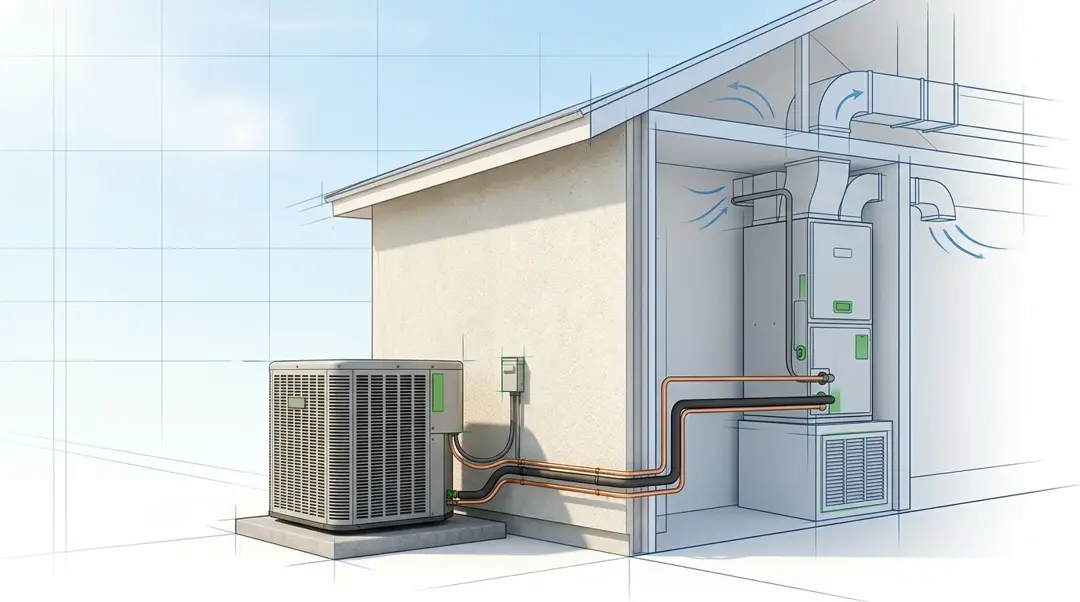
The outdoor equipment needs clear working space, but the indoor side of the system matters just as much. Furniture, storage, and closed grilles can change how air moves through a home. The same is true for a thermostat placed near a sunny window, kitchen, or exterior door. These are useful observations to share, not proof of a specific fault. A technician should test the system before naming the cause. If a home needs duct or vent repair, the scope should stay tied to the condition found. If a replacement is under discussion, homeowners deserve to know how the proposed equipment relates to the existing ducts, rooms, and controls. Clear answers are more useful than a rushed recommendation.
Preparing for a productive service conversation
A short list can make a call or appointment clearer, especially when the issue comes and goes. Note the rooms affected, thermostat setting, unusual sounds, and whether the system changes after a filter replacement. Keep pets and stored items clear of accessible equipment when it is safe to do so. You can also describe prior changes to the home, such as an addition or a moved thermostat. Those facts help a technician understand what the system was asked to do over time. For a replacement question, ask about a free estimate and what findings support each option. A-CLASS is based in Rancho Cordova and serves La Riviera by field service. Reach the team through the service contact page or by phone for current scheduling.
- Describe which rooms are affected and when the pattern occurs.
- Check the filter, thermostat setting, and open grilles if safe.
- Ask what testing supports a repair or replacement recommendation.
- Confirm any exterior-equipment requirements with the property owner or association.
- Call about urgent support and current scheduling when comfort or safety is a concern.
Reviewed by Serghei Poleanschii, Founder & Manager, A-CLASS Heating and Air. Learn about the company's family-owned approach on the about page, then call (916) 342-9108 to discuss scheduled HVAC service in La Riviera.
What an HVAC repair costs in La Riviera
A-CLASS Heating and Air publishes this repair guidance: many straightforward HVAC repairs are framed around $150 to $750, depending on the issue, the parts, access to the equipment, and the condition of the system. That range is guidance, not a quote and not a final invoice amount. Exact repair pricing is reviewed after an on-site diagnosis and before any approved work begins, and a repair can cost more when there are multiple failures, hard-to-source parts, refrigerant work, electrical issues, or safety concerns. Replacement is a separate conversation: you can request a free estimate, and a final replacement scope and price may need an in-home review. Call (916) 342-9108 to describe the problem and arrange a diagnostic visit.
La Riviera HVAC FAQ
Does A-CLASS serve La Riviera from a local office?
No. A-CLASS Heating and Air is based in Rancho Cordova and serves La Riviera by scheduled field service; it does not maintain a La Riviera office.
How much does an HVAC repair cost in La Riviera?
A-CLASS Heating and Air publishes this guidance: many straightforward HVAC repairs are framed around $150 to $750, depending on the issue, the parts, access to the equipment, and the condition of the system. That range is guidance, not a quote and not a final invoice amount. Exact pricing is reviewed after an on-site diagnosis and before any approved work begins. A system replacement is a separate conversation: you can request a free estimate, and a final replacement scope and price may need an in-home review of the home and equipment.
What should I check when one room stays warmer than the rest?
Start with the thermostat setting, a clean filter, and open supply and return grilles. If the pattern continues, a technician can assess airflow, controls, equipment operation, and visible duct conditions.
Can an older La Riviera home keep its existing ducts?
Sometimes. A duct assessment can show whether the layout, condition, and airflow suit the equipment and rooms being served before a repair or replacement decision is made.
Do you offer free estimates for HVAC work?
Yes. Free estimates are available for any service. Repair needs are assessed after diagnosis so the recommendation can match the condition found.
Can you help with urgent heating or AC trouble?
Yes. A-CLASS offers urgent HVAC support when available; call (916) 342-9108 to discuss the problem and current scheduling.
Do you provide duct cleaning or general electrical work?
No. A-CLASS provides HVAC duct and vent installation or repair, but does not offer duct cleaning or general household electrical service.