
End-of-Summer AC Tune-Up Checklist (Sacramento)
Sacramento summers are hard on air conditioners. NOAA's 1991–2020 climate normals show Sacramento averages 90 days per year above 90°F and 23 days above 100°F — across a cooling season that stretches seven months from April through October. By late August, your AC has been running nearly non-stop for months. That's the exact moment when a quick tune-up pays for itself.
This AC tune-up checklist walks you through what you can handle yourself, what needs a licensed technician, and why end-of-summer is one of the smartest times to schedule the service call.
Key Takeaways
- ENERGY STAR states airflow problems can cut AC efficiency by up to 15 percent — and a dirty coil is the top cause (ENERGY STAR)
- Sacramento logs 1,576 cooling degree days per year (NOAA 1991–2020), roughly double the US average, putting outsized wear on local systems
- A professional tune-up in Sacramento runs $89–$249; deferred repairs (failed capacitor damaging the compressor) can cost $1,500–$3,000
- DIY tasks take 30–60 minutes; pro tasks require an EPA-certified technician
What Does an AC Tune-Up Actually Cover?
A proper residential AC tune-up follows ACCA Standard 4 (ANSI/ACCA 4 QM — 2019), the nationally recognized minimum-maintenance standard endorsed by manufacturers and referenced by the DOE's Building Science Education Center. ENERGY STAR's maintenance checklist maps directly to the same tasks. There are eight core items on the pro side, and three you can handle on your own.
The table below breaks it down:
| Task | DIY or Pro? | Notes |
|---|---|---|
| Replace air filter (1" filter: monthly; media filter: every 6–12 months) | DIY | Most impactful DIY step — a clogged filter is the leading cause of airflow restriction |
| Rinse outdoor condenser coil with garden hose | DIY | Turn power off at disconnect first; rinse fins top-down |
| Clear 2-foot clearance around condenser unit | DIY | Remove leaves, weeds, debris |
| Check and adjust thermostat settings | DIY | Verify setback schedules, battery, and calibration |
| Clean evaporator coil (indoor) with coil cleaner | Pro | Chemical cleaning required; refrigerant system access |
| Check refrigerant level; adjust if needed | Pro | Requires EPA Section 608 certification; improper charge hurts efficiency and voids warranty |
| Test and tighten electrical connections; measure motor voltage and current | Pro | "Faulty electrical connections can cause unsafe operation" — ENERGY STAR |
| Inspect and test capacitor and contactor | Pro | Per ACCA Standard 4; most common AC part to fail in Sacramento's heat |
| Flush condensate drain line | Pro (or DIY with vinegar — see our [guide to AC condensate drain lines](/blog/ac-condensate-drain-line/)) | ENERGY STAR: "a plugged drain can cause water damage in the house and affect indoor humidity levels" |
| Lubricate blower motor bearings | Pro | Reduces friction and heat on the motor |
| Adjust blower for proper airflow | Pro | ENERGY STAR: airflow problems cut efficiency up to 15% |
| Verify system controls (startup, run cycle, shutoff) | Pro | Confirms refrigerant, electrical, and controls all work together |
Why Does End-of-Summer Timing Make Sense?
August and early September are the best window for an AC tune-up in Sacramento — not spring. By late summer, your system has already logged its hardest miles, and any wear is visible. Here's what's happening inside a system that ran all summer:
Coil fouling accumulates. Research by Lawrence Berkeley National Laboratory found that AC coils foul enough to double evaporator pressure drop in roughly 7.5 years of typical operation — with the worst degradation happening in the first few seasons (LBNL/DOE, "Dirty Air Conditioners: Energy Implications of Coil Fouling," 2002). A post-summer cleaning resets that clock.
Capacitors run hot all summer. Capacitors are the parts most likely to fail on Sacramento AC systems. They sit inside the outdoor unit absorbing heat all season. A capacitor that measures out of spec in September is a capacitor that fails in June — usually on the hottest day of the year. Testing it now costs $149. Replacing a compressor that burned out because of a failed start capacitor costs $1,500–$3,000 (Angi, 2026).
Drain lines grow algae. A condensate drain line that ran all summer in Sacramento's heat is ripe for algae and mold buildup. ENERGY STAR specifically lists drain inspection as a required maintenance task because a plugged drain can cause water damage and raise indoor humidity. A $10 bottle of distilled vinegar handles a minor buildup. A clogged line that overflows the drain pan into your walls does not.
The shoulder season gives you booking flexibility. Tune-up calls in May fill up fast because everyone wants service before summer. Book in August or September and you'll get next-day availability instead of waiting two weeks.
How Much Does an AC Tune-Up Cost in Sacramento?
Prices here are higher than many national averages because Sacramento's long cooling season and extreme heat put technicians in demand. Based on local contractor data published June 2026 by ARC Heating and Air, a Sacramento-area HVAC company:
- Basic tune-up: $89–$149. Covers thermostat check, filter inspection, visual system review, and basic safety check.
- Comprehensive tune-up: $149–$249. Adds electrical diagnostics, capacitor microfarad test, condensate drain flush, blower adjustment, and a written system report.
- Annual maintenance plan (two visits): $199–$349/year. Best value if you want fall AC service and a spring heating check covered in one contract.
For comparison, HomeAdvisor's national HVAC maintenance cost data (updated June 19, 2026) puts the national average at $250, with a range of $175–$350. Sacramento falls in that band for comprehensive service.
The math is simple. ENERGY STAR reports the average US home spends nearly $1,900 a year on energy bills, with roughly half going to heating and cooling (ENERGY STAR). A $200 tune-up that keeps your system running at full efficiency pays for itself several times over in lower monthly bills — before you count the avoided repair costs.
The DIY Half of the Checklist: What You Can Do This Weekend
You don't need a technician for every item. Four tasks belong firmly in homeowner territory and take less than an hour combined.
1. Replace the air filter. This is the single most impactful maintenance step you can take. ENERGY STAR states directly that airflow problems — most often caused by a dirty filter — can reduce your system's efficiency by up to 15 percent. A 1-inch filter needs monthly replacement during peak cooling season. A 4- or 5-inch media filter typically lasts 6–12 months. Check yours now. If it's gray and dense, it's overdue.
2. Rinse the outdoor condenser coil. First, flip the disconnect switch at the outdoor unit. Then use a garden hose on a gentle setting to rinse the fins from the top down, letting debris wash out through the bottom. Don't use a pressure washer — the fins are aluminum and bend easily. The goal is to clear any Sacramento dust, cottonwood fluff, or dried grass clippings that built up since spring. You'll be surprised how much comes out.
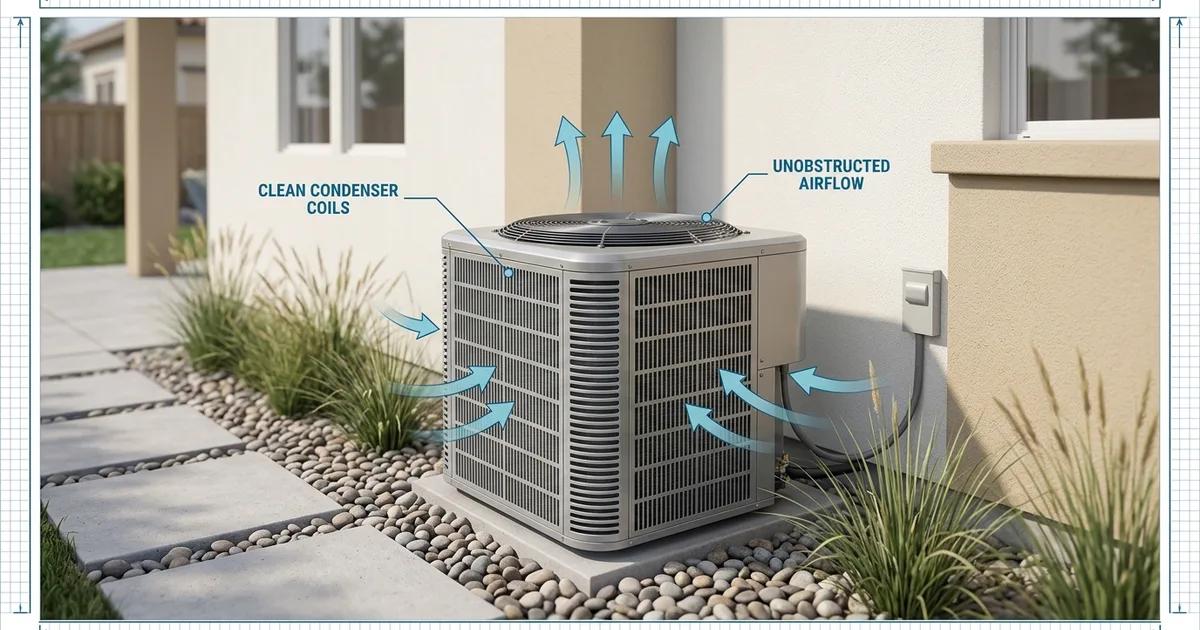
3. Clear the area around the outdoor unit. Your condenser needs 2 feet of clear space on all sides for proper airflow. That overgrown bush that grew into the unit all summer? Trim it back. Remove leaves and debris from the top grille. Airflow restrictions force your compressor to work harder, raising your electric bill and shortening its life.
4. Verify your thermostat settings. Check that your setback schedule still matches your actual household routine. If you're on a smart thermostat, make sure the cooling setpoints haven't drifted from any app updates. And if you've got a programmable thermostat running on AA batteries, swap them before fall — a dead battery at 2 a.m. in September is a frustrating service call.
What the Pro Does That You Can't (And Why It Matters)
Several tune-up tasks legally or practically require a licensed technician. These aren't upsells — they're the steps that prevent the expensive failures.
Refrigerant charge verification. The refrigerant level in your system has to be exactly right — too little and your compressor overheats, too much and your efficiency tanks. Checking and adjusting refrigerant charge requires EPA Section 608 certification. It's also the step most likely to reveal a slow refrigerant leak that, left alone, will kill a compressor within a season or two.
Electrical connections and motor testing. The technician measures voltage and current at the motors and tightens every electrical connection in the unit. ENERGY STAR's maintenance checklist flags this specifically because faulty connections cause overheating and, in worst cases, fire risk. This step also catches a motor drawing too many amps — the early sign of a bearing going out.
Capacitor and contactor inspection. Per ACCA Standard 4, the technician tests the capacitor's microfarad reading against spec. A capacitor reading 10% or more below spec gets replaced before it fails. The contactor — the relay that switches the compressor and fan motor on and off dozens of times each day — gets inspected for pitting and burned contacts. These are the two most common mechanical failures on Sacramento AC systems, and catching them in September costs $100–$250. Catching them in June costs $1,500–$3,000.
Evaporator coil cleaning. The indoor coil sits in a dark, humid, dust-collecting environment all season. Cleaning it requires spraying a no-rinse coil cleaner into the fins and letting it drain away. You can't access the evaporator coil without removing the air handler access panel and, in many systems, moving refrigerant lines. This is a pro task.
For a full walkthrough of the condensate drain flush — one pro task homeowners can sometimes handle themselves — see our step-by-step guide to AC condensate drain line cleaning.
What Happens If You Skip the Tune-Up?
The short answer: deferred maintenance costs more than the service.
Airflow degradation is the most predictable consequence. According to ENERGY STAR, a system working against restricted airflow loses up to 15 percent of its efficiency. That shows up immediately in your SMUD bill. A system running at 85 percent efficiency for a seven-month cooling season costs meaningfully more to operate than one running at full capacity.
Coil fouling is slower but more expensive. LBNL research from the DOE's research arm documented that evaporator coils foul enough to double pressure drop in 7.5 years. The degradation is not linear — it accelerates as buildup compounds. The result is a system that can't keep up on 100°F afternoons, longer run times, and eventually a compressor working so hard it burns out.
Undetected refrigerant leaks get worse. A slow leak that a technician might spot during an annual check-and-verify becomes a compressor-killing shortage over the following season. Refrigerant doesn't disappear on its own — any meaningful drop in charge means there's a leak that needs to be found and fixed.
The cumulative picture: ENERGY STAR data shows that about half of US household energy spending goes to heating and cooling. Sacramento homeowners running an inefficient system — one that hasn't been tuned in two or three years — are paying extra every month without knowing it. The tune-up doesn't just preserve equipment. It pays itself back on the energy bill.
Schedule the Call Before October
Your AC is about to go dormant for six months. That's actually the wrong time to forget about it. Parts that are marginal in September don't get better sitting through winter — they're just as marginal when you fire the system up for the first heat wave next May. Only now there's no availability, and the shop has a two-week backlog.
Book the tune-up now while the AC is still running, the technician can observe actual operating conditions, and you can get next-day service. Our AC system maintenance service covers all eight ENERGY STAR-specified tasks plus capacitor and contactor testing per ACCA Standard 4. Give us a call at (916) 342-9108 — we'll get you scheduled before the season turns.
Frequently Asked Questions
What is included in an AC tune-up?
A professional AC tune-up covers eight tasks spelled out in ENERGY STAR's maintenance checklist: thermostat calibration, electrical connection checks, refrigerant level verification, evaporator and condenser coil cleaning, condensate drain inspection, blower adjustment, lubrication of moving parts, and system controls testing. Some technicians also inspect and test the capacitor and contactor per ACCA Standard 4.
How often should I service my AC?
ENERGY STAR recommends scheduling professional AC maintenance once a year. For Sacramento homeowners, late summer or early fall is a smart window — the system has just finished its hardest season and you can catch worn parts before they fail during the next heat wave. DIY filter changes and condenser coil rinses can happen monthly during the cooling season.
Can I do an AC tune-up myself?
Several tasks are safe for homeowners: replacing the air filter, rinsing the outdoor condenser coil with a garden hose, clearing vegetation around the unit, and checking thermostat settings. Refrigerant handling, electrical testing, coil chemical cleaning, and capacitor inspection require a licensed HVAC technician. Attempting refrigerant work without EPA Section 608 certification is a federal violation.
How much is an AC tune-up in Sacramento?
A basic AC tune-up in Sacramento runs $89 to $149. A comprehensive tune-up that includes electrical diagnostics, capacitor testing, drain flush, and a full system report costs $149 to $249. Annual maintenance plans with two seasonal visits run $199 to $349. Nationally, the average is $250, per HomeAdvisor's June 2026 data.
Frequently Asked Questions
What is included in an AC tune-up?
A professional AC tune-up covers eight tasks spelled out in ENERGY STAR's maintenance checklist: thermostat calibration, electrical connection checks, refrigerant level verification, evaporator and condenser coil cleaning, condensate drain inspection, blower adjustment, lubrication of moving parts, and system controls testing. Some technicians also inspect and test the capacitor and contactor per ACCA Standard 4.
How often should I service my AC?
ENERGY STAR recommends scheduling professional AC maintenance once a year. For Sacramento homeowners, late summer or early fall is a smart window — the system has just finished its hardest season and you can catch worn parts before they fail during the next heat wave. DIY filter changes and condenser coil rinses can happen monthly during the cooling season.
Can I do an AC tune-up myself?
Several tasks are safe for homeowners: replacing the air filter, rinsing the outdoor condenser coil with a garden hose, clearing vegetation around the unit, and checking thermostat settings. Refrigerant handling, electrical testing, coil chemical cleaning, and capacitor inspection require a licensed HVAC technician. Attempting refrigerant work without EPA Section 608 certification is a federal violation.
How much is an AC tune-up in Sacramento?
A basic AC tune-up in Sacramento runs $89 to $149. A comprehensive tune-up that includes electrical diagnostics, capacitor testing, drain flush, and a full system report costs $149 to $249. Annual maintenance plans with two seasonal visits run $199 to $349. Nationally, the average is $250, per HomeAdvisor's June 2026 data.