
Black Mold on AC Vents: Causes and What to Do
Spotting dark patches on a ceiling vent or a wall register stops most Sacramento homeowners in their tracks. The first question is almost always the same: is that actually mold, or just years of dust? The answer matters, because the two problems have different causes and very different fixes.
Black mold on AC vents shows up for a specific reason — cold metal plus warm, humid room air equals condensation, and condensation plus dust equals a surface mold loves. That's the short version. The longer version explains why Sacramento homes are particularly prone to this, what a true mold problem looks like versus harmless buildup, how to clean registers yourself when the situation calls for it, and when the issue has moved past a rag and a bucket of soapy water.
Key Takeaways
- Black discoloration on registers is often surface mold caused by condensation, not a sign of deep duct contamination.
- The EPA recommends keeping indoor humidity between 30–50% — Sacramento's seasonal swings make this harder than it sounds (EPA, A Brief Guide to Mold, Moisture, and Your Home, 2024).
- You can safely clean mold off removable register covers; mold inside the duct opening requires professional remediation.
- The EPA's threshold: any mold patch exceeding 10 square feet calls for a licensed contractor, not a DIY approach.
- Annual AC maintenance is the most cost-effective prevention step for Sacramento homeowners.
What Is the Black Stuff on My AC Vents — Mold or Dust?
The dark material on a supply vent register is often a mixture of both, but mold and ordinary dust behave very differently when you look closely. Dust settles in an even, uniform layer and wipes away cleanly without leaving a stain. Mold tends to form patchy, irregular spots — sometimes fuzzy, sometimes flat — and leaves a faint discoloration on the surface after you wipe it.
The smell test is more reliable than sight alone. A musty, damp smell that appears only when the AC runs and fades when the system is off points to active mold growth somewhere in the airstream. Ordinary dust doesn't have a strong odor.
Here's a quick comparison to guide your first look:
| Characteristic | Ordinary Dust | Surface Mold |
|---|---|---|
| Appearance | Even, uniform gray film | Patchy, irregular spots; may look fuzzy or have a green, black, or white tint |
| Texture | Dry, loose | Can be slightly slimy or have a powdery texture when dry |
| Smell | Faint or none | Musty, earthy odor, especially when AC runs |
| Wipes clean? | Yes, completely | Leaves faint staining or discoloration behind |
| Returns quickly after cleaning? | Slowly, over weeks | Often returns within days if moisture source isn't fixed |
| Location pattern | Spread across full vent face | Concentrated near edges or in corners where condensation pools |
If cleaning reveals stubborn staining or the dark patches return within a week, treat it as mold and work through the steps below.
Why Does Black Mold Appear on AC Vents?
Mold needs three things to grow: moisture, a food source, and a surface to live on. Supply vent registers provide all three when conditions are right.
Condensation is the primary trigger. When your AC pushes cold air through a metal register, the register surface drops in temperature. Warm room air touching that cold metal condenses — the same physics that frosts a glass of ice water. That thin film of moisture, combined with the organic dust that settles on every vent in any lived-in house, gives mold spores (which are always present in indoor air) exactly what they need to take hold.
According to the EPA's guidance on mold and moisture, indoor humidity above 60% dramatically accelerates this process. The EPA recommends keeping relative humidity between 30–50% — but Sacramento's climate makes that a challenge. The valley's marine layer pushes indoor humidity up in mornings and evenings, while afternoon heat drives homeowners to run AC at lower temperatures, which worsens the condensation cycle on vent surfaces.
Other common contributing factors include:
- Clogged condensate drain lines — water backs up and creates standing moisture near the air handler, which feeds mold growth that can then spread to ducts and registers
- Leaky or poorly insulated ductwork — humid attic or crawl-space air sneaks into cooled duct sections, adding moisture that condenses on register surfaces
- Oversized AC units — a unit that's too large for your home cools the space before it can run long enough to pull humidity out of the air, leaving moisture behind
- Restricted airflow — dirty filters slow the airstream, letting moisture settle inside ducts instead of moving through them
Sacramento homes with ducts running through unconditioned attics are especially prone to condensation on the first few feet of supply duct nearest each register. That's where temperature differences between the cold inside and hot outside air are sharpest.
Are Mold on AC Vents a Health Risk?
Surface mold on vent registers is less dangerous than mold inside the duct or on the evaporator coil, but it still warrants attention.
The CDC documents that indoor mold exposure can cause nasal congestion, sore throat, coughing, wheezing, and eye irritation in otherwise healthy people. Those with allergies, asthma, or compromised immune systems face more serious risks, including asthma attacks triggered by airborne spore inhalation. One important nuance from the EPA's mold course materials: dead mold still causes allergic reactions — so killing mold on a register without physically removing it doesn't solve the health concern.
The "toxic black mold" label gets thrown around a lot online, and it's worth being direct about what the science actually says. The term usually refers to Stachybotrys chartarum, a specific species that produces mycotoxins. The EPA and CDC both note that you cannot identify a mold species just by looking at its color — black-colored growth on a vent is most commonly Cladosporium or Aspergillus, both of which can grow on dust-coated metal and both of which can affect air quality, but neither of which is Stachybotrys. Stachybotrys actually prefers waterlogged cellulose materials like drywall and wood, not metal ductwork.
This doesn't mean mold on your vents is harmless — it means the "toxic mold" framing tends to cause either panic or dismissal when what's needed is a practical cleanup and a humidity fix.
If you notice allergy-like symptoms (sneezing, itchy eyes, congestion) that improve when you leave home and worsen when the AC runs, mold in the air system is a reasonable suspect. That pattern warrants a professional inspection, not just a DIY wipe-down.
How to Clean Mold Off AC Vent Registers
Cleaning mold off the removable register covers is a job most Sacramento homeowners can handle themselves, as long as the mold is confined to the cover surface and the first inch or two of accessible duct liner visible through the opening. Here's a safe step-by-step approach.
What you'll need: N-95 respirator (about $12–$25), non-porous gloves, safety glasses, a stiff scrub brush, mild dish soap, warm water, an EPA-registered HVAC mold cleaner, and a HEPA vacuum if you have one.
Step 1: Turn the system off at the thermostat and the breaker. This stops airflow so you're not disturbing spores while the system is running.
Step 2: Protect yourself. Put on the respirator, gloves, and glasses before removing the register. Mold spores become airborne easily when disturbed.
Step 3: Remove the register cover. Most unscrew with two Phillips-head screws. Take it outside or to a utility sink if possible.
Step 4: Wash the cover thoroughly. Scrub with warm water and dish soap, then apply an EPA-registered mold cleaner according to label instructions. Rinse and let it dry completely — a wet register reinstalled in a duct opening creates exactly the conditions mold wants.
Step 5: Vacuum the duct opening. Use a HEPA vacuum to pull loose dust and spores from the first foot or so of accessible duct. Don't push a wet cloth into the duct — moisture deep in ductwork is harder to dry and encourages regrowth.
Step 6: Reinstall the dry register and turn the system back on.
One important warning: don't use bleach inside ductwork. BELFOR, an IICRC-certified restoration contractor, notes that bleach doesn't prevent mold regrowth on porous or semi-porous surfaces and can damage duct liner material. An EPA-registered HVAC mold cleaner is the right tool. Also, never mix cleaners — combining vinegar with bleach or hydrogen peroxide creates toxic gases.
When the Problem Is Bigger Than the Register
Cleaning the cover is a surface fix. The mold keeps coming back if the moisture source driving it hasn't changed.
Return to the duct opening with a flashlight after cleaning the register. If you see mold growth more than two or three inches inside the duct, or if the inner duct liner looks dark and stained throughout, the problem has moved past DIY territory.
The EPA recommends professional remediation when:
- Mold-affected area exceeds 10 square feet (roughly a 3-by-3-foot patch)
- Mold is in inaccessible areas — deeper ductwork, inside the air handler, on the evaporator coil
- The HVAC system may be contaminated (in which case, don't run it)
- Mold keeps returning after surface cleaning
The IICRC S520 standard, which guides certified mold remediation contractors, requires containment, negative air pressure, and HEPA filtration for duct mold remediation. Without those controls, disturbing mold inside ductwork spreads spores to areas that didn't have a problem before. That's why a shop vac and a bottle of cleaner aren't the right tools once growth has moved inside the system.
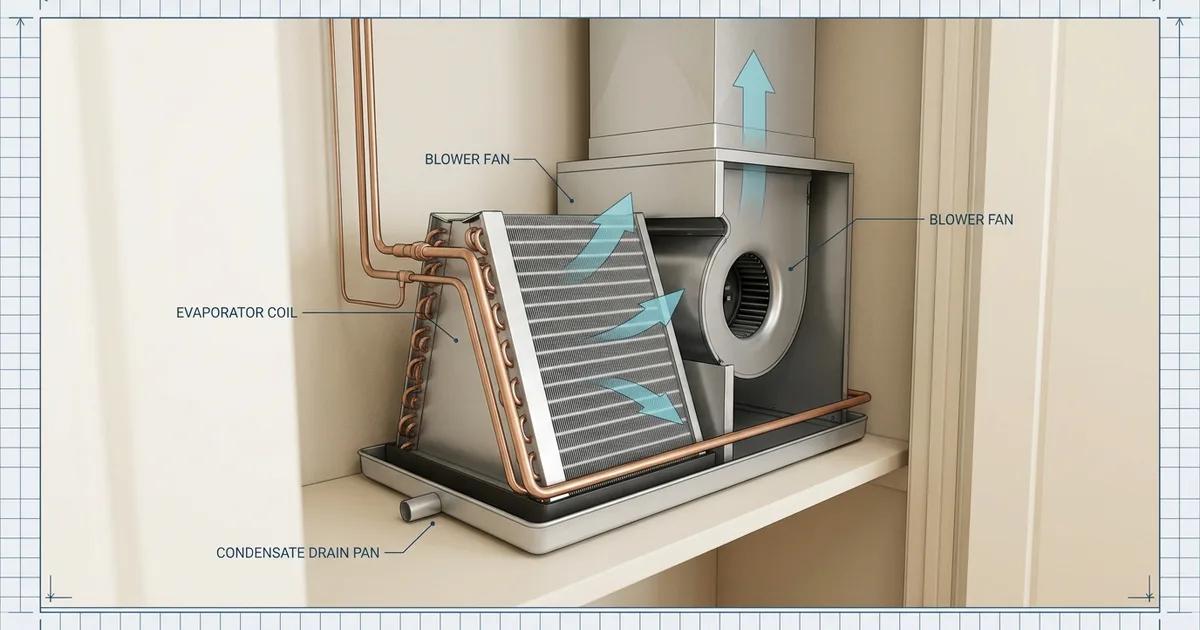
Mold on the evaporator coil is a separate but related issue — if your coil is affected, the entire air supply gets filtered through a mold-coated surface before it reaches your registers. That situation needs a trained HVAC technician, not a homeowner with a spray bottle. For the full picture of mold inside the AC system — coil, drain pan, air handler, and all — see our post on black mold in AC units.
How to Prevent Mold on AC Vents in Sacramento
Getting mold off the registers solves today's problem. Keeping it off requires addressing the two root causes: moisture and airflow.
Control indoor humidity. The EPA's target range — 30–50% relative humidity — is the single most effective mold deterrent. An inexpensive hygrometer (under $20) tells you where you actually stand. In Sacramento summers, running the AC on the "auto" fan setting instead of "on" lets the evaporator coil complete its drainage cycle between runs, rather than continuously recirculating slightly moist air. If your home consistently reads above 55% indoors, a whole-home dehumidifier added to your HVAC system gives you precise control.
Replace filters on schedule. A clogged filter restricts airflow, slowing the air enough for moisture to drop out of suspension inside the duct rather than exiting through the register. Filters should be replaced every 30 to 90 days depending on household conditions. Sacramento's wildfire smoke season — typically July through October — is also a reason to check filters more frequently, since a smoke-loaded filter fills faster than normal.
Insulate ducts properly. Ducts running through unconditioned Sacramento attics (where summer temperatures can exceed 140°F) need at minimum R-8 insulation to prevent the temperature differential that causes register sweating. If your ducts are the original thin-wrap variety from the 1980s or 1990s, re-insulating them is one of the most effective upgrades for both mold prevention and energy efficiency.
Schedule annual AC maintenance. A spring tune-up covers the things homeowners can't easily check themselves: condensate drain line flush, evaporator coil inspection, duct sealing, and refrigerant levels. A dirty coil or a slow drain creates the moisture conditions that show up later as black mold on AC vents. Our AC system maintenance service includes all of these checks, and it's the simplest way to catch a condensate problem before it becomes a mold problem.
Check the condensate drain line. This is the single most preventable cause of AC-related mold in Sacramento. A clogged drain backs water up into the drain pan, where it sits and eventually overflows — feeding moisture into ducts, registers, and surrounding building materials. Pouring a cup of distilled white vinegar down the condensate access port every three to six months keeps algae and biofilm from building up.
Mold on AC vents is one of those problems that looks alarming, but usually has a practical solution when you know what you're dealing with. Surface mold on the register cover? Clean it, dry it, and fix the humidity. Mold inside the duct or on the coil? That's a job for a certified contractor with proper containment equipment.
If you're not sure which situation you have, or if cleaning the registers doesn't stop the growth from returning, A-CLASS Heating and Air can inspect your system and give you a straight answer — no upselling, no scare tactics, just honest information and a quote if work is needed. Give us a call at (916) 342-9108.
Frequently Asked Questions
Why is there black mold around my AC vents?
Cold metal registers sweat when warm room air hits them. That moisture mixes with household dust sitting on the vent surface and gives mold exactly what it needs to grow. A clogged condensate drain, leaky ducts, or indoor humidity above 50% makes the problem worse.
Is mold on AC vents dangerous?
Any indoor mold can trigger respiratory irritation, sneezing, and watery eyes. The CDC links mold exposure to nasal congestion, coughing, and worsened asthma. People with allergies, asthma, or weakened immune systems face the greatest risk. Running a contaminated system circulates spores through every room.
How do I clean mold off AC vents?
Turn the system off, put on gloves and an N-95 mask, remove the register, scrub with warm soapy water and an EPA-registered HVAC cleaner, rinse, and dry completely before reinstalling. Do not use bleach inside ductwork. Call a pro if mold is inside the duct or covers more than a few inches.
What causes mold on air vents?
Three things combine: moisture from condensation on cold metal, darkness inside the duct, and dust on the register surface as a food source. Common triggers include high indoor humidity, poorly insulated ducts, clogged condensate drains, and oversized AC units that cool too fast to remove humidity.
Can I run my AC if there is mold on the vents?
Shut the system off until you know how far the mold extends. Surface mold on the register itself is less urgent, but if growth is inside the duct or on the coil the EPA recommends not running the system because it spreads spores to every room it serves.
When should I call a professional for mold on AC vents?
Call a licensed HVAC contractor or mold remediation specialist when mold is visible inside the duct opening, keeps returning after cleaning, covers more than 10 square feet, or you have health symptoms that improve when you leave home. Annual AC maintenance in Sacramento catches these problems early.