
Should You Repair or Replace Your AC? The Real Math
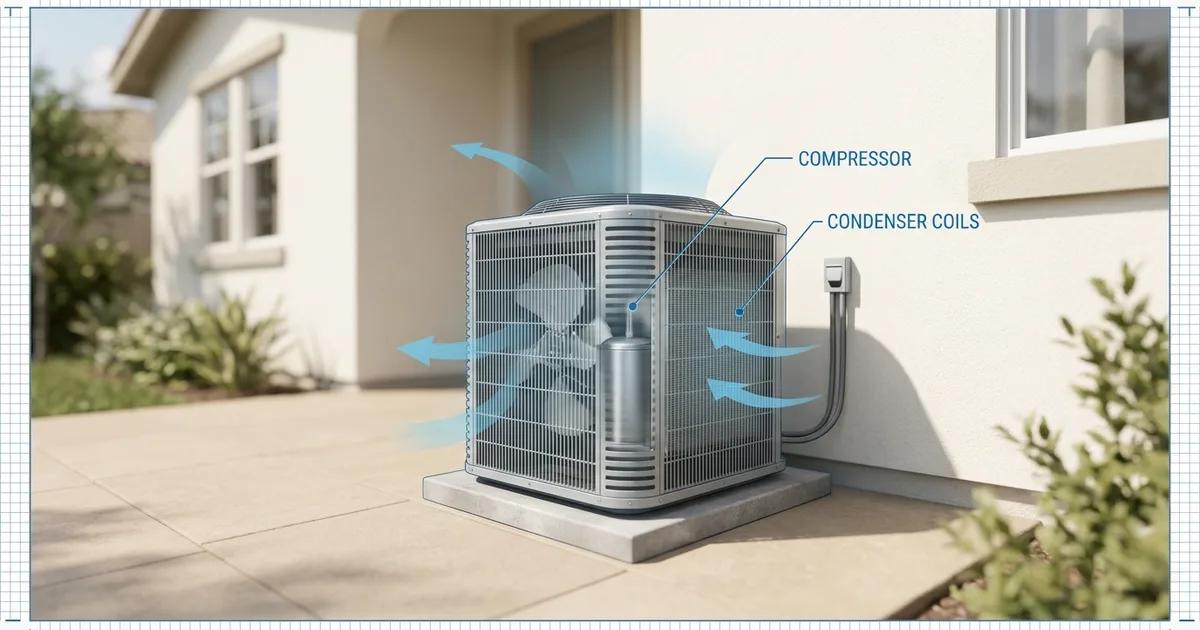
Your AC quit on a 102-degree Sacramento afternoon. You have a repair quote in hand and a gut feeling that something bigger might be coming. That fork in the road — fix it now or replace it — is one of the most common calls homeowners make, and there's no universal right answer. But there is a real framework you can use to land on the right one for your specific situation.
This post walks through the full repair-vs-replace decision: system age, how many times you've already called for service, what R-22 refrigerant status means for your wallet, and what modern SEER2 efficiency gains actually add up to over time. For the quick-math shortcut using your system's age and repair cost, see our dedicated $5,000 Rule post — this guide goes deeper on all the other factors.
Key Takeaways
- Central AC units last 15–20 years with proper maintenance, per Carrier and Trane. After year 10, start tracking repair frequency, not just cost.
- R-22 refrigerant now costs $90–$250 per pound installed — a full recharge runs $660–$2,400. Any R-22 system is at least 16 years old; refrigerant work alone tips the math toward replacement.
- Upgrading from a 10-SEER unit to a modern 16 SEER2 system can cut cooling costs by roughly 30–40% per season in Sacramento's climate.
- Two or more breakdowns in one cooling season is the clearest practical signal to replace — regardless of what any single repair costs.
- New central AC installation runs $3,500–$8,000 for most Sacramento homes, averaging around $5,750.
How Old Is Your AC — and Why That Number Changes Everything
In 2025, a well-maintained central air conditioner lasts 15–20 years, according to all four major manufacturers — Carrier, Trane, Lennox, and Bryant. Without regular maintenance, that same unit may sputter out between years 10 and 12. Sacramento's scorching summers — with temperatures regularly topping 100°F — push systems harder than units in moderate climates, which nudges the realistic expectancy toward the lower end of that range.
Age changes the math on every repair. A $600 repair on a 5-year-old unit is a no-brainer. The same $600 on a 14-year-old unit is a different conversation, because that system is already playing out the final third of its useful life. You're spending today's money on tomorrow's breakdown.
A general age guide for Sacramento homeowners:
- Under 8 years old: Repair almost anything short of a compressor failure. The system has useful life ahead of it.
- 8–12 years old: Repair minor issues. Start getting replacement quotes alongside any repair over $700, so you know what you're comparing.
- 12–15 years old: Replace if any single repair tops $1,000, or if you've had more than one service call this year.
- Over 15 years old: Lean strongly toward replacement. You're past the midpoint of the expected lifespan, and efficiency losses are real and compounding.
How Often Has It Broken Down? The Frequency Signal Matters More Than You Think
Here's something repair quotes don't show you: your repair history. A unit that has needed two service calls in a single season is telling you something no technician quote fully captures — the system is in a general state of decline, and one fix rarely stops at one fix.
The industry threshold most HVAC contractors use privately is two breakdowns per season. After the second call, the math on continued repair tends to lose to replacement even when individual repair costs look reasonable. A homeowner who spends $400 in May and $650 in August has spent $1,050 on a unit that may still hand them a $900 compressor issue in September.
At A-CLASS, we track customer service history before we ever quote a repair on a system over 10 years old. We've seen families spend $2,800 across three seasons nursing a unit that eventually needed a $2,500 compressor. A $6,000 replacement in year one would have been cheaper — and they would have had a warranty and lower energy bills for three Sacramento summers. We tell people what we see, not just what will fix it today.
A useful self-check: pull your service records for the past three years. If you find two or more calls in any single 12-month window, that's a stronger replace signal than the dollar amount on today's quote.
What Does R-22 Refrigerant Mean for Your Repair Decision?
If your AC was installed before 2010, it almost certainly uses R-22 refrigerant — also called Freon. The U.S. phased out domestic production of R-22 in January 2020 under EPA regulations tied to the Montreal Protocol, and no new R-22 has been manufactured or imported since. What's left exists only as recycled and reclaimed stockpiles, and those shrink every year.
The cost consequence is severe. In 2025–2026, R-22 runs $90–$250 per pound installed, averaging around $125 per pound, according to Angi and HomeGuide. A decade ago, the same pound cost $10–$20. A full recharge — typically 6–12 pounds for a home system — now runs $660–$2,400 just for refrigerant and labor, not counting any leak repair. The same recharge in 2015 might have cost under $200 total.
Here's the other thing: any system still using R-22 is at least 16 years old as of 2026, since manufacturers stopped building R-22 units in 2009. That alone already tips the age calculation toward replacement. Add a refrigerant service call, and you have two strong replacement signals at once.
The R-22 decision rule is simple: if your technician tells you the system needs a refrigerant recharge and it runs on R-22, skip the repair-vs-replace math. Replace the system. You're paying premium prices to extend the life of a unit already past its useful midpoint, with costs that will only climb as stockpiles keep shrinking.
| Refrigerant | Status | Approx. Cost per Pound (2025–26) | Notes |
|---|---|---|---|
| R-22 (Freon) | Production banned since 2020 | $90–$250 | Any system using R-22 is 16+ years old |
| R-410A | Being phased down | $20–$50 | Still widely available; phasedown underway |
| R-454B / R-32 | Current standard | $15–$40 | Used in new equipment; environmentally preferred |
Do the SEER2 Efficiency Savings Actually Add Up in Sacramento?
A 10-year-old AC likely carries a SEER rating of 10–13. California's current minimum efficiency standard requires 14.3 SEER2 for new central air conditioners — that's the floor, not the typical mid-grade option. A practical upgrade lands at 16 SEER2.
Going from 10 SEER to 16 SEER2 cuts cooling energy use by roughly 37%. Sacramento sits in one of the hotter inland California climates, with cooling seasons that stretch from May through October and peak demand during multi-week heat events. At PG&E's summer rates, which ran $0.30–$0.40 per kWh in 2024–2025 for tiered residential customers, the annual savings on a typical 2,000 square foot home are meaningful.
At 2,000 cooling hours per year and an average electricity rate of $0.33/kWh, a home running a 10-SEER system and upgrading to 16 SEER2 saves roughly $200–$350 per year on cooling costs alone. Over 15 years — a new system's expected life — that's $3,000–$5,250 in energy savings, before any utility rebates or federal credits.
ENERGY STAR puts the annual savings at up to 20% for a qualified replacement system. In Sacramento's high-rate, high-cooling-hour environment, savings at the upper end of that range are realistic.
For 2025 installations, ENERGY STAR-certified central ACs meeting the 15.2 SEER2 threshold were eligible for a 25C federal tax credit of up to $600. Check current IRS guidance for 2026 eligibility, as tax credit rules have shifted.
A practical efficiency comparison:
| Old System SEER | New System SEER2 | Estimated Annual Savings (Sacramento, ~2,000 hrs, $0.33/kWh) |
|---|---|---|
| 10 SEER | 16 SEER2 | $250–$350/year |
| 12 SEER | 16 SEER2 | $140–$200/year |
| 13 SEER | 16 SEER2 | $100–$150/year |
| 10 SEER | 18 SEER2 | $320–$430/year |
These figures assume a 3-ton unit running at average Sacramento load. Actual savings depend on your specific home, duct condition, and thermostat habits.
What Does a Repair Cost vs. What Does Replacement Cost?
Most AC repairs fall into a predictable cost range. According to Angi and Trane, here's what common fixes actually run:
| Repair Type | Typical Cost Range |
|---|---|
| Capacitor replacement | $100–$300 |
| Fan motor replacement | $300–$800 |
| Refrigerant recharge (R-410A) | $200–$600 |
| Refrigerant recharge (R-22) | $660–$2,400+ |
| Evaporator coil repair/replace | $400–$1,500 |
| Compressor replacement | $1,000–$3,000 |
| Full system replacement (installed) | $3,500–$8,000 |
A capacitor replacement at $150 on a 7-year-old unit? Easy call — repair. A compressor at $2,200 on a 13-year-old unit? The gap between that repair and a new $5,500–$6,500 system narrows fast, especially when you add in the efficiency savings over the next decade-plus.
For AC system repair, the rule of thumb we use at A-CLASS: if any single repair costs more than 30–40% of what a comparable new system would cost installed, run the full replacement math before approving it. You're often closer to a new system than it feels.
The Decision Framework: A Side-by-Side Summary
Use this table as your starting point. It covers the most common combinations of age and situation:
| System Age | Condition | Recommendation |
|---|---|---|
| Under 8 years | First or second repair, under $1,000 | Repair |
| Under 8 years | Compressor failure | Get quotes; may still repair |
| 8–12 years | Single repair under $700 | Repair, monitor closely |
| 8–12 years | Second breakdown this season | Get replacement quotes |
| 8–12 years | R-22 refrigerant needed | Replace |
| 12–15 years | Any repair over $1,000 | Lean toward replace |
| 12–15 years | Two breakdowns in one year | Replace |
| Over 15 years | Any repair | Replace unless minor (<$300) |
| Any age | Cracked heat exchanger | Replace immediately (safety) |
| Any age | R-22 refrigerant needed | Replace |
No table covers every case. If your situation involves multiple overlapping signals — age over 12, R-22, and a second breakdown — the answer is almost always replacement. A single factor in the gray zone means dig deeper; multiple factors pointing the same direction means trust the pattern.
When Should You Just Call a Pro and Get a Real Quote?
Reading about repair vs. replace is useful. But the honest answer is that the right call depends on your specific unit, its full service history, duct condition, and what a replacement would actually cost in your home. Online averages don't account for the fact that your Sacramento neighborhood might have an older electrical panel, 20-year-old ductwork, or a non-standard tonnage requirement.
If you're sitting on a decision right now, the most useful thing you can do is get both numbers — repair cost and replacement cost — at the same time, from someone who has actually looked at your system. That's how you compare apples to apples instead of guessing.
Our team does no-pressure consultations for exactly this situation. We look at your system, pull the service history, check the refrigerant type, and give you a straight read: here's what the repair costs, here's what a replacement costs, and here's what we'd recommend and why. For new AC system installation or a repair estimate, call A-CLASS Heating and Air at (916) 342-9108 — we serve Sacramento homeowners and don't use commission-based sales.
Frequently Asked Questions
Is it worth repairing a 10 year old AC?
A 10-year-old AC sits at roughly the halfway point of its expected 15–20 year lifespan (Carrier, 2024). Repairs under $500 on a unit that's had few prior service calls are generally worth it. Once a repair tops $800–$1,000, or the unit has already been serviced twice in the last two years, replacement starts to make more financial sense — especially with Sacramento's energy rates and long cooling seasons.
Should I repair or replace my AC unit?
Repair if the system is under 10 years old and the fix costs less than $1,000. Replace if it's 12 or more years old, uses R-22 refrigerant, has broken down more than once this season, or the repair quote approaches half the cost of a new installation. Age and frequency together tell a clearer story than any single repair cost.
How do I know if I need a new AC?
The clearest signals: system over 15 years old, a refrigerant recharge on an R-22 unit, compressor failure after year 12, uneven cooling across multiple rooms despite repeat service calls, and steadily climbing summer energy bills. Two or more service calls in a single season is the strongest practical red flag that replacement has become the smarter financial move.
How much does it cost to replace vs repair an AC?
Most repairs run $200–$1,500 for common fixes. A new central AC costs $3,500–$8,000 installed for a typical Sacramento home, with $5,750 as a common average for a 3-ton unit (HVAC.com, 2025). A compressor replacement — the most expensive single repair at $1,000–$3,000 — often lands within striking distance of a full replacement, especially once efficiency savings are factored in.
Frequently Asked Questions
Is it worth repairing a 10 year old AC?
A 10-year-old AC sits right at the midpoint of its expected 15-20 year lifespan. Repairs under $500 on a well-maintained unit are usually worth it. Once a single repair tops $800-$1,000, or if the unit has already needed service twice in recent years, replacement starts to make more financial sense — especially given today's higher-efficiency SEER2 equipment.
Should I repair or replace my AC unit?
Repair if the unit is under 10 years old and the fix costs less than $1,000. Replace if the system is 12 or more years old, uses R-22 refrigerant, has broken down more than once in the past two years, or the repair bill exceeds roughly half the cost of a new installation. Age and repair frequency matter as much as the dollar figure on any single quote.
How do I know if I need a new AC?
Clear signals include a system over 15 years old, a refrigerant recharge on an R-22 unit, a compressor failure on a system past 12 years, uneven cooling across rooms despite multiple service calls, and energy bills that keep climbing summer over summer. Two or more breakdowns in a single cooling season is the strongest practical signal that replacement beats repair.
How much does it cost to replace vs repair an AC?
Most AC repairs run $200-$1,500 for common fixes like fan motors, capacitors, and refrigerant top-offs. A full central AC replacement runs $3,500-$8,000 installed for a typical Sacramento home, averaging around $5,750. A compressor replacement — the most expensive single repair — can hit $1,000-$3,000, at which point a new system often costs only a bit more and comes with a warranty.