
What Is an AC Condenser & What Does It Do?
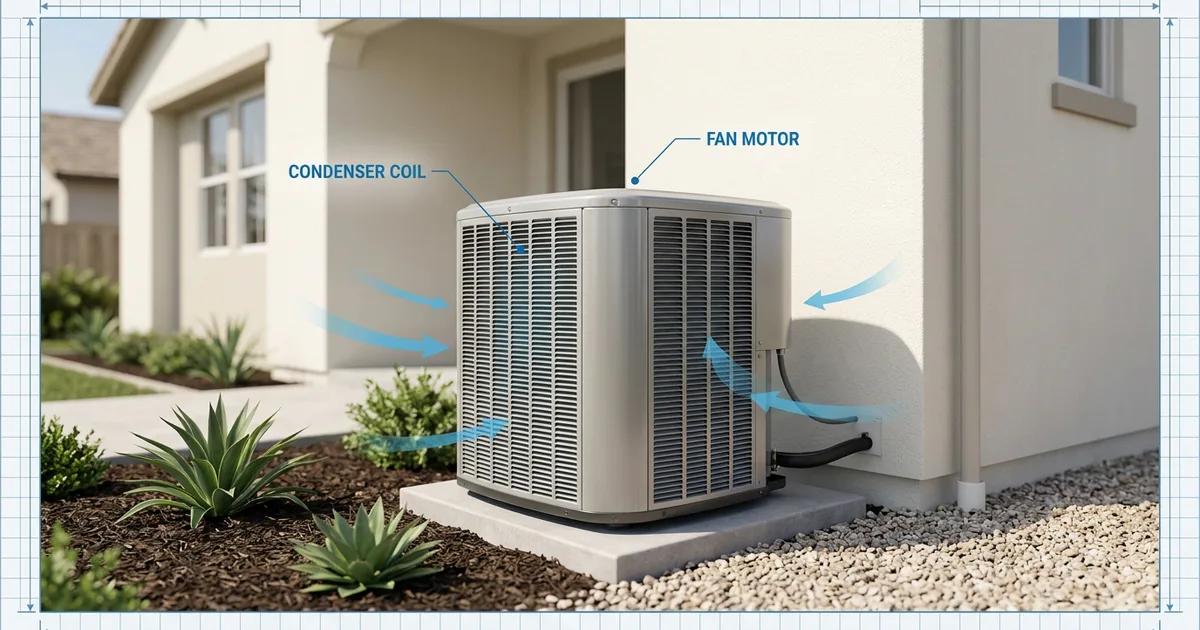
Most Sacramento homeowners think of their air conditioner as that big box sitting beside the house. That box has a name — the AC condenser — and understanding what's inside it, and what happens when something goes wrong, can save you from a surprise breakdown during the hottest week of the year.
This guide covers what an AC condenser is, what each part inside it does, how it fits into the bigger cooling picture, and what to watch for when it starts to fail. By the end, you'll know exactly what you're dealing with — and what questions to ask your HVAC tech if something isn't right.
Key Takeaways
What Is an AC Condenser?
The AC condenser is the metal cabinet that sits outside your home. In a standard split-system central air conditioner, it's the outdoor half of the system — the indoor half is the air handler or furnace with an evaporator coil inside. The outdoor unit earns its name because this is where the refrigerant condenses from a gas back into a liquid, a phase change that dumps heat into the outside air.
People sometimes call the outdoor unit "the compressor," but that's not quite right. The compressor is one part that lives inside the condenser unit. The condenser includes three main components:
- The compressor — pressurizes and pumps refrigerant
- The condenser coil — the coil of copper tubing wrapped in aluminum fins where heat is released
- The condenser fan — pulls outdoor air through the fins to carry heat away
All three work together every time your AC runs.
How Does an AC Condenser Work?
The AC condenser releases heat by running hot refrigerant gas through metal coils while a fan blows outdoor air across those coils — the air picks up the heat and carries it away, cooling the refrigerant back into a liquid. The whole process takes only seconds per cycle and repeats continuously while your system runs.
Here's the step-by-step refrigerant loop:
Step 1 — Evaporator coil (indoors). The refrigerant starts as a cold liquid inside the indoor evaporator coil. Your home's warm air blows across the coil, and the refrigerant absorbs that heat, boiling off into a low-pressure gas.
Step 2 — Compressor. That gas travels to the compressor inside the outdoor unit. The compressor squeezes the gas, raising its pressure and temperature dramatically — hot, high-pressure gas is now ready to shed its heat.
Step 3 — Condenser coil. The hot gas flows through the condenser coil. The aluminum fins conduct heat away from the copper tubes, and the condenser fan blows outdoor air through the fin stack. Heat transfers from the refrigerant to the air and is expelled outside.
Step 4 — Refrigerant becomes liquid. As the refrigerant releases heat, it cools and condenses back into a high-pressure liquid. That liquid flows through the refrigerant line to an expansion valve, which drops the pressure so the refrigerant can absorb heat again indoors.
Step 5 — Cycle repeats. The cooled liquid re-enters the indoor evaporator coil, and the cycle starts again.
According to the U.S. Department of Energy, central air conditioning can consume more than 2,000 kilowatt-hours of electricity per year in an average-sized home (Energy.gov, Central Air Conditioning, 2025). How well your condenser releases heat directly affects how much of that electricity your system needs — a dirty or failing condenser works harder and costs more to run.
Condenser vs. Compressor vs. Evaporator: What's the Difference?
The condenser (outdoor unit) releases heat outdoors; the compressor inside it pressurizes the refrigerant to make that possible; and the evaporator coil (indoors) is where heat is actually absorbed from your home's air. Each has a distinct job, and a failure in any one disrupts the whole cycle.
This table shows how the three components compare side by side:
| Component | Location | Primary Job | Refrigerant State Change |
|---|---|---|---|
| **Evaporator coil** | Indoors (inside air handler) | Absorbs heat from indoor air | Liquid → Low-pressure gas |
| **Compressor** | Inside the outdoor condenser unit | Pressurizes refrigerant; pumps it through the system | Raises pressure and temperature of gas |
| **Condenser coil + fan** | Outdoors (condenser unit) | Releases heat to outside air | High-pressure gas → High-pressure liquid |
| **Expansion valve** | Between outdoor and indoor unit | Drops refrigerant pressure before evaporator | High-pressure liquid → Low-pressure liquid |
A common point of confusion: when a technician says "the compressor failed," they mean one component inside the outdoor unit has failed — not the whole cabinet. But when they say "the condenser failed" or "needs to be replaced," they usually mean the entire outdoor unit. Context matters, so don't hesitate to ask your tech to clarify.
One thing we see often at A-CLASS: Sacramento homeowners get quoted "compressor replacement" and "condenser replacement" as if they're interchangeable. They're not. A compressor swap alone typically runs $800 to $2,300. Replacing the full condenser unit runs $2,500 to $5,000+. Knowing the difference helps you verify you're getting the right repair at the right price.
What Are the Signs of a Bad AC Condenser?
A failing AC condenser most often shows up as warm air from your vents, rising energy bills, or oily residue near the outdoor unit. The tricky part is that condenser problems tend to creep up gradually — the system still runs, it just can't keep up on a 105°F Sacramento afternoon.
Watch for these six warning signs:
1. Warm or barely cool air from vents. This is the most common symptom. The condenser can't shed heat efficiently, so the refrigerant comes back to the indoor coil still carrying warmth it should have dumped outside. Your home never quite reaches the thermostat setpoint.
2. Oily residue or refrigerant leaks near the outdoor unit. A cracked condenser coil lets refrigerant escape and leaves an oily film on the unit or nearby surfaces. Refrigerant leaks don't fix themselves — the crack worsens under pressure cycling, and a system low on refrigerant damages the compressor over time.
3. Rattling, buzzing, or grinding from the outdoor cabinet. Debris caught in the fan blade, a failing fan motor bearing, or a loose refrigerant line can all cause noise. Don't ignore it. A minor fix caught early is a lot cheaper than a seized fan motor.
4. Higher electric bills without a change in usage. The U.S. EPA notes that refrigerant leaks can cause significant efficiency losses (EPA, Section 608 guidance, Clean Air Act, 2024). When the condenser can't release heat properly, the compressor runs longer every cycle — which shows up on your bill before it shows up as a total breakdown.
5. Short cycling — the system turns on and off rapidly. If the condenser is overheating because airflow is blocked or the coil is dirty, a built-in safety switch shuts the unit down to prevent damage. It restarts, overheats again, and shuts down again.
6. The system won't turn on at all. Electrical failures in the condenser — a blown capacitor, failed contactor, or burned motor winding — can prevent the unit from starting. These are component-level failures, not always a sign the whole unit needs replacing.
From our technicians: The call we get most in June and July is "my AC stopped working overnight." Nine times out of ten, the outdoor unit shut itself down on a thermal overload — meaning it got too hot. Before calling for a full condenser diagnosis, check that the area around the unit is clear and that the filter inside isn't completely clogged. Those two things alone can cause a condenser to shut off.
How Long Does an AC Condenser Last?
A residential AC condenser typically lasts 15 to 20 years with proper annual maintenance; neglected units often fail between 10 and 12 years. According to Carrier's product resource library, proper maintenance extends AC system life to 15 to 20 years, while neglect can reduce it to about 10 years (Carrier, "How Long Do AC Units Last?", 2026).
Sacramento's climate is a factor you can't ignore. The Central Valley regularly sees temperatures above 100°F for weeks at a stretch. More runtime hours mean more wear on the compressor, the fan motor, and the coil joints — all of which accumulate faster here than in cooler climates.
These are the main factors that affect how long your condenser lasts:
- Annual maintenance. A yearly tune-up that includes cleaning the coil, checking refrigerant charge, and testing electrical components is the single biggest factor in lifespan. Most manufacturers also require documented maintenance to keep your warranty valid.
- Coil cleanliness. The condenser coil collects cottonwood seeds, pet hair, grass clippings, and dust. A coated coil can't shed heat efficiently, which forces the compressor to run hotter and longer.
- Clearance around the unit. The outdoor unit needs at least two feet of clear space on all sides for proper airflow. Shrubs, fence panels, and garden equipment pressed up against the unit restrict the airflow the condenser depends on.
- Refrigerant charge. An undercharged system makes the compressor work harder. An overcharged system can cause liquid refrigerant to enter the compressor — immediate mechanical damage. Only a licensed technician can legally handle refrigerant under EPA Section 608 of the Clean Air Act.
Basic AC Condenser Maintenance: What Homeowners Can Do
You don't need tools or technical knowledge to do the maintenance that matters most. These four tasks extend condenser life and keep your system running efficiently through Sacramento's long cooling season.
Clear the area around the unit. Trim any plants to at least two feet away. Remove garden hoses, storage, or anything else that reduces airflow around the cabinet.
Gently rinse the coil fins with a garden hose. Turn the power off at the disconnect box first. Spray from the inside out if possible to push debris out rather than in. Don't use a pressure washer — the aluminum fins bend easily.
Replace the indoor air filter on schedule. A clogged filter reduces airflow through the indoor coil, which raises the workload on the condenser. Most homes need a new filter every 60 to 90 days; monthly if you have pets.
Schedule a professional tune-up every spring. A licensed technician can measure refrigerant charge, check electrical connections, test the capacitor and contactor, and clean the coil with the right products. Catching a weak capacitor ($150 to $350 to replace) before it fails prevents a compressor burnout ($1,200 to $2,300 to replace).
If your condenser is due for a check-up or you've noticed any of the warning signs above, our AC system maintenance service covers everything in one visit. If something more serious has developed, our AC system repair team can diagnose and fix condenser issues the same day in most cases.
How Much Does It Cost to Replace an AC Condenser?
Replacing a home AC condenser in Sacramento typically costs $2,500 to $5,000 installed, with a national average near $2,900 according to HomeAdvisor's 2026 cost data (HomeAdvisor, "AC Condenser Replacement Cost", 2026). Some jobs run higher — up to $6,100 — depending on system size and brand.
The biggest cost drivers:
- System size (tonnage). A 1.5-ton unit for a small home costs far less than a 5-ton unit for a large two-story house.
- Efficiency rating (SEER2). Higher-efficiency units cost more upfront but cost less to run monthly. Systems manufactured after January 2025 use the new R-454B refrigerant due to federal phase-down rules, which affects parts availability and pricing on older systems.
- Whether the indoor coil needs replacing too. Trane's guidance recommends replacing the outdoor condenser and indoor evaporator coil at the same time when the system is older (Trane, "AC Condenser Replacement Cost", 2025). Mismatching an old coil to a new condenser reduces efficiency and can void the new unit's warranty.
- Warranty status. If your unit is still under the manufacturer's warranty, you may only owe labor — $300 to $1,500 — rather than the full replacement cost.
The 5,000-dollar rule: if the repair cost exceeds half the price of a new system and the unit is more than 10 years old, most HVAC professionals recommend replacing rather than repairing. Carrier uses 50% of replacement cost as the guideline (Carrier, lifespan guide, 2026).
Frequently Asked Questions
What does an AC condenser do?
The AC condenser releases heat from your home into the outside air. It takes high-pressure refrigerant gas from the compressor, runs it through a metal coil, and a fan blows outdoor air across those coils to carry the heat away. Once the refrigerant releases its heat, it condenses back into a liquid and cycles indoors to absorb more heat — and the process repeats.
What is the difference between a condenser and a compressor?
The compressor is one component that lives inside the outdoor condenser unit. It pressurizes refrigerant gas before that gas enters the condenser coil. The term "condenser" refers to the entire outdoor cabinet — coil, fan, compressor, and electrical components all together. The confusion comes from technicians sometimes using "compressor" as shorthand for the outdoor unit. If you hear both terms in a service conversation, ask which specific part is being discussed.
How much does a new AC condenser cost?
Replacing a home AC condenser typically runs $1,300 to $6,100, with most Sacramento homeowners spending $2,500 to $5,000 installed (HomeAdvisor, 2026). The exact price depends on system size in tons, brand, efficiency rating, and whether the indoor coil needs replacing at the same time.
What are the signs of a bad AC condenser?
The clearest signs are warm air from vents even when the system is running, oily residue or visible leaks near the outdoor unit, rattling or grinding noises from the outdoor cabinet, and rising energy bills without a change in usage. Short cycling — where the system turns on and off rapidly — often points to the condenser overheating. If you spot any combination of these, call a licensed tech before the compressor takes damage.
How long does an AC condenser last?
A well-maintained residential condenser lasts 15 to 20 years. Without regular tune-ups, that drops to 10 to 12 years (Carrier, 2026). Sacramento's 100°F-plus summers add runtime hours faster than cooler climates, so annual maintenance matters more here than in most of the country.
Have questions about your outdoor unit? Call A-CLASS Heating and Air at (916) 342-9108. We're a Sacramento family-owned shop — no commissioned sales, no pressure. If your condenser needs work, we'll tell you exactly what it is and what it costs.
Frequently Asked Questions
What does an AC condenser do?
The AC condenser releases heat from your home into the outside air. It takes high-pressure refrigerant gas from the compressor, runs it through a coil, and a fan blows outdoor air across those coils to carry the heat away. Once the refrigerant releases its heat, it turns back into a liquid and cycles indoors to absorb more heat.
What is the difference between a condenser and a compressor?
The compressor is one component inside the outdoor condenser unit. Its job is to pressurize refrigerant gas before it enters the condenser coil. The condenser is the entire outdoor cabinet including the coil, the fan, and the compressor. Think of the compressor as the engine and the condenser as the full drivetrain.
How much does a new AC condenser cost?
Replacing a home AC condenser typically runs $1,300 to $6,100, with most Sacramento homeowners spending $2,500 to $5,000 installed. The exact price depends on system size in tons, brand, efficiency rating, and whether the indoor coil needs replacing at the same time. Labor alone adds $300 to $1,250.
What are the signs of a bad AC condenser?
The clearest signs are warm air from vents even when the system is running, visible refrigerant leaks or oily residue on the outdoor unit, rattling or grinding noises from the outdoor cabinet, rising energy bills without a change in usage, and the system short-cycling or shutting off before your home reaches temperature.
How long does an AC condenser last?
A residential AC condenser lasts 15 to 20 years with regular maintenance. Without annual tune-ups, that can drop to 10 to 12 years. Sacramento summers routinely push temperatures above 100 degrees Fahrenheit, which adds runtime hours and puts condensers at the shorter end of that range unless you keep up with annual service.