
Commercial HVAC in Sacramento: What Business Owners Need to Know
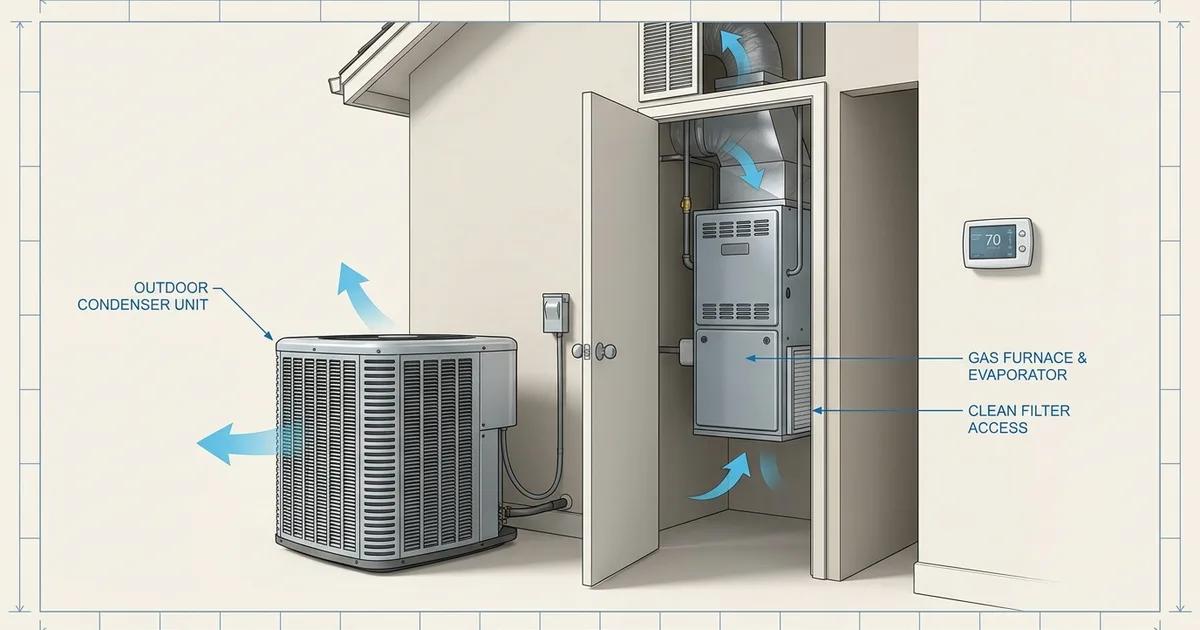
Commercial HVAC systems keep employees productive, customers comfortable, and perishable inventory safe. For Sacramento small business owners, they also run in one of the harshest climates in the continental United States — a Sacramento summer routinely delivers 40+ consecutive days above 90°F, and in recent years triple-digit heat has become a near-annual event. A system that coasts through a Boston summer will be fighting for its life on J Street in August.
This guide covers what separates commercial from residential HVAC, the system types most common in Sacramento's small-business market, how California's energy code affects your options, and the maintenance discipline that keeps costs from spiraling out of control.
Key Takeaways
- In 2025, 78% of single-story commercial buildings under 100,000 SF ran on rooftop package units (AHRI, 2025 Shipment Data).
- ENERGY STAR certified light commercial HVAC equipment uses approximately 17% less energy than standard equipment (ENERGY STAR, energystar.gov).
- California Title 24 pushes Sacramento commercial HVAC installation costs 18–32% above the national baseline (Terrapin Construction Group, Q1 2026).
- Every dollar spent on preventive maintenance saves an estimated $4–$5 in avoided repair and replacement costs (U.S. Department of Energy).
- At least 25% of commercial rooftop units are oversized, increasing energy costs and accelerating wear (Consortium for Energy Efficiency, via ENERGY STAR).
How Is Commercial HVAC Different from Residential?
Commercial HVAC systems handle bigger loads, more complex zoning requirements, and stricter regulatory standards than anything you'd find in a house. The gap starts with capacity. Residential air conditioners typically run 1.5 to 5 tons. Light commercial systems — the kind serving most Sacramento small businesses — start at 3 tons and commonly reach 20 tons or more. A 2,500-square-foot retail shop might need a 7.5-ton system; a restaurant kitchen generates enough heat to demand a separate dedicated unit entirely.
Beyond tonnage, commercial systems differ in three meaningful ways:
Power supply. Residential units run on single-phase 120V/240V power. Commercial systems run on three-phase 208V or 480V, which changes the cost and complexity of electrical work significantly.
Zoning. A typical home runs off one thermostat. A commercial building might need a server room held at 65°F year-round while the showroom runs at 72°F and the storage area gets minimal conditioning. Multi-zone systems use variable air volume (VAV) boxes, separate thermostats, and in larger buildings a Building Automation System (BAS) to manage competing demands.
Code requirements. Residential HVAC in California is regulated, but commercial HVAC faces ASHRAE Standard 62.1 ventilation requirements, California's Title 24 Part 6 energy code, mandatory economizers on most commercial-sized units, and Acceptance Testing by a certified technician before a permit closes. There's no equivalent burden on a residential changeout.
Commercial vs. Residential HVAC at a Glance
| Feature | Residential | Light Commercial | Large Commercial |
|---|---|---|---|
| Typical capacity | 1.5–5 tons | 3–20 tons | 20–100+ tons |
| Power supply | Single-phase | Three-phase | Three-phase |
| Placement | Side yard or closet | Rooftop (RTU) | Rooftop or mechanical room |
| Thermostat zones | 1 (sometimes 2–3) | 2–8 | 8–unlimited (BAS) |
| Ventilation standard | Not mandated | ASHRAE 62.1 required | ASHRAE 62.1 required |
| California energy code | Title 24 Part 6 (residential) | Title 24 Part 6 (nonresidential) | Title 24 Part 6 (nonresidential) |
| Maintenance frequency | Once per year | 2–4 times per year | Quarterly to monthly |
| Typical install cost | $5,000–$15,000 | $15,000–$45,000 | $50,000–$500,000+ |
| Expected lifespan (maintained) | 15–20 years | 15–20 years | 20–25 years |
What Type of Commercial HVAC System Does a Small Business Need?
In 2025, 78% of single-story commercial buildings under 100,000 square feet still ran on rooftop package units, according to AHRI shipment data. That figure isn't an accident — RTUs dominate because they work well for the majority of Sacramento small businesses.
Packaged Rooftop Units (RTUs) house every component — compressor, condenser, evaporator coil, and air handler — in one cabinet bolted to the roof. The benefits for a business owner are straightforward: no indoor mechanical space consumed, no refrigerant lines running through the building, and one piece of equipment one technician can service without entering the occupied space. For retail stores, small offices, restaurants, and similar spaces, an RTU is almost always the right answer.
Split systems separate the condensing unit (outdoor) from the air handler (indoor). They're common in smaller suites where rooftop access is shared or restricted. Installation costs are similar to RTUs, but service requires access to two locations.
Variable Refrigerant Flow (VRF) systems use one outdoor unit connected to multiple small indoor units — think of a modern mini-split scaled up to serve an entire building. VRF costs $24–$38 per square foot installed versus $14–$28 for RTUs (Terrapin Construction Group, Q1 2026), but the efficiency gains and zoning flexibility make VRF compelling for multi-tenant office buildings or spaces with highly variable occupancy patterns.
For most Sacramento small businesses in single-story buildings between 1,000 and 10,000 square feet, an RTU is the most cost-effective choice — especially with the refrigerant transition still unfolding. A 5-ton Trane or Carrier RTU installed correctly and maintained on schedule will outlast a poorly sized VRF by years.
Our commercial service calls in Sacramento follow a consistent pattern: the businesses with the biggest emergency repair bills are almost always running oversized systems that short-cycle heavily — exactly what the Consortium for Energy Efficiency documented when they found at least 25% of commercial rooftop units are oversized.
For deeper information on what commercial HVAC service looks like for Sacramento businesses, see our HVAC services overview.
What Does California's Title 24 Mean for Your Commercial HVAC?
Title 24 Part 6 is California's building energy efficiency standard. For Sacramento businesses in Climate Zone 12, it's not optional — any new HVAC installation or significant replacement triggers compliance requirements.
In 2025, the California Energy Commission restructured the code with several notable changes that affect commercial HVAC directly:
Economizer requirements. Most commercial cooling systems above a certain tonnage threshold must include an economizer — a damper that pulls in free cool outside air when conditions allow, reducing compressor run time. In Sacramento's climate, economizers can deliver meaningful savings during spring and fall shoulder seasons.
Demand-controlled ventilation (DCV). High-occupancy spaces like conference rooms and retail floors must use CO₂ sensors or occupancy data to reduce ventilation rates when spaces are empty or lightly occupied. This matters for energy bills and also for ASHRAE 62.1 compliance.
Advanced HVAC controls. Variable air volume systems now require ASHRAE Guideline 36 control sequences — a performance-based standard for how the system manages airflow, temperature, and pressure.
Acceptance Testing. Before a city inspector will sign off on a final permit, a California-certified Acceptance Test Technician must verify that the economizer, DCV, and controls actually function as designed. This is a real step that adds cost and scheduling time — plan for it.
We see businesses get surprised by Acceptance Testing requirements more often than anything else in the Title 24 process. A replacement that the owner expected to finish on a Tuesday often runs an extra week because the ATTCP technician isn't available and the city won't close the permit without the signed form. Build that lead time into any replacement project.
California's requirements push installation costs 18–32% above the Mountain West baseline on comparable scopes, according to Terrapin Construction Group's Q1 2026 data. That premium is real — but it also delivers equipment that runs more efficiently, which matters in a market where Sacramento's commercial electric rates continue to climb.
How Often Does Commercial HVAC Need Maintenance?
Commercial HVAC maintenance isn't an annual suggestion. In Sacramento's climate, it's a minimum twice-per-year professional service obligation — spring before cooling season starts and fall before the first heating load hits.
The business case is straightforward. The U.S. Department of Energy estimates that preventive maintenance returns $4–$5 in avoided costs for every dollar spent. Facilities running structured preventive programs see unplanned downtime drop by 73% and average equipment lifespan extend from 12 years to 20+ years (various DOE and industry studies).
What happens when maintenance gets skipped? A dirty condenser coil forces the compressor to work harder, raising energy consumption and heat stress on the motor. A loose belt on the air handler creates noise and then snaps at 3 PM on a 105°F Friday. An economizer damper stuck open in winter heats unconditioned outside air for eight hours before anyone notices the gas bill.
Commercial HVAC Maintenance Schedule
| Task | Frequency | Who Does It |
|---|---|---|
| Check/replace air filters | Monthly (high-dust) or quarterly | Business owner or facilities staff |
| Inspect belts and pulleys | Quarterly | HVAC technician |
| Clean condenser and evaporator coils | Semi-annually (spring and fall) | HVAC technician |
| Test economizer operation | Semi-annually | HVAC technician |
| Check refrigerant charge | Semi-annually | Licensed HVAC technician |
| Verify thermostat/BAS calibration | Semi-annually | HVAC technician |
| Inspect electrical connections and contactors | Annually | HVAC technician |
| Full system performance test | Annually | HVAC technician |
| Duct inspection for leaks | Every 2–3 years | HVAC technician |
Sacramento's summer heat accelerates wear on every component listed above. A refrigerant level that's technically borderline in San Francisco will become a hard failure in Sacramento by week three of a heat wave. Twice-a-year professional visits aren't overkill here — they're the minimum.
Our HVAC maintenance plans for commercial properties are structured specifically for Sacramento's climate and California's Acceptance Testing requirements.
Does Energy Efficiency Actually Matter for a Small Business?
Space cooling accounts for roughly 15% of electricity used in commercial buildings, according to the U.S. Energy Information Administration — second only to lighting. For a small business running eight or more hours a day in Sacramento's summer heat, that's a significant line item.
ENERGY STAR certified light commercial HVAC equipment uses approximately 17% less energy than standard equipment (ENERGY STAR, energystar.gov). On a system running 2,500 hours per cooling season, that 17% compounds quickly. Stepping up from a baseline efficiency unit to a high-efficiency model for a packaged RTU typically adds $1.80–$2.60 per square foot at installation and pays back within 4–6 years in Sacramento's hot climate, according to Terrapin Construction Group's cost analysis.
The broader pattern holds too. ENERGY STAR certified commercial buildings use 35% less energy than typical buildings nationwide (ENERGY STAR, energystar.gov/buildings/about-us/facts-and-stats). Much of that gap is HVAC. If you're replacing a system that's 12 or more years old, the efficiency delta between the old equipment and a current ENERGY STAR unit is substantial — often enough to make replacement pencil out ahead of schedule even without a breakdown forcing your hand.
SMUD, Sacramento's municipal utility, offers commercial rebates for qualifying high-efficiency equipment. Rebate amounts and eligibility requirements change annually, so check directly with SMUD's business programs before purchasing — but a properly sized high-efficiency RTU often qualifies for $500–$2,000 back, which meaningfully changes the payback math.
What Are the Signs Your Commercial HVAC Needs to Be Replaced?
Most commercial HVAC systems are designed to last 15–20 years with proper maintenance. Without it, expect 10–12 years. The tricky part is that systems rarely quit cleanly — they degrade, limp, and run expensively for years before a hard failure, which means the cost of delay is often invisible until you look at the energy bills.
Age. A commercial RTU pushing 15+ years is statistically near end of life. At that age, major components — compressor, heat exchanger, controls — are all approaching wear thresholds simultaneously.
Repair frequency and cost. The industry rule of thumb: if a single repair costs 50% or more of replacement value, replace. If you've spent 50% across multiple repairs in the past 12 months, the math is the same.
Refrigerant type. Systems running R-22 refrigerant can no longer be recharged with virgin refrigerant under EPA rules — only recycled R-22 is legal, and it's expensive and increasingly scarce. R-410A systems face a different pressure: EPA AIM Act regulations pushed equipment manufacturers to A2L refrigerants (R-454B) starting January 2025. R-410A equipment can still be legally installed through the end of 2026, creating a narrow window for businesses still on R-410A equipment to replace with familiar technology before A2L becomes the only new option.
Uneven temperatures. If one side of your building is always too warm and the other too cold, the system is either oversized (short-cycling and not dehumidifying), failing to zone properly, or suffering from duct problems. All three get worse with age.
Rising energy bills without operational changes. A degrading system works harder to deliver the same cooling — which shows up in electricity consumption before it shows up as a breakdown.
How Much Does Commercial HVAC Cost in Sacramento?
Commercial HVAC pricing in Sacramento is driven by system type, building size, and California's regulatory requirements. Here are honest ranges based on 2025–2026 data.
Packaged RTU installation: $14–$28 per square foot. For a 2,500-square-foot small office or retail space, that's roughly $35,000–$70,000 for a full system, though many light commercial changeouts fall in the $15,000–$30,000 range when ductwork is in good condition.
VRF system installation: $24–$38 per square foot — roughly $10–$12 per square foot more than RTU for the equipment and zoning capability.
Annual preventive maintenance: Most small commercial systems run $1,000–$5,000 per year depending on size, visit frequency, and system complexity.
California premium: Title 24 compliance, prevailing wage requirements, and permit/Acceptance Testing add 18–32% to costs that would be lower in neighboring states. Budget for that reality upfront rather than letting it surprise you mid-project.
The refrigerant transition adds a short-term wrinkle. New A2L refrigerant equipment (R-454B) ran 12–18% above legacy R-410A systems in early 2025 and compressed to roughly 6–10% above by Q1 2026 (Terrapin Construction Group, Q1 2026). If your current system is R-410A and within replacement range, there's a case for acting before end of 2026 to capture the remaining inventory of R-410A equipment before the full market transition to A2L.
A-CLASS Heating and Air has worked with Sacramento small businesses and property managers since 2016. If your system is aging, behaving inconsistently, or if you're facing a Title 24 replacement for the first time, we're happy to walk through the options with you — no pressure, just straight answers. Call us at (916) 342-9108 or visit our HVAC services overview to learn more about how we work.
Frequently Asked Questions
What is commercial HVAC and how is it different from residential?
Commercial HVAC covers heating, cooling, and ventilation systems designed for business occupancies — offices, retail stores, restaurants, and warehouses. Commercial systems start at 3 tons and commonly reach 20 tons or more, run on three-phase power, must meet ASHRAE 62.1 ventilation standards, and often serve multiple independently controlled zones. Residential systems are typically 1–5 tons, single-phase, and run off one thermostat.
How often should commercial HVAC be serviced in Sacramento?
Sacramento's extreme summer heat demands at minimum two professional service visits per year — one before cooling season in spring and one before heating season in fall. Rooftop units in high-dust environments benefit from quarterly filter checks. Refrigerant charge, coil cleaning, belt tension, and economizer function should all be verified at every professional visit to prevent compounding failures during heat waves.
How much does commercial HVAC cost in Sacramento?
A new commercial rooftop unit for a small office or retail space in Sacramento typically runs $15,000 to $30,000 installed for a light commercial changeout. California adds 18–32% over national averages due to Title 24 energy compliance and permitting requirements. Annual preventive maintenance plans for light commercial systems generally run $1,000 to $5,000 depending on system size and service frequency (Terrapin Construction Group, Q1 2026).
What is a rooftop unit (RTU) and does my business need one?
A rooftop unit is a self-contained HVAC package — compressor, condenser, evaporator, and air handler all in one cabinet — mounted on the roof. RTUs dominate light commercial buildings because they free up interior space, simplify service access, and keep a single contractor responsible for the whole system. In 2025, 78% of single-story commercial buildings under 100,000 square feet still used RTUs (AHRI, 2025). Most Sacramento small businesses in single-story retail or office buildings under 10,000 square feet are well served by an RTU.
What are the signs my commercial HVAC system needs to be replaced?
Key replacement signals: age over 15 years, repair bills exceeding 50% of replacement cost in any 12-month period, refrigerant leaks requiring repeated recharging, inconsistent temperatures across zones, and energy bills rising without changes in occupancy. On R-22 systems, replacement is nearly always the right call — legally recharging them is both expensive and increasingly difficult. Get a professional assessment before a system fails during Sacramento's peak summer heat.
Does California Title 24 apply to my commercial HVAC replacement?
Yes. Any new HVAC installation or major replacement in a California commercial building must comply with Title 24 Part 6. For Sacramento (Climate Zone 12) this means minimum efficiency ratings, mandatory economizers on most commercial units, demand-controlled ventilation in high-occupancy spaces, and documented Acceptance Testing by a certified technician before the city will issue a final permit. Build the Acceptance Testing step into your project timeline — it's a real scheduling constraint.
Frequently Asked Questions
What is commercial HVAC and how is it different from residential?
Commercial HVAC covers heating, cooling, and ventilation systems designed for business occupancies — offices, retail stores, restaurants, and warehouses. The main differences are scale and complexity. Commercial systems start at 3 tons and commonly reach 20 tons or more. They use three-phase power, must meet ASHRAE 62.1 ventilation standards, and often serve multiple independently controlled zones. Residential systems are typically 1-5 tons, single-phase, and run off one thermostat.
How often should commercial HVAC be serviced in Sacramento?
Sacramento's extreme summer heat demands at minimum two professional service visits per year — one before cooling season in spring and one before heating season in fall. Rooftop units in high-dust environments such as parking lots or near construction benefit from quarterly filter checks. Refrigerant, coil cleaning, belt tension, and economizer function should be verified at every professional visit.
How much does commercial HVAC cost in Sacramento?
A new commercial rooftop unit for a small office or retail space in Sacramento typically runs $15,000 to $30,000 installed. California adds 18-32% over national averages due to Title 24 energy compliance requirements and prevailing wage rules. Annual preventive maintenance plans for a light commercial system generally run $1,000 to $5,000 depending on system size and service frequency.
What is a rooftop unit (RTU) and does my business need one?
A rooftop unit is a self-contained HVAC package — compressor, condenser, evaporator, and air handler all in one cabinet — mounted on the roof. RTUs dominate light commercial buildings because they free up interior space, simplify service access, and keep a single contractor responsible for the whole system. Most Sacramento small businesses in single-story retail or office buildings under 10,000 square feet use RTUs.
What are the signs my commercial HVAC system needs to be replaced?
Key replacement signals include age over 15 years, repair bills exceeding 50% of replacement cost in any 12-month period, refrigerant leaks on R-22 or R-410A systems that require repeated recharging, inconsistent temperatures across zones, and energy bills rising without any change in occupancy or operations. Sacramento's sustained summer heat accelerates wear — get a professional assessment before a system fails mid-July.
Does California Title 24 apply to my commercial HVAC replacement?
Yes. Any new HVAC installation or major replacement in a California commercial building must comply with Title 24 Part 6, the state's building energy efficiency standard. For Sacramento (Climate Zone 12) this means minimum efficiency ratings, mandatory economizers on most commercial units, demand-controlled ventilation in high-occupancy spaces, and documented Acceptance Testing by a certified technician before the city will issue a final permit.