
How Do Attic Fans Work? (And Do They Actually Help?)
Sacramento attic temperatures routinely hit 150°F on August afternoons. If you have ever climbed into your attic in summer, you know it. So the idea of installing a fan to blow all that heat out makes total sense — until you dig into how these things actually behave.
Attic fans are one of the most misunderstood products in home cooling. Knowing how they work — and where the research says they fall short — can save you from spending a few hundred dollars on something that might not lower your energy bill at all. This guide covers how the three main types of attic ventilation work, what the honest science says, and what actually moves the needle for Sacramento homes.
Key Takeaways
- Powered attic fans pull air out of the attic but typically consume 300–600 watts and can draw conditioned air out of your home, often offsetting any cooling savings (DOE Building America Solution Center, 2022).
- A whole-house fan is a different product entirely — it cools your living space, not just the attic, and fits Sacramento's hot-days/cool-nights climate well.
- Passive ridge-and-soffit ventilation is the baseline every home needs and the safest investment before considering powered fans.
- Improving attic insulation and air sealing delivers more consistent, verifiable cooling savings than adding a powered fan.
How Do Attic Fans Work? The Basic Mechanics
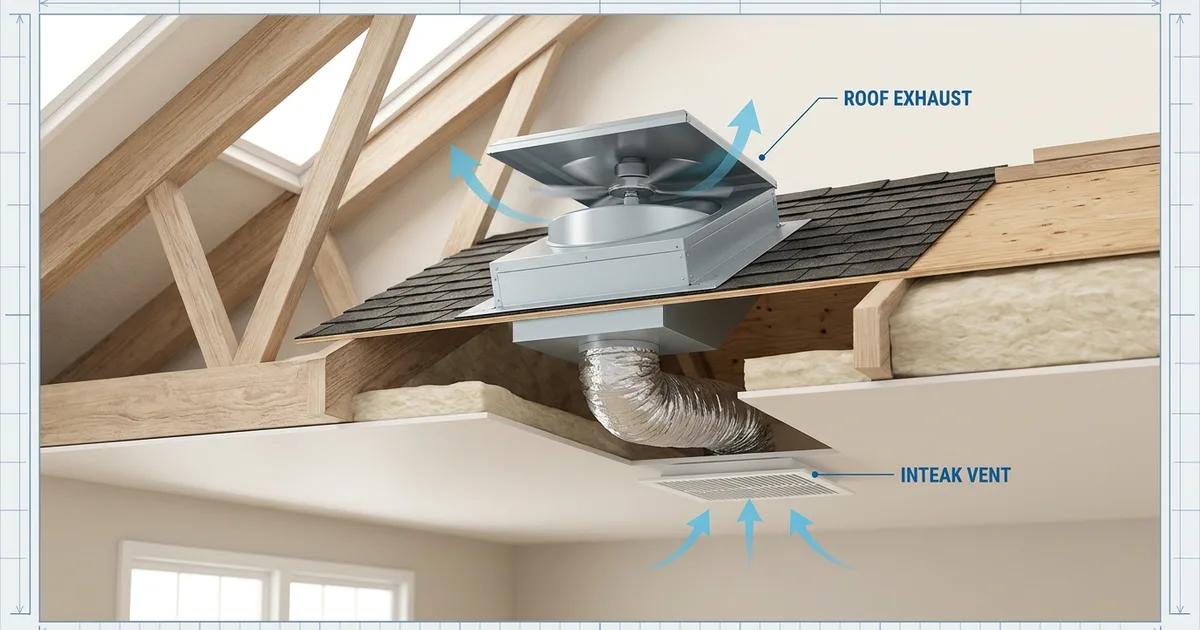
Powered attic fans are exhaust fans — they sit in the roof or gable wall and pull air out of the attic space. Cool outside air is drawn in through intake vents (usually soffit vents under the eaves) to replace the hot air the fan removes. A thermostat typically triggers the fan when attic temps hit around 100°F and shuts it off around 85°F (DOE Building America Solution Center, 2022).
There are three main types to know:
Electric (grid-powered) attic fans are the most common. They draw 300–600 watts while running and can move large volumes of air quickly. Most are thermostat-controlled and require an electrical connection to the home's wiring.
Solar-powered attic fans use a small PV panel instead of grid electricity, so there is no extra electricity cost during operation. The trade-off is lower airflow — the motor is smaller — and they only run when direct sunlight hits the panel. Georgia's building code actually prohibits plug-in powered attic fans and allows only solar-powered units, which signals where regulatory opinion has landed.
Passive ventilation (no fan at all) relies on the physics of hot air rising. Ridge vents at the roof peak let heated air escape while soffit vents under the eaves pull in cooler air. The system works 24 hours a day with zero electricity and zero moving parts. Most building scientists consider a well-balanced passive system the preferred baseline before anything else is added.
Attic Fan Types at a Glance
| Type | Power Source | Typical CFM | Best Use Case | Key Drawback |
|---|---|---|---|---|
| Electric powered attic fan | Grid (300–600W) | 1,000–1,500 | Poorly ventilated attic, no AC | Can pull conditioned air from home |
| Solar attic fan | Solar PV panel | 500–1,200 | Any attic — no grid draw | Only runs in direct sunlight |
| Whole-house fan | Grid (200–700W) | 3,000–6,000+ | Cooling living spaces, dry climates | Requires open windows, not for humid days |
| Passive ridge + soffit | None | Variable | All homes — baseline requirement | Needs proper NFA sizing to work |
| Turbine / whirlybird vent | Wind-driven | Low | Low-use supplemental exhaust | Minimal in low-wind conditions |
What the DOE Research Actually Says
Here is where most homeowners are surprised. The DOE Building America Solution Center reviewed the available research and found that powered attic ventilators "can use more electricity for powering the fan than they save in A/C consumption" (DOE Building America Solution Center, 2022). That is not a fringe opinion — it reflects a consistent finding across multiple field studies going back to the early 1990s.
The Florida Solar Energy Center (FSEC) ran one of the better-controlled field studies. Researchers measured about a 6 percent reduction in space cooling energy in well-insulated test homes — worth roughly 460 kWh per cooling season. The problem: the fan's own electricity consumption, combined with additional A/C load, often ate that saving or turned it into a net loss. The FSEC concluded that powered ventilation "does not typically result in a net energy savings" unless the attic is essentially uninsulated.
Why the math rarely works out: Attic heat transfer is dominated by radiation, not convection. Infrared energy radiates directly from the hot roof deck to the attic floor — and from there conducts down into your living space. Blowing air around a hot attic addresses the convective portion of that heat load, which is the smaller piece. It's a bit like trying to cool a cast-iron skillet by fanning it: the air helps, but the mass still holds the heat.
ENERGY STAR does not recommend powered attic ventilators, and as of the 2022 update, the DOE Building America Solution Center guidance does not recommend them for most applications.
The Conditioned Air Problem — Sacramento Homeowners, Take Note
The most important mechanical issue with powered attic fans is depressurization. A fan that can move 1,200 CFM of air has to pull that air from somewhere. If your attic has limited intake vent area, or if your ceiling has gaps, penetrations, or recessed lights that aren't air-sealed, the fan will pull from the path of least resistance — which is often your conditioned living space.
In summer, that means your A/C-cooled air gets sucked into the attic and exhausted outside. Your air conditioner then runs longer to compensate — and you pay for both the fan's electricity and the extra compressor runtime. In Sacramento, where we run air conditioning from May through October, that compounding effect adds up.
The DOE Building America Solution Center also flags combustion safety: "combustion appliances (other than sealed combustion) may not draft as well or could potentially backdraft" (DOE Building America Solution Center, 2022). If you have a gas water heater or furnace with an atmospheric flue, a powered attic fan creating negative pressure can pull combustion gases — including carbon monoxide — back into your home. That risk is serious enough that most building scientists name it as the primary reason to avoid powered fans in homes with naturally drafted gas appliances.
Attic Fan vs. Whole-House Fan — These Are Not the Same Thing
This is the mix-up A-CLASS sees most often. A lot of Sacramento homeowners buy an attic fan when they probably wanted a whole-house fan, or vice versa. The two products do fundamentally different jobs.
An attic fan ventilates the attic. It runs during the hottest part of the day to exhaust 130–150°F attic air. Your living spaces may benefit slightly if the attic gets cooler, but the fan does not pull air through your bedrooms or living room.
A whole-house fan is installed in the ceiling of the top floor and pulls air through your entire living space — through open windows, through the rooms you actually occupy, and out through the attic. It replaces the stale hot air inside your home with cooler outside air. Most whole-house fans move 3,000–6,000 CFM, versus 1,000–1,500 for a typical attic fan.
Sacramento is one of the better cities in California for whole-house fans because of the large swing between daytime and nighttime temperatures. Daytime highs hit 100°F in July, but overnight lows commonly drop into the mid-60s. Whole-house fans work best when outdoor air is below indoor temperature — the cool-night pattern Sacramento gets reliably from May through September. Running a whole-house fan for an hour after sunset can flush the day's heat out of your home before you go to sleep, often with 90 percent less electricity than running central air conditioning (Brower Mechanical, 2023).
One caveat specific to Sacramento: during wildfire smoke events — which have become a regular feature of August and September — whole-house fans bring in outdoor air and should not be used when the AQI is elevated. On those days, your central AC with a good filter is the right tool.
How Passive Ventilation Works — and Why It Comes First
Before considering any fan, your attic needs a properly sized passive ventilation system. The International Residential Code requires a minimum net free ventilation area (NFA) of 1/300 of the attic floor area when a vapor barrier is present, or 1/150 without one (Building America Solution Center, PNNL).
For a typical Sacramento home with a 1,500 square-foot attic and a vapor barrier, that works out to 720 square inches of NFA — split roughly 50/50 between soffit intake vents at the eaves and ridge vents at the peak. The ridge-and-soffit system uses the stack effect: hot air rises and exits at the ridge while cooler air is drawn in at the soffits below. It works 24 hours a day with no electricity cost and no moving parts to maintain.
The two most common passive ventilation failures A-CLASS sees in Sacramento homes:
- Blocked soffit vents. Blown-in insulation covers the soffit openings from the inside. Without baffles (rafter channels that keep the vent opening clear), the insulation plugs the intake and the entire passive system stops working.
- Mismatched vent types. Mixing ridge vents with gable vents or turbine vents can short-circuit airflow, causing one type to act as an intake rather than an exhaust. A balanced system uses one exhaust type paired with soffit intake.
If your passive system isn't working, adding a powered fan on top of a broken foundation doesn't fix anything — it just adds electricity cost.
What Actually Cools Your Sacramento Home's Attic
Powered fans move hot air. That's real. But the building science evidence points to three interventions that consistently outperform powered fans in terms of cost per degree of cooling:
1. Air sealing the ceiling. Gaps around recessed lights, plumbing penetrations, and the attic access hatch let conditioned air escape and hot attic air radiate into living spaces. Air sealing is unglamorous work, but it directly reduces both the attic heat load and the conditioned-air loss problem that makes powered fans counterproductive.
2. Adding attic insulation. The DOE recommends R-38 to R-60 for attic floors in Sacramento's climate zone (Zone 3). If your attic has less than R-30, more insulation will cut cooling loads more predictably than any fan. The heat that matters — the conducted heat coming through the floor — is blocked by insulation, not by airflow.
3. Radiant barrier sheathing or foil. A radiant barrier on the underside of the roof deck reflects infrared energy back toward the roof before it can radiate to the attic floor. This directly addresses the radiation-dominant heat transfer problem that makes attic fans less effective than they look on paper.
For homes where the HVAC system itself is in the attic — which is common in Sacramento's single-story ranch-style houses — keeping ducts well-insulated and air-sealed matters even more. Hot attic air surrounding leaky ductwork forces your air conditioner to work harder on every single cooling cycle. Scheduling an AC system maintenance visit that includes duct inspection is often the fastest way to find hidden efficiency losses tied to attic conditions.
When a Powered Attic Fan Actually Makes Sense
The DOE Building America Solution Center acknowledges a narrow set of conditions where a powered attic fan can help without creating a net energy penalty:
- The attic has ample intake vent area — enough that the fan is never pulling from the living space
- The ceiling is well air-sealed, cutting off the conditioned-air leakage path
- The home has no atmospherically vented gas appliances (or they have been replaced with sealed-combustion units)
- The fan used is low-CFM (targeting roughly 50 CFM per 1,000 square feet of attic area) rather than a high-output unit
- HVAC ducts or equipment are located in the attic — in that scenario, reducing attic temperatures has a more direct impact on system efficiency
A solar-powered fan is the best option when any powered fan is used: no grid electricity penalty, inherently lower CFM, and code-compliant in the strictest state markets. The airflow is lower than a plug-in unit, but so are the risks.
What A-CLASS Recommends for Sacramento Homeowners
Our honest take after years of working in Sacramento attics: the best money most homeowners can spend on attic cooling is on air sealing, insulation, and passive vent balance — not a powered fan. Those three things address the actual physics of how heat gets into your living space.
If you're interested in a whole-house fan, Sacramento's cool-night climate makes you a good candidate — and it's a more direct cooling solution than an attic fan.
If someone quotes you a powered attic fan as an energy-saving measure and your attic already has reasonable insulation, ask them to show you the math. The fan costs money to run, and the risk of pulling conditioned air out of your home is real.
A-CLASS offers straightforward HVAC assessments with no high-pressure upselling. If you'd like us to look at your attic ventilation, duct condition, and overall cooling setup, call us at (916) 342-9108 or visit our HVAC services page to schedule a visit.
Frequently Asked Questions
Do attic fans really work?
Powered attic fans do remove hot air from the attic, but DOE-funded research consistently finds they often cost more to run than they save on air conditioning. The fan's electricity draw — 300 to 600 watts — plus the added A/C load from conditioned air pulled into the attic can cancel out or exceed any cooling benefit (DOE Building America Solution Center, 2022). Passive ventilation and better insulation are more reliably cost-effective.
What is the difference between an attic fan and a whole-house fan?
An attic fan vents only the attic space and runs during the hottest part of the day. A whole-house fan pulls air through your entire living area and exhausts it through the attic — it cools the rooms you actually occupy, not just the attic. Whole-house fans are most effective in the evening when outside air drops below indoor temperature, which is common in Sacramento's dry summers. See the comparison table above for a side-by-side breakdown.
Do attic fans save money on energy bills?
The evidence is mixed. A Florida Solar Energy Center field study found space cooling savings of roughly 6 percent in well-insulated homes, but the fan's own electricity consumption often wiped out that gain. The DOE Building America Solution Center notes they can use more electricity than they save in A/C. Solar-powered attic fans avoid the grid electricity penalty but produce lower airflow than plug-in units.
Are attic fans worth it in Sacramento?
For most Sacramento homeowners, a properly air-sealed, insulated, and passively vented attic delivers better results than adding a powered fan. If your attic has poor insulation or HVAC equipment routed through it, addressing those issues first will move the needle more. A whole-house fan may offer more direct benefit during Sacramento's reliably mild evenings. Contact A-CLASS at (916) 342-9108 for an honest assessment of your specific situation.
Can an attic fan pull carbon monoxide into my home?
Yes — that is a documented risk. The DOE Building America Solution Center specifically warns that powered attic fans create negative pressure that can cause atmospherically vented combustion appliances — gas water heaters, furnaces, and boilers — to backdraft, spilling combustion gases including carbon monoxide into living areas. Sealed-combustion appliances reduce but do not fully eliminate the concern if other draft pathways exist.
How much passive ventilation does my attic need?
The International Residential Code requires a minimum of 1 square foot of net free ventilation area (NFA) per 300 square feet of attic floor area when a vapor barrier is present (1:150 without one). For a 1,500 square-foot attic, that is 720 square inches of NFA — roughly split between soffit intake vents and ridge exhaust vents. A-CLASS can assess whether your current vent balance is adequate during a routine maintenance visit.
A-CLASS Heating and Air has served Sacramento homeowners since 2016. We do not sell powered attic fans — this post reflects what the research says, not what generates the most revenue. Questions about your specific attic? Call (916) 342-9108.
Frequently Asked Questions
Do attic fans really work?
Powered attic fans do remove hot air from the attic, but research funded through the DOE consistently finds they often cost more to run than they save on air conditioning. The fan's electricity draw — 300 to 600 watts — plus the added A/C load from conditioned air pulled into the attic can cancel out or exceed any cooling benefit. Passive ventilation and better insulation are more reliably cost-effective.
What is the difference between an attic fan and a whole-house fan?
An attic fan vents only the attic space and runs during the hottest part of the day. A whole-house fan pulls air through your entire living area and exhausts it through the attic — it cools the rooms you actually live in, not just the attic. Whole-house fans are most effective in the evening when outside air drops below indoor temperature, which is common in Sacramento's dry summers.
Do attic fans save money on energy bills?
The evidence is mixed and leans negative for powered attic fans. A Florida Solar Energy Center field study found space cooling savings of roughly 6 percent in well-insulated homes, but the fan's own electricity consumption often wiped out that gain. The DOE Building America Solution Center notes they can use more electricity than they save. Solar-powered attic fans avoid the grid electricity penalty but offer lower airflow.
Are attic fans worth it in Sacramento?
For most Sacramento homeowners, a properly air-sealed and insulated attic delivers better, more reliable results than adding a powered fan. If your attic has poor insulation or HVAC ducts routed through the attic space, the case for passive ventilation improvement is stronger than adding a powered fan. A whole-house fan may offer more direct benefit during Sacramento's mild evenings. Call A-CLASS at (916) 342-9108 for an honest assessment.
Can an attic fan pull carbon monoxide into my home?
Yes, that is a real risk. The DOE Building America Solution Center specifically warns that powered attic fans create negative pressure that can cause atmospherically vented combustion appliances — water heaters, furnaces, boilers — to backdraft. When a gas appliance backdrafts, combustion gases including carbon monoxide can spill into living areas. Sealed-combustion appliances reduce this risk, but it does not eliminate the concern.