
Should I Replace My 25-Year-Old HVAC System?
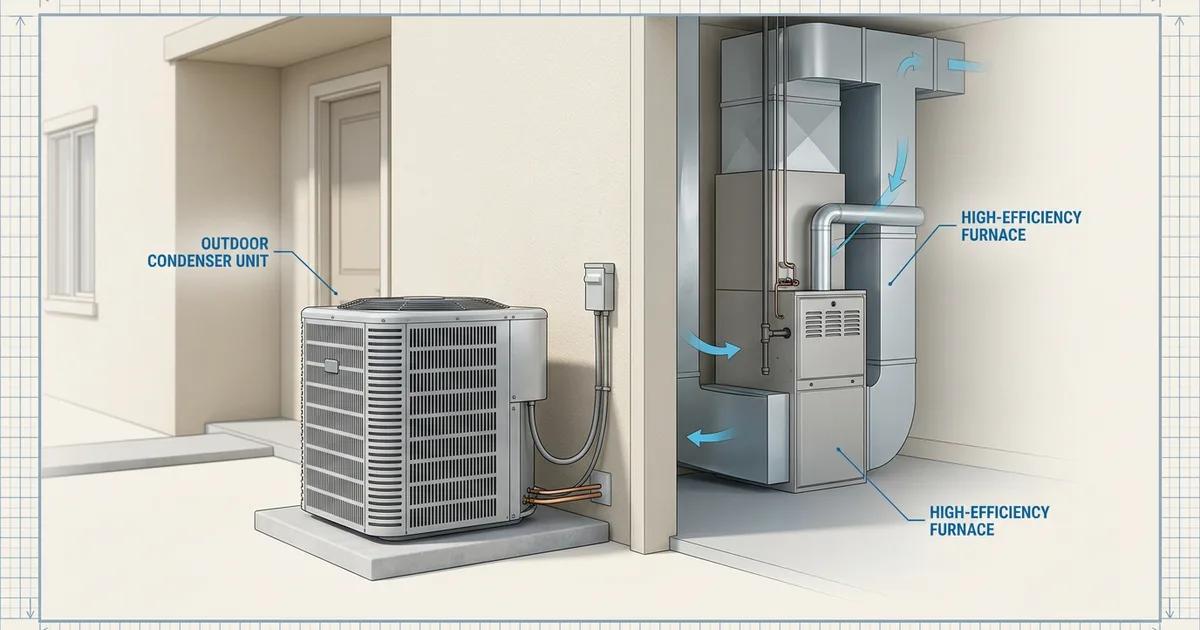
Your HVAC system has been running since around the year 2000. Maybe it fired up fine last summer. Maybe it struggled a little. That fork in the road has a name: should you replace a 25 year old HVAC system, or squeeze out one more repair season?
At 25 years, the decision is almost always to replace — not because we're in the business of selling new systems, but because the math, the safety data, and the parts availability situation have all moved decisively against keeping a unit that old alive. This post walks through every factor in plain terms so you can make the call with confidence.
For the general repair-versus-replace formula that applies to any age system, see our repair or replace AC guide. And if you're not quite sure how old your system is, our average AC and HVAC lifespan post covers how to find the manufacture date and what it means.
Key Takeaways
- ENERGY STAR recommends replacing AC systems older than 10 years and furnaces older than 15; a 25-year-old system is a decade past that threshold (ENERGY STAR, U.S. EPA).
- The EPA banned all new R-22 production and import on January 1, 2020; the refrigerant now costs $90–$250 per pound installed, up from $10–$20 a decade ago (Today's Homeowner, 2025).
- HVAC systems lose roughly 3% efficiency per year from normal degradation; a 25-year-old system running at roughly 60–70% of its original output wastes significant money every month.
- Cracked heat exchangers in old furnaces are a leading cause of home carbon monoxide exposure, per the U.S. Consumer Product Safety Commission.
- ENERGY STAR-certified replacements save homeowners up to 20% on heating and cooling costs; nearly half of home energy bills go to HVAC (ENERGY STAR, U.S. EPA).
A 25-Year-Old System Has Already Outlived Its Expected Lifespan
At 25 years, yes — age alone is a compelling reason to replace. The ASHRAE Handbook — HVAC Applications puts the median residential central AC lifespan at 15 years and gas furnace lifespan at 18 years. ENERGY STAR, the U.S. EPA's efficiency program, goes further: it recommends replacing AC units or heat pumps older than 10 years and furnaces or boilers older than 15 years (ENERGY STAR, "When Is It Time to Replace?", current guidance).
A 25-year-old system has already outlasted ASHRAE's median by 7 to 10 years. That's not a badge of honor — it's a sign the unit has been running in a degraded state for a long time, burning extra electricity, cycling harder than it should, and deferring the costs that eventually show up in one large repair bill.
That said, age doesn't act alone. R-22 refrigerant status, efficiency loss, parts availability, and safety factors all pile on in the same direction for a 25-year-old unit. Each one is worth understanding separately.
What Is the R-22 Problem — and How Expensive Does It Get?
R-22, the refrigerant used in virtually every central AC built before 2010, became illegal to produce or import in the U.S. on January 1, 2020. The EPA's phase-out under the Clean Air Act left only recycled and reclaimed stockpiles available (U.S. EPA, "Phaseout of Class II Ozone-Depleting Substances", current regulation).
As those stockpiles shrink, the price keeps climbing. In 2025, R-22 costs $90 to $250 per pound installed, with an average around $125 per pound — compared to $10 to $20 per pound a decade ago (Today's Homeowner, "How Much Does R-22 Freon Cost?", 2025). Trane, one of the major HVAC manufacturers, pegs the 2025 average at $150 per pound and notes that a full recharge on a 5-ton system can cost $1,250 before service fees, not counting the technician's hourly rate (Trane, "Is R-22 Refrigerant Still Available?", 2025).
A refrigerant leak on an R-22 system isn't just a repair cost — it's a decision point. Here's what that math looks like:
| Repair or Action | Approximate Cost | Notes |
|---|---|---|
| R-22 refrigerant recharge (3–5 lbs, small leak) | $270–$1,250 | Does not fix the underlying leak |
| R-22 recharge (full 5-ton system) | $1,250–$2,000+ | Per Trane 2025 pricing |
| Leak detection and seal attempt | $200–$500 additional | Not always effective long-term |
| Retrofit to R-410A refrigerant | Usually not cost-effective | Most R-22 compressors and coils are incompatible |
| New ENERGY STAR system (Sacramento install) | $4,500–$9,000 installed | Comes with warranty, no refrigerant uncertainty |
| Keep vs. replace at age 25 with refrigerant leak | **Replace** | R-22 costs + age = clear replacement trigger |
The EPA is explicit that homeowners are not required by law to replace R-22 systems, but it also makes clear that no new central AC using R-22 can be purchased (U.S. EPA, "Homeowners and Consumers: Frequently Asked Questions", current). Any R-22 system in operation today is already at least 16 years old. A refrigerant leak on a 25-year-old system is almost always a replacement conversation.
How Much Efficiency Does a 25-Year-Old HVAC System Actually Lose?
Every year of normal use degrades an HVAC system's efficiency. Research from the University of Central Florida's Florida Solar Energy Center found average annual efficiency degradation of 3.7% to 5.2% across monitored homes, with systems 20 years and older showing degradation rates roughly 3.5 times higher than newer equipment (FSEC/UCF, 2018 ACEEE Summer Study on Energy Efficiency in Buildings). U.S. DOE Energy Saver guidance uses a 3% annual figure as a conservative baseline.
Compound that over 25 years and the picture gets stark. A system that left the factory rated at SEER 10 — a common efficiency rating in the late 1990s — may now be operating at the equivalent of a SEER 5 or 6. A modern system qualifies for ENERGY STAR at SEER2 16 or higher. That's not a minor difference.
Nearly half of the average home energy bill goes to heating and cooling, according to ENERGY STAR (ENERGY STAR, "Heat and Cool Efficiently", current). In Sacramento, where SMUD's summer peak rate hits $0.3765 per kWh during weekday peak hours (5–8 PM, June through September) (SMUD Residential Rates, effective June 2026), an inefficient system costs real money every time it runs. Sacramento averages 90 days per year at or above 90°F and 23 days at or above 100°F, with the cooling season stretching from May through October (Current Results, citing NOAA 1991–2020 climate normals).
Our finding: Sacramento homeowners face a compounding efficiency penalty. A degraded old system running through one of California's highest-volume cooling seasons loses far more energy per dollar than the national degradation averages suggest — making the savings case for replacement stronger here than almost anywhere else in the state.
ENERGY STAR estimates that replacing old equipment with a certified unit can cut annual heating and cooling costs by nearly $140 per year, with some households saving up to 20% (ENERGY STAR, "When Is It Time to Replace?"). For a Sacramento home running a 25-year-old unit through a six-month cooling season, the real-world savings are likely higher.
Parts Availability: Why 1990s-Era HVAC Systems Are a Dead End
Parts availability is the practical problem that often ends the replacement debate faster than efficiency math. HVAC manufacturers typically support parts production for 10 to 15 years after a model is discontinued. A system installed in 1999 or 2000 has been out of manufacturer support for 15 or more years.
That creates real sourcing problems:
- Compressors for late-1990s model lines are often available only through salvage suppliers at significant markup.
- Control boards from that era are frequently discontinued; replacements may be refurbished, incompatible, or impossible to find.
- Heat exchangers for older furnace models can take weeks to source and may require retrofitting.
- R-22 coils and refrigerant lines are no longer manufactured new; used components carry no warranty.
One critical part failure on a 25-year-old system can cost as much as a replacement — or be impossible to complete on a Sacramento summer timeline. Planning now, before a failure forces the decision, means better pricing and more equipment choices.
What Are the Safety Concerns With an Old Furnace Specifically?
Old furnaces have a safety dimension old AC units don't. The heat exchanger — the metal component that separates combustion gases from the air your family breathes — develops stress fractures over decades of thermal cycling.
A cracked exchanger can allow carbon monoxide to leak into living spaces. The U.S. Consumer Product Safety Commission identifies home heating systems as a top contributor to non-fire CO poisoning from consumer products (U.S. CPSC, Carbon Monoxide Information Center — Home Heating Equipment) and recommends annual professional inspection of fuel-burning furnaces.
From our service calls: Finding a cracked heat exchanger on a Sacramento home with a 20-plus-year furnace is not rare — it's a regular occurrence. That finding changes the conversation immediately, and it should.
A 25-year furnace has cycled through roughly 12,500 to 25,000 heating cycles. A technician who flags a cracked exchanger isn't being an alarmist — that finding is almost always a replacement conversation, not a repair one.
The Narrow Case for Waiting — and Why It Rarely Applies in Sacramento
Almost none for Sacramento homeowners. Two common objections come up:
"I'm selling in a few years" — a failing R-22 system flags home inspections and puts off buyers. A recent installation is a selling point. A-CLASS's experience is that it's rarely a sunk cost.
"It's still running fine" — running and efficient are different things. A 25-year-old unit is still degraded, still costing more per cooling hour than it should, and still one breakdown away from an emergency replacement decision.
The rare legitimate exception is a home where central AC is genuinely optional — a mild foothills location with light summer use. In Sacramento's Central Valley, where temperatures top 100°F on 23 days per year (Current Results, NOAA 1991–2020 climate normals), that exception almost never applies.
For a deeper look at how to run the numbers on any age system, see our repair or replace AC guide.
What Should Sacramento Homeowners Do Next?
If your system is 25 years old, the most useful next step isn't waiting for a breakdown. It's getting a professional assessment now so you can plan the replacement on your timeline rather than an emergency one.
A good assessment will confirm your system's current efficiency, check the heat exchanger on a furnace, document R-22 status, and give you an honest picture of what's likely to fail first. From there, you can look at equipment options, utility rebates, and financing that fit your situation.
A-CLASS Heating and Air has been serving Sacramento-area homeowners since 2016. We give you the straight picture — no upsell, no scare tactics. If a repair makes sense, we'll tell you. If it doesn't, we'll explain exactly why and walk you through what a replacement looks like. Call us at (916) 342-9108 or see our AC installation and replacement options to get started.
Frequently Asked Questions
Should I replace a 25 year old AC?
Yes, in almost every case. A 25-year-old AC has already exceeded the 15-year median lifespan cited by the ASHRAE Handbook and is nine years past ENERGY STAR's replacement recommendation. It runs on banned R-22 refrigerant now costing $90 to $250 per pound, has likely lost 40% or more of its original efficiency, and replacement parts for units this age are increasingly scarce. The math rarely favors repair.
How long does an HVAC system last?
The ASHRAE Handbook — HVAC Applications puts the median residential central AC lifespan at 15 years and gas furnaces at 18 years. ENERGY STAR recommends replacing AC systems older than 10 years and furnaces older than 15. Sacramento's intense cooling season — 90 days at or above 90°F per year — pushes systems harder than national averages, so real-world lifespans here often fall toward the lower end of those ranges. See our full HVAC lifespan guide for the complete breakdown.
Is it worth fixing an old furnace?
Rarely, at 20-plus years. Beyond the cost math, cracked heat exchangers in old furnaces can leak carbon monoxide into living spaces — a risk the U.S. Consumer Product Safety Commission identifies as a leading cause of CO-related deaths from home heating systems. An inspection that finds a cracked exchanger is almost always a replacement conversation. Even without that finding, furnaces past 20 years are running degraded, and parts availability for older models is limited.
What is R-22 refrigerant and why does it matter?
R-22, also known as Freon, was the standard refrigerant in central AC systems built before 2010. The EPA banned all new U.S. production and import of R-22 on January 1, 2020, leaving only recycled stockpiles. Today it costs $90 to $250 per pound installed, versus $10 to $20 a decade ago. Any system still running on R-22 is now at least 16 years old, and a refrigerant leak alone can cost as much as a down payment on a new system.
What efficiency gains can I expect from replacing a 25-year-old HVAC system?
ENERGY STAR-certified equipment saves up to 20% on annual heating and cooling costs compared to average older equipment. Because a 25-year-old system has also been losing 3 to 5 percent efficiency per year through normal degradation, the real-world improvement is often 35 to 50 percent or more in total operating cost reduction. In Sacramento, where cooling runs six months and SMUD peak rates hit $0.3765 per kWh, that difference adds up fast.
Are parts available for a 25-year-old HVAC system?
Many parts for units manufactured in the late 1990s and early 2000s are discontinued or available only through specialty salvage suppliers at significant markup. Compressors, control boards, and heat exchangers for specific model lines from that era are especially difficult to source. One critical part failure can make the repair as expensive as replacement — or impossible to complete on a reasonable timeline, which matters in Sacramento's summer heat.
Frequently Asked Questions
Should I replace a 25 year old AC?
Yes, in almost every case. A 25-year-old AC has already exceeded the 15-year median lifespan cited by ASHRAE and is at least nine years past ENERGY STAR replacement guidance. It runs on banned R-22 refrigerant costing $90-$250 per pound, loses roughly 3% efficiency per year, and replacement parts for units this old are increasingly scarce. The math rarely favors repair at this age.
How long does an HVAC system last?
The ASHRAE Handbook puts the median residential central AC lifespan at 15 years and gas furnaces at 18 years. ENERGY STAR recommends replacing AC or heat pumps older than 10 years and furnaces older than 15. Sacramento's intense summers push systems harder than national averages, so real-world lifespans here often fall toward the lower end of those ranges.
Is it worth fixing an old furnace?
Repairing a furnace over 20 years old is rarely worth it. Beyond cost, cracked heat exchangers in old furnaces can leak carbon monoxide — a risk the U.S. Consumer Product Safety Commission cites as a top cause of CO-related deaths from home heating systems. An inspection that finds a cracked exchanger is almost always a replacement conversation, not a repair one.
What is R-22 refrigerant and why does it matter?
R-22, also called Freon, is the refrigerant used in most AC systems built before 2010. The EPA banned new production and import as of January 1 2020, leaving only recycled stockpiles. Today R-22 costs $90-$250 per pound installed, versus $10-$20 a decade ago. Any R-22 system is now at least 16 years old; a refrigerant leak alone can cost more to fix than many newer systems are worth.
What efficiency gains can I expect from replacing a 25-year-old HVAC system?
ENERGY STAR-certified equipment can reduce heating and cooling costs by up to 20%. Because a 25-year-old system has also lost 3-5% efficiency per year through normal degradation, the real-world improvement is often far higher. Upgrading from a 10-SEER 1990s unit to a modern 16-plus SEER2 system typically cuts Sacramento cooling costs by 35-50% per season.
Are parts available for a 25-year-old HVAC system?
Many parts for units manufactured in the late 1990s and early 2000s are discontinued or available only through specialty salvage suppliers, often at significant markup. Compressors, control boards, and heat exchangers for specific model lines from that era are especially difficult to source. One critical part failure can make the repair as expensive as a replacement — or impossible to complete at all.