Duct installation Sacramento: the answer before the work
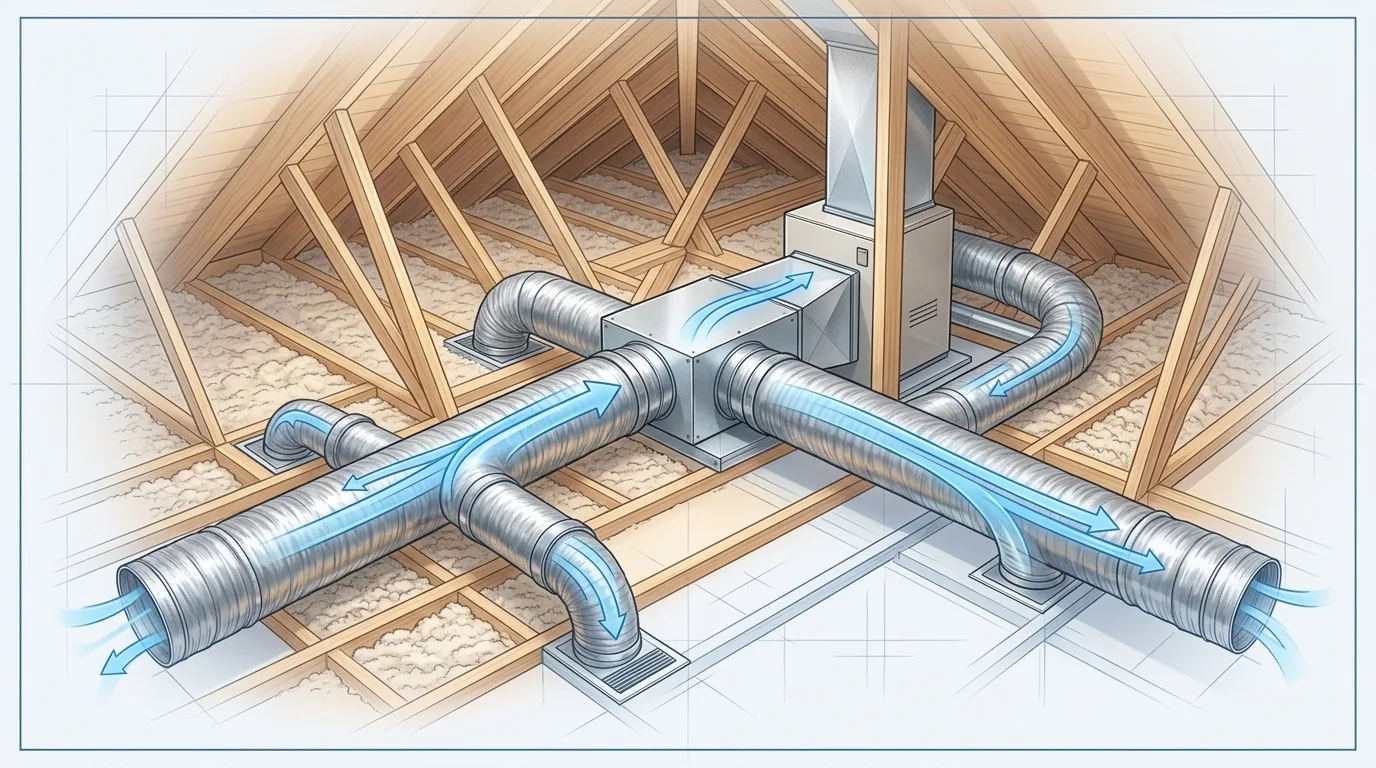
New or replacement ductwork applies when runs are broadly undersized, poorly routed, or damaged beyond practical sealing. At a glance, ducts are the delivery system between HVAC equipment and each room. Static pressure is the resistance the blower works against as it moves air through equipment, filters, ducts, and registers. High resistance can leave rooms short of air, even when the equipment itself still runs. Sacramento homes add real constraints: older homes may hide awkward runs, while hot July and August attics can punish flex duct. In our experience, a tight flex bend or undersized return visible during an attic review gives a better starting point than a request for a larger register. The U.S. Department of Energy explains that ducts distribute conditioned air and that losses can affect system performance in its ducts overview (U.S. Department of Energy, 2026).
A replacement decision should separate one failed section from a system that no longer fits the home. A torn connection, a slipped boot, or a single crushed run may belong with our targeted airflow repair service. New runs and full replacement belong here. Duct sizing means matching a run’s dimensions to the air it must carry, rather than choosing a size by appearance alone. The supply side needs enough air to reach the room, and the return side needs a clear route back to the equipment. We foundthat a small return, tight flex bend, and restrictive filter can combine into one comfort problem. A plan should therefore consider equipment airflow, room use, register placement, and the available path through the home.
When to repair an existing run or plan replacement ductwork| What the review shows | Likely path | Reason |
|---|
| One loose, torn, or disconnected section | Assess a focused duct fix | The rest of the delivery system may still be sound. |
| Several undersized, crushed, or poorly routed runs | Discuss a replacement layout | A patch may leave the core airflow problem in place. |
| New addition, remodel, or equipment replacement | Plan new duct runs | The changed space and equipment need an aligned air path. |
California projects can add a verification step that should not be treated as an afterthought. HERS verification is an independent testing process used for certain California energy-code measures, including applicable duct-sealing and leakage work. The exact requirement depends on the scope, so the project needs the right path before work begins. The California Energy Commission’s Title 24 information explains the state building-efficiency standards and their compliance framework (California Energy Commission, 2026). Our team found that a documented duct-leakage result and accessible return paths make the verification conversation more concrete. It avoids treating ducts as hidden material with no performance role. Consider a full system replacement: the new equipment, returns, sealing, and verification may affect one another. Clear planning gives each decision a place.
Sacramento's housing mix also shapes how a new run is planned. Many midtown and East Sacramento homes carry ductwork sized for smaller equipment decades ago, while newer Elk Grove and Rocklin builds usually have tighter envelopes and longer runs to bonus rooms. We found that measuring static pressure before drawing a layout settles most sizing questions early, because the numbers show what the existing trunk can actually carry. ENERGY STAR's duct guidance notes that a meaningful share of conditioned air can be lost through leaky or poorly connected ducts (ENERGY STAR, 2026). A plan that starts from measurements, the home's layout, and the equipment it must serve gives the installation a performance target rather than a guess, and it gives you a clear basis for comparing the options in front of you.
What a duct layout review should cover
The review starts with what you notice and where the ducts can actually go. Rooms that fade in the afternoon, noisy supply grilles, and a return that seems starved all help frame the discussion. Return air is the air pulled from the home back to the HVAC equipment to be heated or cooled again. It matters as much as the supply side because the system needs a complete loop. Visible registers tell only part of the story. Attic, crawlspace, and wall access often shape what is possible. For instance, a straight run may be better than a long route with sharp turns, but the home’s structure still sets limits. The goal is a practical layout that serves the equipment and rooms, not an oversized promise. See our Sacramento service-area guidance for local context.
Installation also asks practical questions that a repair visit may not need to answer. Will a new run serve an addition, replace a deteriorated attic network, or support different equipment? The route, insulation, connections, and register location all need to work together. Older Sacramento homes can have limited access, while newer construction may have a more defined chase system. Neither condition decides the solution by itself. A clear walk-through of the home keeps assumptions from becoming the design. It also gives the homeowner a better way to compare the proposed scope. A good conversation names what will stay, what will change, and why that choice supports the rooms you use. That is more useful than promising a single fix before the paths are visible.
- Equipment airflow: what the system needs to move.
- Supply and return paths: how air reaches rooms and returns.
- Access: attic, crawlspace, chase, and register constraints.
- Project scope: whether code verification may apply.
There is no honest universal price or per-foot answer for a replacement layout. The work depends on access, number of runs, material choices, equipment airflow, returns, register locations, and whether the project joins a larger system replacement. A-CLASS offers free estimates on system replacements. For duct-only work, the right next step is a conversation about the home and requested scope. A few clear notes help: Which rooms feel different? Is the concern new? Did a remodel change the space? Those facts are more useful than a guess based on a photo. A-CLASS Heating and Air has been family-owned since 2016, with CSLB License #1090886, licensed & insured. Read about the company’s approach on our A-CLASS Heating and Air story.
The bottom line is simple: installation is for new or replacement duct runs, while repair is for fixing what can reasonably stay in place. Do you have a whole-home layout concern, or does one accessible section need attention? That distinction keeps the conversation useful. Homeowners get clearer choices when they describe the rooms, timing, and any visible duct condition without trying to name the fix. A-CLASS can discuss the path without high-pressure sales tactics. If the work is part of a system replacement, ask about the verified free-estimate option. Otherwise, contact A-CLASS Heating and Air to describe the ductwork concern or call (916) 342-9108. We serve Sacramento County and parts of Placer and El Dorado counties before deciding on a scope.
Reviewed by Serghei Poleanschii, Founder & Manager, A-CLASS Heating and Air