
9 Most Common Furnace Problems (and How to Fix Them)
Space heating accounts for 42% of a typical home's energy use, according to the U.S. Energy Information Administration's 2020 Residential Energy Consumption Survey. That means when your furnace isn't working right, you're not just uncomfortable — you're likely overpaying on your gas bill too. Most common furnace problems have straightforward causes, and knowing the pattern helps you decide quickly whether to grab a screwdriver or pick up the phone.
This guide covers nine problems Sacramento homeowners call us about most often. For each one, you'll find the likely cause, what you can check yourself, and a clear call on whether it's a safe DIY fix or a job for a licensed technician. Three topics — a furnace that won't start at all, short-cycling, and a suspected cracked heat exchanger — each have their own detailed page linked below. Here you'll find the overview and the quick action to take.
Key Takeaways
- Space heating accounts for 42% of home energy use (EIA, 2020 RECS), so an inefficient furnace hits your wallet hard every month it runs poorly.
- A clogged air filter is the first thing to check for almost every common furnace problem — it costs under $20 to fix and solves more service calls than most homeowners expect.
- Gas furnaces have a median service life of 18 years (ASHRAE equipment life data). Older units that fail repeatedly deserve a replacement estimate alongside any repair quote.
- The CPSC reports more than 200 Americans die yearly from non-fire CO poisoning linked to consumer products including furnaces (CPSC, 2020 Annual Estimates). A working CO detector on every floor is non-negotiable.
Quick Problem-Cause-Fix Reference
Before reading the full sections, use this table to match your symptom to the right problem entry.
| Problem | Most Likely Cause | DIY or Pro? |
|---|---|---|
| Furnace runs but only blows cold air | Clogged filter → high-limit switch trip | DIY first: replace filter |
| Furnace won't start at all | Thermostat, breaker, ignitor, or gas supply | Start DIY; see full [gas furnace not working guide](/blog/gas-furnace-not-working/) |
| Starts and stops every few minutes | Short-cycling from restricted airflow or oversized unit | See [furnace short-cycling guide](/blog/furnace-short-cycling/) |
| Banging or booming at startup | Delayed ignition from dirty burners | Pro — gas-related, call a tech |
| Squealing or screeching | Blower motor bearing or belt failure | Pro — motor service |
| Uneven heat room to room | Duct leaks, blocked vents, or undersized system | DIY check first; Pro for duct work |
| Furnace runs constantly without reaching set temp | Thermostat fault or undersized unit | DIY thermostat check; Pro for sizing |
| Gas bill suddenly higher | Dirty filter, duct leaks, or declining efficiency | DIY filter; Pro for full tune-up |
| Yellow or flickering flame | Combustion air problem or heat exchanger crack | Pro immediately — CO risk |
| CO alarm or rotten-egg smell | Gas leak or cracked heat exchanger | **Leave now. Call 911 from outside.** |
Problem 1: Dirty or Clogged Air Filter
A clogged filter is the most common cause behind nearly every furnace complaint. ENERGY STAR recommends checking your filter monthly and replacing it at minimum every three months. When you don't, the filter restricts airflow to the heat exchanger. The heat exchanger overheats, the high-limit safety switch trips, and the furnace shuts down or blows cold air. It's a safety feature doing its job — triggered by a $15 problem.
A dirty filter also forces the blower to work harder to pull the same volume of air, raising your energy bill and shortening blower motor life. ENERGY STAR notes that blower and airflow problems can reduce your HVAC system's efficiency by up to 15%.
What to check: Pull the filter (usually in the return air cabinet or at the furnace itself). Hold it up to a light source. If you can't see light through it, replace it. 1-inch filters typically need replacement every 1–3 months. 4- and 5-inch media filters can last 6–12 months.
DIY or pro? Replace the filter yourself. If the furnace doesn't recover within 15 minutes of a filter swap, the limit switch may need to reset — some reset automatically after cooling down, others have a manual button. If cold air continues after that, call a tech.
Problem 2: Thermostat Failure or Misconfiguration
Thermostat problems cause more furnace "failures" than most homeowners realize — and they're often the easiest to fix. Dead batteries are among the top no-heat service calls Sacramento HVAC companies receive every November, right when furnaces come back on after sitting idle all summer. Even partially drained batteries can cause intermittent failures: the voltage drops just enough that the furnace control board never receives a clean call-for-heat signal.
Beyond batteries, a misconfigured thermostat can make a perfectly functional furnace appear broken. If the mode is set to COOL instead of HEAT, or if the set temperature is below the current room temperature, the furnace simply won't call for heat — as designed.
What to check: Confirm mode is set to HEAT and set point is at least 2°F above room temperature. Replace batteries (AA or AAA depending on your model) with fresh ones. If you have a smart thermostat, check whether it's in a "vacation" or "eco" mode that's holding back the temperature.
DIY or pro? Battery replacement and settings check are DIY. If the thermostat screen is blank with fresh batteries, or the furnace still won't respond after confirming all settings, the thermostat itself may need replacement — a straightforward pro repair, typically under $200 parts and labor.
Problem 3: Furnace Won't Turn On or Start
If your furnace is completely dead — no clicking, no blower, no ignition attempt — the cause could be anything from a tripped breaker to a failed ignitor or control board. This is the broadest category of common furnace problems and deserves its own deep-dive treatment.
Gas furnaces have a median service life of 18 years, per ASHRAE equipment life data. A furnace that dies completely on the first cold night of the season was often showing smaller warning signs through the previous winter that went unaddressed.
What to check: Run the four free checks first — thermostat setting, thermostat batteries, circuit breaker position, and the power switch on the furnace unit itself. Gas furnaces need electricity for the blower, ignition, and control board; a tripped breaker kills all of them.
DIY or pro? See our complete gas furnace not working guide for a full symptom-by-symptom walkthrough. If all four free checks are good and the furnace still won't start, you're looking at ignitor, flame sensor, gas valve, or control board — all pro territory.
Problem 4: Ignitor or Flame Sensor Failure
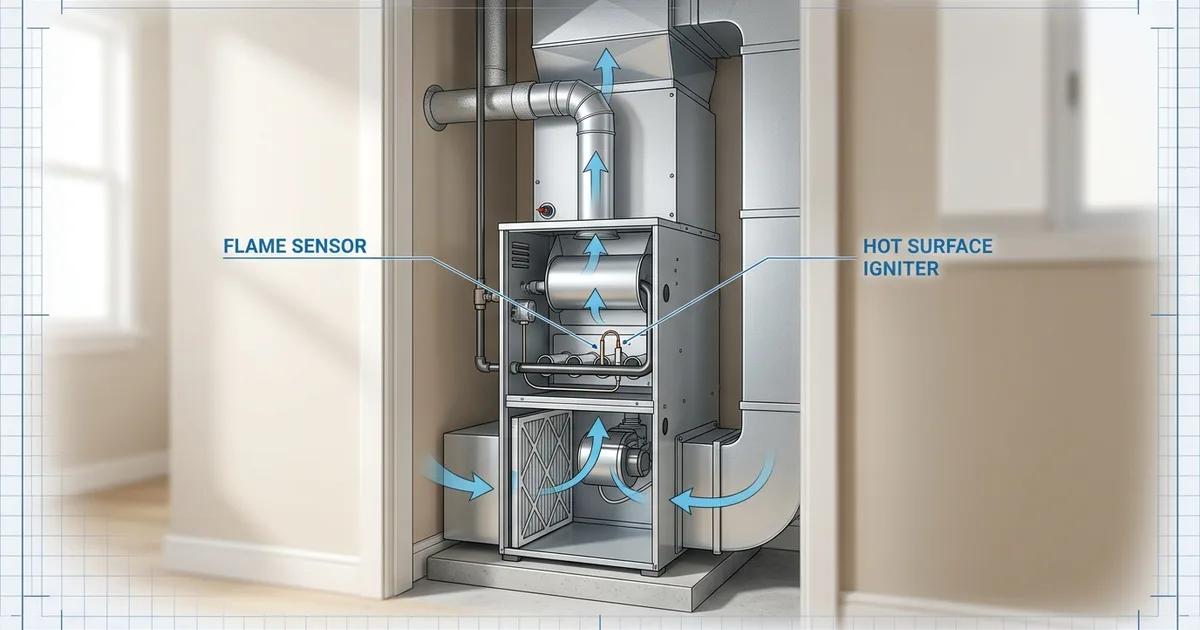
The hot surface ignitor and the flame sensor are the two most common parts-level failures on modern gas furnaces. They're separate components, but their failure signatures look similar: the furnace tries to start, you hear the blower come on, gas flows, and then… the system shuts off within 3–10 seconds and tries again. After two or three attempts, the control board locks out and the furnace goes dead until it's reset.
A hot surface ignitor (the glow-plug that lights the gas) typically costs $150–$425 to replace professionally, according to Today's Homeowner. Compare that to full furnace replacement, which averages $4,813 nationwide per HomeAdvisor. A single ignitor replacement is usually money well spent if the furnace is under 15 years old and otherwise in good shape.
A flame sensor is a thin metal rod that sits in the burner flame. Over time, the rod develops a thin oxide coating that prevents it from reading the flame reliably. The control board, not seeing confirmed combustion, shuts the gas off as a safety measure. Cleaning the sensor — a 15-minute job for a technician — is often all that's needed.
What to check: Watch and listen. If the furnace clicks, ignites briefly (you may see a glow or a flame through the inspection window), then shuts off and tries again, that's the ignitor/flame sensor pattern.
DIY or pro? Pro. Both components involve working near an active burner and gas supply. Ignitor replacement requires handling a fragile ceramic component that breaks if touched with bare hands. Call a tech.
Problem 5: Short-Cycling (Starts and Stops Every Few Minutes)
Short-cycling — where the furnace runs for only 3–7 minutes before shutting off, then restarts again — is one of the harder common furnace problems to diagnose because it has multiple causes. It can stem from a clogged filter causing repeated high-limit trips, an oversized furnace that heats the space too fast and satisfies the thermostat before running long enough for efficient combustion, a failing heat exchanger, or a control board problem.
Short-cycling is hard on equipment because the startup sequence stresses the ignitor and heat exchanger every single time. Letting it continue for weeks can turn a moderate repair into a premature replacement.
What to check: Start with the filter — again. A clogged filter causes more short-cycling than any other single cause. If the filter is clean, check for blocked supply or return vents. Make sure furniture hasn't drifted in front of return air grilles.
DIY or pro? Filter and vent checks are DIY. Everything else requires a pro diagnosis. Short-cycling has enough possible causes that guessing at parts is expensive and unreliable. See our furnace short-cycling guide for a full breakdown.
Problem 6: Blower Motor Problems
The blower motor is the workhorse of your furnace — it's what moves warm air from the heat exchanger through your ducts and into every room. Blower problems show up in a few ways: the furnace ignites and heats, but airflow is weak; the blower makes a high-pitched squeal or grinding noise; or the blower won't run at all. ENERGY STAR notes that blower and airflow problems can reduce overall HVAC efficiency by up to 15%.
Squealing usually means a worn bearing or (on older belt-drive motors) a frayed belt. Grinding typically means the bearing has failed and the motor is close to seizing. Weak airflow with a running motor could be a clogged filter, a dirty blower wheel, or a failing capacitor that's reducing motor speed.
What to check: Listen for noise changes at startup and during operation. Check the filter first — always. Check supply vents for restricted airflow. If the furnace heats but airflow is noticeably weaker than normal, the blower wheel may be coated with dust and debris.
DIY or pro? Noisy or non-functional blower motors are a pro repair. The motor requires accessing the furnace cabinet and in many cases disconnecting electrical wiring. A failing capacitor is a relatively inexpensive fix ($75–$200); motor replacement runs $300–$700 depending on the motor type.
Problem 7: Uneven Heating Room to Room
Some rooms in your house are too hot while others never quite warm up. Uneven heat is one of the most common furnace complaints in Sacramento — and it's almost never the furnace itself. ENERGY STAR estimates that in a typical house, 20–30% of the air moving through the duct system is lost due to leaks, holes, and poorly connected ducts. Seal and insulate those ducts and you can improve system efficiency by as much as 20%.
Beyond duct leaks, common causes include closed or blocked supply vents, return air vents blocked by furniture or rugs, dirty duct registers, or an HVAC system that was sized or zoned incorrectly for the home.
What to check: Walk through the house and confirm every supply and return vent is open, unblocked, and clean. Hold your hand over each supply vent while the furnace is running — you should feel strong, warm airflow from every one. Check visible duct connections in the attic or crawlspace for gaps or disconnected sections.
DIY or pro? Opening vents and moving furniture is DIY. Duct sealing is a pro job — it requires the right mastic compound or foil tape and a pressure test to confirm the fix held. If your system was never balanced properly, a technician can adjust dampers (if installed) or recommend zone controls.
Problem 8: Rising Gas Bills Without a Weather Explanation
Heating and air conditioning together account for 52% of a typical household's annual energy use, per EIA data. A furnace that's lost efficiency quietly costs money on every bill without displaying a single obvious symptom. Gradual efficiency loss is one of the most overlooked common furnace problems precisely because the furnace keeps running — just less effectively.
Causes include a dirty burner assembly, a clogged heat exchanger, duct leaks (20–30% energy loss, per ENERGY STAR), a dirty blower wheel reducing airflow, or a furnace that's simply aging past its efficient operating years. DOE research shows residential gas furnaces account for approximately 19% of annual residential energy consumption nationally — so a furnace running at 80% of its rated efficiency is a meaningful monthly cost.
What to check: Pull your last three gas bills and compare to the same months in the prior year. If your usage (in therms, not dollars) is higher with similar weather, the furnace is the most likely culprit. Check the filter. Look at the burner flame through the inspection window — it should be a steady blue with a small blue-orange tip. Yellow, flickering flame indicates combustion problems.
DIY or pro? Filter replacement is DIY. Anything beyond that — burner cleaning, heat exchanger inspection, duct testing — is a pro job. An annual furnace tune-up typically catches efficiency losses before they compound.
Problem 9: Yellow Flame, CO Risk, or Heat Exchanger Concerns
This is the most serious entry on this list. A normal furnace flame is a steady blue with a small orange tip at the very peak. A yellow or orange flame, or a flame that flickers and dances, signals incomplete combustion — meaning the furnace isn't burning fuel completely and may be producing carbon monoxide (CO).
The CPSC reports that more than 200 Americans die each year from non-fire CO poisoning associated with consumer products, with a significant portion linked to gas heating equipment (CPSC, 2020 Annual Estimates). A cracked heat exchanger — the metal barrier between the combustion gases and the air circulating through your home — is the most dangerous cause of CO in residential furnaces. For a full treatment of this topic, see our cracked heat exchanger guide.
What to check: Look at the burner flame through the furnace inspection window. Yellow or flickering means stop and call a tech. Check that CO detectors on every floor of your home have working batteries. Never run a furnace that's triggering a CO alarm.
DIY or pro? Pro — immediately. Yellow flame diagnosis, heat exchanger inspection, and CO testing require combustion analysis equipment. Do not attempt to inspect the heat exchanger yourself.
When to Repair vs. Replace
Most Sacramento homeowners have heard the "5,000 rule" — multiply the furnace's age (in years) by the repair cost. If the result exceeds $5,000, replacement is usually the smarter financial move. A 16-year-old furnace facing an $800 blower motor repair scores 12,800 — well over the threshold. A 6-year-old furnace needing a $300 ignitor scores 1,800 — clearly worth fixing.
Gas furnaces have a median service life of 18 years per ASHRAE equipment life data. Furnaces approaching or past that age deserve a replacement quote alongside any significant repair estimate.
DOE efficiency standards effective late 2028 will require new non-weatherized gas furnaces to achieve 95% AFUE. If your current furnace runs at 80% AFUE and is aging toward replacement anyway, the timing calculus for a new install may be sooner than you'd expect.
A Word on Annual Maintenance
Most of the nine common furnace problems on this list are either prevented by annual maintenance or caught early enough to avoid expensive failures. A yearly tune-up from a licensed technician includes cleaning the burner assembly and flame sensor, inspecting the heat exchanger, testing the ignitor, checking the blower wheel, testing safety controls, measuring combustion efficiency, and confirming there's no CO production. It's the single best investment Sacramento homeowners can make in furnace reliability heading into heating season.
If your furnace is showing any of the nine symptoms above, or if it hasn't been serviced in the past 12 months, our team at A-CLASS Heating and Air is a call away. We've been serving Sacramento-area homeowners since 2016. Give us a ring at (916) 342-9108 or visit our heating system repair page to request a service appointment.
Related Reading
- Gas Furnace Not Working? Troubleshooting & When to Call a Pro — the complete step-by-step guide for a completely dead or non-igniting furnace
- Furnace Short-Cycling: Causes, Fixes, and When to Worry — deep dive into the start-stop-start pattern and its many possible causes
- The Cracked Heat Exchanger: What Sacramento Homeowners Need to Know — CO risk, inspection process, and repair vs. replace decisions
Sources: ENERGY STAR Maintenance Checklist · EIA 2020 RECS · EIA — Use of Energy in Homes · DOE Furnace Efficiency Standards · ENERGY STAR Furnaces · CPSC CO Annual Estimates 2020 · ASHRAE Equipment Life Data · Today's Homeowner — Furnace Ignitor Cost · HomeAdvisor — Furnace Replacement Cost
Frequently Asked Questions
What is the most common furnace problem?
A clogged air filter is the single most common furnace problem. A dirty filter restricts airflow, forces the furnace to work harder, trips the high-limit safety switch, and can cause the system to shut down entirely. ENERGY STAR recommends checking your filter monthly and replacing it at minimum every three months.
Why is my furnace not blowing hot air?
Cold air from a running furnace usually means the burner lit briefly but a safety switch cut it off before the heat exchanger warmed up. Start with the air filter — a clogged filter triggers the high-limit switch. If the filter is clean, the flame sensor or ignitor are the next most likely causes.
How do I know if my furnace is broken?
Signs your furnace needs attention include short-cycling (starting and stopping every few minutes), cold air from the vents when the heat is on, a furnace that runs constantly without reaching your set temperature, strange banging or squealing noises, a rising gas bill without a weather explanation, and a yellow or flickering burner flame.
When should I call a furnace repair pro?
Call a licensed technician for any issue involving gas supply, a suspected cracked heat exchanger, repeated tripping of the high-limit switch, a blower motor that won't run, ignitor or flame sensor failure, or a CO detector alarm. A good rule: if the fix involves the heat exchanger, gas valve, or control board, it's a pro job.
How long should a furnace last?
Gas furnaces have a median service life of 18 years according to ASHRAE equipment life data. With annual professional maintenance and timely filter changes, many Sacramento furnaces reach 20 years or more. If your furnace is over 15 years old and needs a major repair, get a replacement quote alongside the repair estimate.