
Cracked Heat Exchanger: Real Danger or Upsell Scare?
A Sacramento homeowner called us last January. An HVAC company had just told her that her 8-year-old furnace had a cracked heat exchanger, shut off her gas, and left her with a $6,800 replacement quote. She had 36 hours to decide, they said, because carbon monoxide was a risk.
We went out the next morning. The heat exchanger was fine.
That story isn't rare. The cracked heat exchanger diagnosis is simultaneously one of the most serious legitimate findings an HVAC technician can make — and one of the industry's most abused upsell tactics. Both things are true at the same time, and that tension is exactly what homeowners need to understand.
This post covers what a heat exchanger actually does, why a real crack is dangerous, how honest technicians verify a crack (and what that process looks like), and how to recognize when the diagnosis is being used as a pressure sale.
Key Takeaways
- A cracked heat exchanger is a real carbon monoxide risk — the CDC reports more than 400 Americans die per year from unintentional, non-fire CO poisoning, with gas furnaces listed as a primary source.
- It is also the single most abused upsell diagnosis in residential HVAC. Multiple contractors report finding zero cracks after another company condemned a furnace.
- A legitimate diagnosis uses at least two independent methods: ambient CO testing, a flame observation test, combustion analysis, and/or a borescope inspection — all documented in writing.
- Furnaces under 10 years old rarely crack. If yours is newer and a tech calls a crack in under 10 minutes, get a second opinion before signing anything.
- You have the right to see the crack, get a written report, and take 24 hours before deciding. Any honest company will agree to all three.
What Does a Heat Exchanger Actually Do?
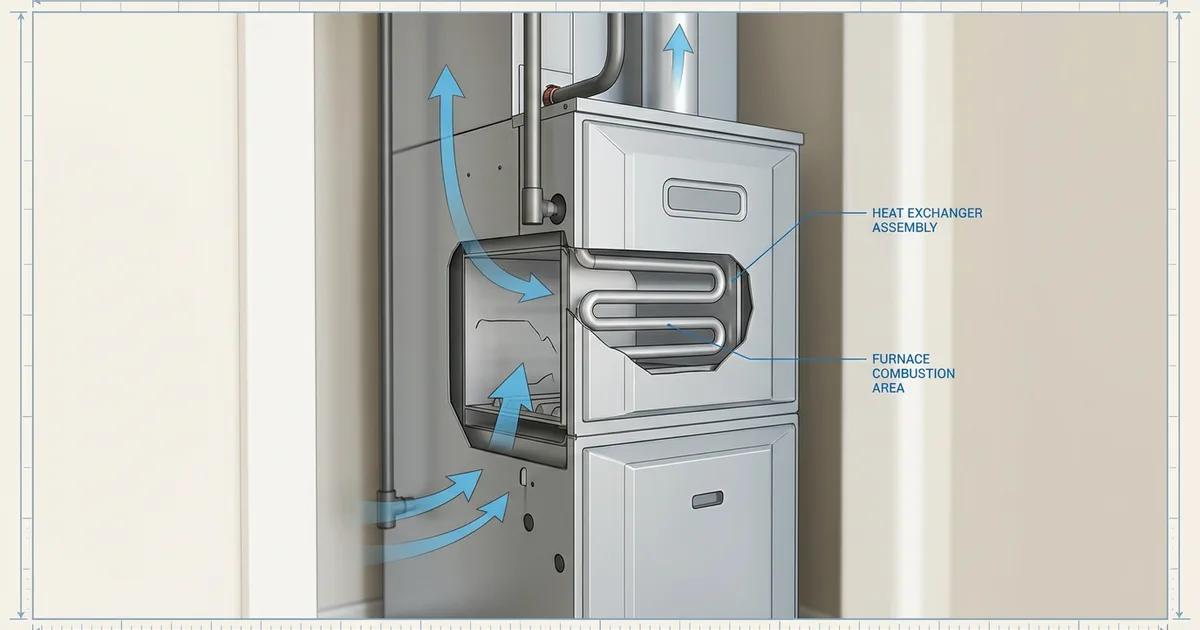
The heat exchanger is the core of your gas furnace — a sealed metal assembly of tubes or clamshells that sits between the burner and the blower. It has one job that splits into two parts: transfer heat into your home's air, and keep combustion gases out of that air.
Here's how it works. Your furnace burners ignite, and the flame heats the inside walls of the heat exchanger. A few minutes later, your blower kicks on and pushes the air in your home across the outside of those hot metal walls. That air warms up and flows through your ducts. Meanwhile, the combustion gases — including carbon monoxide — stay sealed inside the exchanger and travel out through the flue to the outside.
The two airstreams never touch. That separation is the entire point.
A 90%-efficiency "condensing" furnace has a secondary heat exchanger that wrings additional heat out of the exhaust before it exits. An 80%-efficiency furnace has a single primary exchanger. Both designs rely on the same principle: metal walls thick enough and sealed well enough to keep combustion products away from your breathing air.
When the metal develops a crack, that separation fails.
Why a Real Crack Is a Carbon Monoxide Emergency
Carbon monoxide is colorless, odorless, and tasteless. You cannot detect it without an instrument. It displaces oxygen in your blood, and at sufficient concentrations it kills without warning. That's not a sales pitch — it's chemistry.
The risk from a cracked heat exchanger is specific: the blower that pushes air across the exchanger also creates a pressure differential. If there's a crack, that pressure can push air through the gap in the wrong direction, or allow combustion gases to escape into the airstream. How much CO escapes depends on the size and location of the crack, the furnace's operating condition, and how well the home is ventilated.
In 2023, the CDC confirmed that more than 400 Americans die each year from unintentional, non-fire-related CO poisoning, with gas- and oil-burning furnaces listed as one of the primary household sources (CDC, Carbon Monoxide Poisoning Basics, 2023). More than 100,000 Americans visit emergency departments for CO poisoning annually.
The CPSC recommends a yearly professional inspection of all fuel-burning home heating systems, including furnaces, boilers, and their venting — specifically to catch problems like heat exchanger failures before they cause harm (CPSC, Home Heating Equipment Safety).
A confirmed crack is not something to run the furnace through while you think about it. Shut it off and get it addressed.
That said, the word "confirmed" is doing a lot of work in that sentence. Which brings us to the other half of this story.
Why This Diagnosis Gets Abused So Often
The cracked heat exchanger claim is a nearly perfect setup for a dishonest technician. Consider the conditions:
The damaged part is buried deep inside the furnace — you can't see it from the outside. Carbon monoxide is invisible and odorless — you can't smell it yourself. The danger is genuine and frightening — and "your family could be poisoned" is a phrase that shuts down rational thinking fast. In some states, a technician can "red-tag" a furnace — physically lock out the gas — leaving you without heat and under pressure to sign immediately.
Multiple HVAC contractors and consumer advocates have documented this pattern. Companies report routinely dispatching second-opinion calls where another company has condemned a furnace, only to find no crack at all — just an inexpensive failed part like an ignitor or flame sensor. In some documented cases, the photos the original technician showed on a tablet turned out to be images from a different furnace entirely.
Dishonest companies often start the process with a deep-discount or "free" tune-up offer. The tune-up isn't the service — it's the foot in the door. The goal is to get a salesperson into your home legally, find a reason to condemn the system, and close a replacement sale the same day.
Here's the core problem: because the danger is real when a crack exists, the diagnosis carries built-in credibility. That's exactly what makes it exploitable.
How a Real Crack Is Actually Verified
A legitimate heat exchanger diagnosis doesn't rely on one quick look. Here's what proper verification looks like — and what to expect from an honest technician:
Step 1 — Ambient CO Measurement
Before anything else, a thorough tech measures carbon monoxide in your living space while the furnace is running. Any ambient CO reading above zero in the conditioned air warrants investigation. This test costs nothing extra and takes two minutes. It's also the most direct evidence that combustion gases are reaching your air supply.
Step 2 — Flame Observation Test
Your furnace has a built-in delay between burner ignition and blower start. A trained tech watches the burner flame during that transition. Because the burner and heat exchanger should be completely isolated from the airstream, the flame should not move or flicker when the blower turns on. If the flame wavers, bends, or changes color when the blower starts, that's a physical sign of a pressure leak through the exchanger wall — and a reason to investigate further.
Step 3 — Combustion Analysis
A calibrated combustion analyzer measures oxygen, CO levels, and stack temperature at the exhaust. If CO readings shift significantly when the blower kicks on — compared to the baseline taken before the blower started — that change suggests air from the living space is mixing with the combustion chamber through a gap. This is not confirmation of a visual crack, but it is functional evidence of a breach.
Step 4 — Borescope or Camera Inspection
A borescope is a flexible camera that lets a technician see into the heat exchanger through the burner openings without fully disassembling the furnace. High-resolution photos or video give the homeowner visual proof. A legitimate tech can describe exactly where on the exchanger a crack or split seam is located. Blurry, low-contrast images or photos taken from a distance are not adequate documentation.
No single test is definitive on its own. The gold standard is two or more of these methods pointing to the same conclusion, with written documentation.
Real Crack vs. Upsell Red Flag: How to Read the Situation
This table gives you a quick reference for telling a legitimate diagnosis from a pressure sale.
| What you observe | Likely legitimate | Red flag |
|---|---|---|
| Time to diagnosis | 30–60 minutes including multiple tests | Under 10 minutes, single visual check |
| Documentation offered | Written report, photos, CO readings | Verbal claim only, no paperwork |
| Proof shown | Camera footage of the crack location | Blurry tablet photo, no location specified |
| Your options presented | Repair vs. replace, with cost estimates for both | Replacement only, no repair option offered |
| Timeline pressure | "Take 24 hours, get a second opinion" | "Sign today or we can't guarantee your safety" |
| Furnace age | 15+ years, or known history of airflow problems | 5–8 years old, no prior issues |
| CO alarm status | CO detected in living space | No CO detected, furnace running fine |
| Second opinion | Welcomed, company stands behind findings | Discouraged or dismissed |
| Red-tagging furnace | Done with explanation of your rights | Done immediately, before you can ask questions |
One age benchmark worth knowing: heat exchanger cracks in furnaces under 10 years old are genuinely uncommon. Metal fatigue from the expansion-contraction cycle of daily heating typically takes 15–20 years to accumulate to the point of failure, unless there's been a specific stress — chronic restricted airflow from a dirty filter, for example, or an oversized furnace short-cycling. If your furnace is 6 years old and a tech diagnoses a cracked heat exchanger in eight minutes, that deserves scrutiny.
What to Do If You Get This Diagnosis
You do not have to decide the same day. Here's a practical response:
Ask to see the evidence. Request a photo or camera footage showing the exact crack location. A legitimate tech will have this or will take the time to get it. If they can't show you the crack, don't accept the diagnosis.
Ask what tests were run. Did they measure ambient CO? Did they watch the flame during blower startup? Did they use a combustion analyzer? If the answer is "I looked at it and I can tell," that's not a complete diagnosis.
Get a written report. Before anyone leaves your home, ask for documentation of what was found: the test methods used, the results of each test, the specific location of any defect, and a written estimate for both heat exchanger replacement and full furnace replacement if applicable.
Don't panic if the furnace is shut off. You're not obligated to sign anything while you're cold and under pressure. If the tech has red-tagged your unit, you can call a second company to verify the diagnosis before any money changes hands. Honest companies encourage this. Scammers don't.
Call for a second opinion. Find a second licensed, NATE-certified HVAC contractor with verifiable local reviews. Ask them to assess the heat exchanger independently without telling them what the first company said. See if the diagnoses match.
If you're in Sacramento and you've gotten a cracked heat exchanger diagnosis that doesn't feel right, we're happy to come out and take a second look. We'll run the tests, show you what we find, and tell you straight. Call us at (916) 342-9108 or visit our heating system repair page to book a diagnostic visit.
What Happens If the Crack Is Real?
If two independent evaluations agree that your heat exchanger is cracked, take it seriously. You have two options: replace the heat exchanger assembly, or replace the entire furnace.
Patching or sealing a cracked heat exchanger is not a safe repair. Most manufacturers explicitly prohibit it, and it doesn't hold up under the thermal stress of daily heating cycles.
Heat exchanger replacement (the part alone, without replacing the furnace) typically runs $500–$2,000 in parts and labor, depending on the furnace brand and model. Many furnaces — especially mid-range and higher-efficiency models — carry a 20-year or lifetime warranty on the heat exchanger itself. Check your documentation before paying for a replacement part out of pocket.
For furnaces over 15 years old, replacing the exchanger often doesn't make financial sense. You'd be putting significant money into an aging system that may have other failures around the corner. In that case, a full furnace replacement is usually the smarter call — and our heating system repair page walks through how we approach that conversation honestly, without pressure.
If your furnace isn't igniting at all and you're not sure whether it's the heat exchanger or something simpler, our gas furnace not working guide covers the eight most common failure causes you can check yourself before calling anyone.
The Bottom Line
A cracked heat exchanger is a real danger. Carbon monoxide poisoning is serious, and gas furnaces are a documented source. The CPSC and CDC both recommend annual inspections of fuel-burning heating equipment for exactly this reason.
And the cracked heat exchanger diagnosis is also one of the most commonly abused tactics in the residential HVAC industry. Both facts are true.
The way to protect yourself isn't to dismiss every diagnosis or to accept every diagnosis. It's to understand what legitimate verification looks like — ambient CO measurement, flame observation, combustion analysis, borescope documentation — and to insist on seeing that evidence before signing anything.
Ask to see the crack. Get it in writing. Take 24 hours. Call a second company if something feels off.
An honest technician will be fine with all of that. In fact, they'll suggest it.
A-CLASS Heating and Air has served Sacramento homeowners since 2016. We're family-owned and built our business on straight talk, not scare tactics. Questions about your furnace? Call us at (916) 342-9108.
Frequently Asked Questions
Is a cracked heat exchanger dangerous?
Yes, a confirmed crack is a genuine safety issue. The heat exchanger separates combustion gases from your breathing air. A crack can allow carbon monoxide to enter your home's airstream. The CDC reports more than 400 Americans die each year from unintentional, non-fire-related CO poisoning. Get any suspected crack verified by a licensed tech using multiple diagnostic methods.
Can you run a furnace with a cracked heat exchanger?
You should not. Running a furnace with a confirmed cracked heat exchanger risks carbon monoxide entering your living space. CO is odorless and colorless — you won't notice until symptoms appear. Shut the furnace off, open windows if you suspect CO exposure, and call a licensed HVAC technician. Install CO alarms on every floor if you don't already have them.
How do you know if a heat exchanger is really cracked?
A legitimate diagnosis uses at least two independent methods: ambient CO measurement in the living space while the furnace runs, a flame observation test when the blower starts, combustion analysis with a calibrated analyzer, and a borescope or camera inspection of the exchanger surface. A tech who calls a crack based on a 2-minute visual look alone is not giving you a complete diagnosis.
Should I get a second opinion on a cracked heat exchanger diagnosis?
Yes, always. The cracked heat exchanger call is one of the most commonly abused diagnoses in the HVAC industry. Multiple HVAC contractors report finding nothing wrong after another company condemned a furnace. Ask the second company to document their findings in writing with photos. A furnace under 10 years old with a claimed crack deserves especially close scrutiny.
How much does it cost to fix a cracked heat exchanger?
If a crack is confirmed, the exchanger itself cannot be patched — that is not a safe repair. Options are replacing the heat exchanger (typically $500–$2,000 in parts and labor, depending on furnace brand and model) or replacing the entire furnace. For furnaces over 15 years old, full replacement usually makes more financial sense than a heat exchanger swap.
What are the red flags of a heat exchanger scam?
Watch for a technician who refuses to show you the crack, pushes same-day replacement with no written estimate, condemns the furnace within minutes of arrival, or discourages a second opinion. Real HVAC pros document their findings with photos, explain what test they ran, and give you time to think. Pressure and urgency are the clearest warning signs.