
Heating System Installation: A Sacramento Homeowner's Guide
Picking a new heating system is one of the bigger home decisions you'll make — not because it's complicated, but because the wrong choice follows you for the next 15 to 20 years. Sacramento homeowners have a real advantage here: our mild winters mean more system options work well, and local incentives through SMUD make the math friendlier than in most of California. This guide walks you through the main system types, realistic costs, permit requirements, and how to work through the installation process without overpaying or undersizing.
Key Takeaways
- Gas furnaces cost $3,500–$8,000 installed; heat pump systems run $6,000–$13,000 for most Sacramento homes.
- Sacramento's mild winters (rarely below 35°F) put the area squarely in heat pump territory.
- SMUD now offers up to $3,000 for gas-to-electric heat pump conversions (effective February 2026).
- Every heating installation in Sacramento requires a permit and Title 24 compliance under California's 2025 Energy Code.
- Proper sizing via Manual J load calculation is non-negotiable — oversizing costs you money every month.
Which Heating System Is Right for a Sacramento Home?
Sacramento's Climate Zone 12 sits in a sweet spot: hot summers, short mild winters, and overnight lows that rarely touch freezing. That climate profile means all three major residential heating system types can work here — but they don't all work equally well for every household.
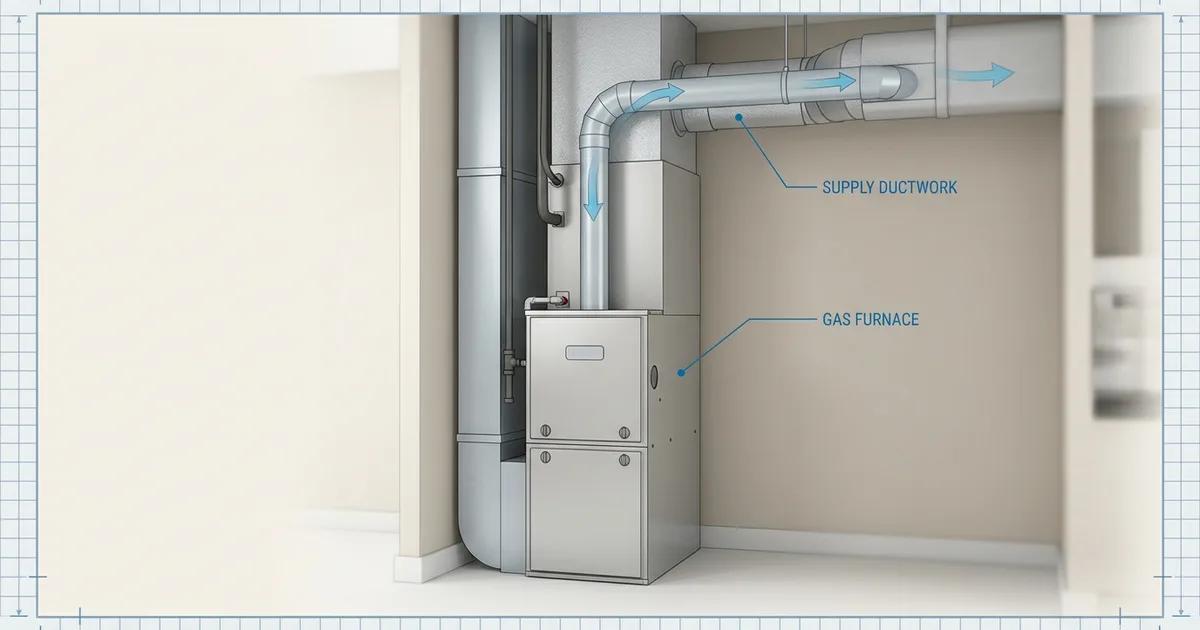
Gas furnaces are what most Sacramento homes already have. They produce high-temperature supply air (110°F–130°F) and recover room temperature quickly on cold mornings. Modern condensing furnaces operate at 95%–98% AFUE, meaning they convert 95 to 98 cents of every dollar of gas into usable heat (U.S. Department of Energy, energy.gov/save, 2025). The downside: you're tied to a natural gas connection, and California is moving steadily toward electrification.
Heat pumps move heat rather than generate it, which makes them dramatically more efficient than any combustion system. In 2026, the federal minimum HSPF2 rating for a split-system heat pump is 7.5, but most Energy Star-qualified models land between 8.2 and 13 HSPF2 (DOE HVAC Standards, energy.gov, 2026). The U.S. Department of Energy notes that modern air-source heat pumps can reduce electricity used for heating by up to 75% compared to electric resistance baseboard heaters. For Sacramento homeowners on SMUD's grid — where electric rates run roughly 58% lower than PG&E according to industry comparisons — a heat pump is often the most cost-effective long-term choice.
Dual-fuel systems pair a heat pump with a gas furnace. The heat pump handles all the heating work above 35°F–40°F; the furnace takes over during the coldest stretches. For Sacramento, that means the furnace might fire only a handful of nights per winter, while the heat pump runs 90%+ of the heating season. This hybrid approach gives you heat pump efficiency when it matters most and gas backup for peace of mind.
Heating System Comparison: Cost, Efficiency, and Fit for Sacramento
The table below compares the three main options side by side using Sacramento-area cost data and current efficiency standards.
| System Type | Installed Cost (Sacramento) | Efficiency Rating | Best Fit | Typical Lifespan |
|---|---|---|---|---|
| Gas Furnace (80% AFUE) | $3,500–$6,000 | 80% AFUE | Budget-conscious; existing gas line | 15–20 years |
| Gas Furnace (96% AFUE) | $5,500–$8,000 | 96–98% AFUE | Cold nights; older home with good ducts | 15–20 years |
| Heat Pump (standard) | $6,000–$11,000 | 8.2–10.5 HSPF2 | SMUD customers; replacing AC + heat together | 15–20 years |
| Heat Pump (variable-stage) | $9,000–$13,000 | 10.0–13.0 HSPF2 | Maximum efficiency; qualifies for $3,000 SMUD rebate | 15–20 years |
| Dual-Fuel (heat pump + furnace) | $12,000–$18,000 | Combined | Best of both; older home with good gas supply | 15–20 years |
Sources: HVAC Pulse, Sacramento heat pump cost data, 2026; Clarke & Rush, Sacramento furnace replacement costs, 2025; DOE Residential HVAC Standards, 2026.
What Does Heating System Installation Cost in Sacramento?
In Sacramento, a standard heating system installation runs $6,000 to $13,000 for a heat pump or $3,500 to $8,000 for a gas furnace replacement, according to local contractor pricing data (HVAC Pulse, 2026; Clarke & Rush, 2025). Premium heat pump installs — variable-stage equipment, panel upgrade, new air handler — can reach $20,000 in complex situations. Several cost factors drive that range.
Equipment tier. A variable-stage heat pump costs $2,000–$4,000 more than a standard two-stage model. The efficiency difference (roughly 10–13 HSPF2 versus 8.2–10 HSPF2) can mean $100–$200 in annual energy savings, so the payback period runs 10–20 years. Run the math with your contractor using your actual utility rates.
Electrical panel capacity. Heat pumps draw more peak amperage than gas furnaces. Homes in Land Park, East Sacramento, and Midtown built before 1980 often have 100-amp panels that need upgrading before a heat pump can be installed. Panel upgrades add $1,500–$4,000 to the project, though SMUD's $2,000 Go Electric bonus partially offsets that cost for qualifying customers.
Ductwork condition. If your ducts haven't been sealed in a decade or more, expect to spend $500–$2,000 on duct sealing and insulation to meet Title 24 requirements. HERS duct-leakage testing is mandatory for most Sacramento heating installations — your contractor schedules a certified HERS rater to verify the duct system before the permit is closed.
Labor and permits. Labor accounts for roughly 30%–40% of a typical installation quote. Sacramento permit fees for HVAC work run $200–$500 through the City or County building department, depending on project scope.
According to local contractor estimates, a mid-range heat pump installation — 3-ton variable-stage unit, existing ductwork in decent shape, standard electrical panel — lands around $10,000–$12,000 before rebates. After a $3,000 SMUD rebate, the net cost drops to $7,000–$9,000. That's competitive with a high-efficiency gas furnace install when you factor in eliminating the AC replacement cost.
How SMUD Rebates Cut Your Net Installation Cost
In February 2026, SMUD boosted its rebate amounts specifically to offset the expiration of federal tax credits. As of that announcement, SMUD offers (SMUD, smud.org, February 2026):
- $3,000 for a variable-stage gas-to-electric heat pump HVAC conversion
- $2,000 for a two-stage heat pump (15.2 SEER2 minimum) gas-to-electric conversion
- $1,000 for an electric-to-electric heat pump upgrade
- $2,000 Go Electric bonus for a qualifying electrical panel upgrade at the same time
According to SMUD's Chief Zero Carbon Officer, heat pumps deliver roughly $500 per year in real energy savings for average Sacramento households. At that rate, the equipment upgrade pays for itself faster when you stack the utility rebate with lower monthly operating costs.
To qualify, you must be an active SMUD customer with individually metered service and use a contractor enrolled in the SMUD Contractor Network. Your contractor submits the rebate application after installation; in many cases they'll offer the rebate amount upfront and collect directly from SMUD.
For current program details and to search the contractor network, visit smud.org/GoElectric.
Do You Need a Permit for Heating Installation in Sacramento?
Yes — every heating system installation or replacement in Sacramento requires a permit, and skipping this step is one of the costliest mistakes a homeowner can make.
Permits in Sacramento are issued by the City of Sacramento Community Development Department (for addresses within city limits) or Sacramento County's Building Division (for unincorporated areas). Before your contractor starts work, confirm which jurisdiction applies to your address — the rules are the same, but different offices handle applications.
What Title 24 means for your project. California's Building Energy Efficiency Standards (Title 24, Part 6) set the technical rules for any permitted HVAC installation. Projects with permit applications submitted on or after January 1, 2026 must comply with the 2025 Energy Code, which pushes heat pumps as the baseline for new construction and encourages electric-readiness in residential retrofits (California Energy Commission, energy.ca.gov, 2025).
HERS testing is mandatory. Under Title 24, duct systems must be sealed and tested for leakage in all California climate zones, including Sacramento's Zone 12. A certified HERS (Home Energy Rating System) rater — a third-party inspector, not your contractor — performs the leakage test and files verification with the state. Plan for $250–$500 for HERS testing on top of your permit fee.
Who pulls the permit. Your contractor should pull the permit, not you. A licensed C-20 Warm-Air Heating, Ventilating and Air-Conditioning contractor is required for jobs totaling $500 or more. If a contractor asks you to pull your own permit or suggests skipping it, that's a red flag.
For Sacramento permit questions, reach the City's building department at cityofsacramento.gov/community-development or the County at building.saccounty.gov. The California Energy Commission also runs a free Energy Code Hotline at 800-772-3300 if you have technical Title 24 questions.
How Do You Size a Heating System for a Sacramento Home?
Sizing is where a good installation lives or dies. An oversized furnace short-cycles — it heats the house quickly, shuts off, and repeats, which wastes energy, creates humidity problems, and puts extra wear on the heat exchanger. An undersized system runs constantly on cold mornings and never quite gets there.
The right approach is a Manual J residential load calculation, which accounts for:
- Square footage and ceiling height
- Insulation levels in walls, attic, and floors
- Window area, orientation, and glazing type
- Ductwork layout and location (attic ducts gain or lose heat differently than those in conditioned space)
- Sacramento's climate design data (cooling design temp: ~100°F; heating design temp: ~29°F)
As a rough rule of thumb, Sacramento homes typically need 25–30 BTUs of heating capacity per square foot, but that number swings significantly based on the factors above. A 2,000 sq ft home with poor attic insulation and single-pane windows may need 70,000 BTUs; the same footprint with modern insulation and dual-pane glass might need only 50,000 BTUs.
Ask any contractor for their Manual J before agreeing to equipment size. If they refuse to do one, find a different contractor.
For heat pump sizing specifically: The heat pump's tonnage is sized for the cooling load (Sacramento summers hit 100°F regularly, so this drives the number). The heating performance follows from that tonnage selection. A HSPF2 rating of 8.1 or higher qualifies for SMUD rebates; variable-stage units that hit 10+ HSPF2 qualify for the $3,000 tier.
What Happens During a Heating System Installation?
A well-run heating installation follows a consistent sequence. Here's what to expect when you hire a licensed HVAC contractor in Sacramento.
Step 1: Site assessment and load calculation. A good contractor visits your home, measures the space, checks ductwork condition, inspects the electrical panel, and runs the Manual J before quoting. This visit is the foundation of everything else.
Step 2: Permit application. Your contractor submits an application to the City or County building department with equipment specs and site details. Permit approval typically takes a few business days for residential HVAC work in Sacramento.
Step 3: Installation day (1–2 days). For a gas furnace replacement using existing ductwork, expect one day. A heat pump installation that includes a new air handler, refrigerant lines, electrical connections, and thermostat wiring typically takes two days. The contractor will also seal accessible duct connections with mastic or UL-rated tape to prepare for HERS testing.
Step 4: HERS duct-leakage test. A certified HERS rater performs the leakage test independently of your contractor. The system must meet Title 24 leakage limits before the permit can be finaled. Your contractor should schedule this test as part of the project — it's not your responsibility to chase it down.
Step 5: Permit final inspection. A city or county building inspector visits to verify the installation matches the permitted plans and meets code. Once they sign off, the permit is closed and your installation is legally complete.
Step 6: System commissioning and walkthrough. Before leaving, your contractor should run the system through heating and cooling cycles, verify airflow at each register, confirm thermostat programming, and walk you through filter replacement and maintenance schedules.
The full process from permit application to final inspection typically runs 1–2 weeks. The physical installation itself is 1–2 days.
Should You Repair or Replace Your Old Heating System?
A heating system replacement is a significant investment, so it's worth making sure it's actually necessary. The HVAC industry uses a simple rule of thumb: multiply the repair quote by the system's age. If that number exceeds $5,000, replacement is almost always the better financial call — you're paying serious money to extend the life of a system that's already aging out.
For Sacramento homeowners specifically:
- Gas furnaces last 15–20 years. A 17-year-old furnace that needs a $600 heat exchanger repair probably has 3–5 years left. At that age, you're better off putting that money toward a new install.
- Heat pumps last 15–20 years as well, with compressors typically needing replacement at the 12–15 year mark if the system hasn't been maintained.
- If your heating system predates California's current efficiency standards (pre-2015 equipment), upgrading to a modern system can reduce heating energy use by 20%–30%.
For a deeper look at the repair-or-replace decision, read our AC repair vs. replacement guide — the same financial logic applies to heating systems.
Ready to Install a New Heating System in Sacramento?
A-CLASS Heating and Air has been installing and replacing heating systems for Sacramento families since 2016. We're a family-owned shop — not a franchise — and we don't work on commission. That means you get an honest recommendation based on your home, your utility, and your budget, not the product that pays us the best margin.
We pull every permit, perform Manual J load calculations on every job, and submit SMUD rebate paperwork for qualifying customers. Call us at (916) 342-9108 or visit our heating system installation page for pricing details and to schedule a free in-home assessment. We serve Sacramento, Elk Grove, Rancho Cordova, Citrus Heights, Folsom, and surrounding areas.
Frequently Asked Questions
How much does a new furnace cost in Sacramento?
A new gas furnace installed in a Sacramento home typically costs $3,500 to $8,000 for equipment and labor, assuming existing ductwork is in good shape. High-efficiency condensing furnaces (96% AFUE) run toward the top of that range. Adding duct repairs or a new air handler can push the total higher. Get at least two on-site quotes for an accurate figure.
Is a furnace or heat pump better for Sacramento?
For most Sacramento homes, a heat pump is the better choice. Sacramento winters rarely drop below 35°F, which is well within the comfortable operating range of a modern heat pump. SMUD customers in particular benefit from lower electric rates and rebates up to $3,000. Homeowners who want maximum backup heat capacity sometimes choose a dual-fuel system that pairs both.
How long does heating installation take?
A standard heating system installation in Sacramento takes one to two days for a licensed HVAC contractor. Replacing a furnace in an existing duct system is typically a one-day job. Installing a heat pump that includes new refrigerant lines, an air handler, and electrical work can run into a second day. Permit inspections are scheduled separately and add a few days to the overall timeline.
Do I need a permit to install a heater in Sacramento?
Yes. Sacramento requires a permit for any heating system installation or replacement. Work is performed under California Title 24, Part 6 energy standards, and most installations also require HERS duct-leakage testing by a certified rater. Your contractor should pull the permit before starting. Never let a contractor skip this step.
What SMUD rebates are available for heating installation?
As of February 2026, SMUD offers up to $3,000 for a variable-stage gas-to-electric heat pump conversion and $2,000 for a qualifying two-stage system. An electric-to-electric upgrade earns $1,000. A separate $2,000 Go Electric bonus applies if you also upgrade your electrical panel. Your contractor must be in the SMUD Contractor Network to submit the rebate.
What size heating system do I need for my Sacramento home?
A licensed HVAC contractor sizes your heating system using a Manual J load calculation that accounts for your home's square footage, insulation level, window area, and orientation. As a rough starting point, Sacramento homes typically need 25 to 30 BTUs of heating capacity per square foot. Avoid any contractor who sizes a system by the old unit's label alone without measuring.
A-CLASS Heating and Air — Sacramento, CA — (916) 342-9108 — Licensed, Bonded, and Insured — C-20 HVAC Contractor
Also see: SMUD Rebates & California HVAC Incentives | New AC Installation Cost in California
Frequently Asked Questions
How much does a new furnace cost in Sacramento?
A new gas furnace installed in a Sacramento home typically costs $3,500 to $8,000 for equipment and labor, assuming existing ductwork is in good shape. High-efficiency condensing furnaces (96% AFUE) run toward the top of that range. Adding duct repairs or a new air handler can push the total higher. Get at least two on-site quotes for an accurate figure.
Is a furnace or heat pump better for Sacramento?
For most Sacramento homes, a heat pump is the better choice. Sacramento winters rarely drop below 35°F, which is well within the comfortable operating range of a modern heat pump. SMUD customers in particular benefit from lower electric rates and rebates up to $3,000. Homeowners who want maximum backup heat capacity sometimes choose a dual-fuel system that pairs both.
How long does heating installation take?
A standard heating system installation in Sacramento takes one to two days for a licensed HVAC contractor. Replacing a furnace in an existing duct system is typically a one-day job. Installing a heat pump that includes new refrigerant lines, an air handler, and electrical work can run into a second day. Permit inspections are scheduled separately and add a few days to the overall timeline.
Do I need a permit to install a heater in Sacramento?
Yes. Sacramento requires a permit for any heating system installation or replacement. Work is performed under California Title 24, Part 6 energy standards, and most installations also require HERS duct-leakage testing by a certified rater. Your contractor should pull the permit before starting. As the homeowner you should never let a contractor skip this step.
What SMUD rebates are available for heating installation?
As of February 2026, SMUD offers up to $3,000 for a variable-stage gas-to-electric heat pump conversion and $2,000 for a qualifying two-stage system. An electric-to-electric upgrade earns $1,000. A separate $2,000 Go Electric bonus applies if you also upgrade your electrical panel. Your contractor must be in the SMUD Contractor Network to submit the rebate.
What size heating system do I need for my Sacramento home?
A licensed HVAC contractor sizes your heating system using a Manual J load calculation that accounts for your home's square footage, insulation level, window area, and orientation. As a rough starting point, Sacramento homes typically need 25 to 30 BTUs of heating capacity per square foot. Avoid any contractor who sizes a system by the old unit's label alone without measuring.