
Is It Worth Replacing a 30-Year-Old Furnace?
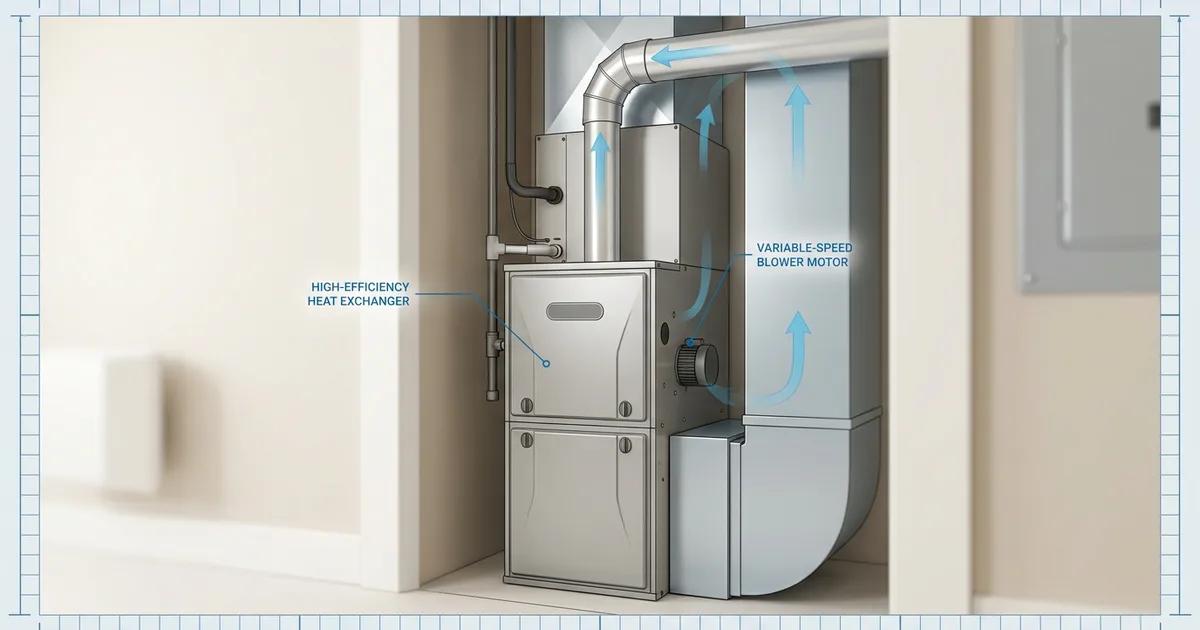
Your furnace has been running since before smartphones existed. It heats the house, hasn't broken down in a year or two, and the idea of spending $4,000 to $7,000 on a replacement feels hard to justify when it still starts every morning. That instinct is understandable. It's also frequently wrong.
A furnace that's 30 years old is not just old — it's operating under a fundamentally different set of rules than any unit you'd buy today. The efficiency gap is massive. The safety profile has deteriorated. Parts for units that old are genuinely hard to source. This post looks at each of those factors honestly so you can make a clear-eyed call about whether to replace your 30-year-old furnace or keep nursing it along.
For the general repair-or-replace math that applies to younger systems, see our repair-or-replace guide for AC and HVAC. This post focuses specifically on the case for furnaces that have already outlasted their design life by a decade or more.
Key Takeaways
- ENERGY STAR advises replacement for any furnace older than 15 years; a 30-year-old unit is already 10 to 15 years past that window.
- Pre-1992 furnaces run at 56%–70% AFUE; modern condensing units reach 96%–98.5%, per U.S. Department of Energy.
- Upgrading from 56% to 90% AFUE "can often cut your fuel bills and your furnace's pollution output in half," according to DOE's Energy Saver program.
- CO risk increases with furnace age; CPSC estimates more than 200 Americans die annually from non-fire CO poisoning tied to consumer products, with heating equipment a top category.
- Sacramento homeowners replacing gas furnaces with heat pumps may qualify for up to $3,000 in SMUD rebates (funding-dependent).
Is 30 Years Too Old for a Furnace?
Yes — by any standard measure, a 30-year-old furnace has already outlived what it was engineered to do. ENERGY STAR explicitly recommends considering replacement when a furnace is more than 15 years old (ENERGY STAR, energystar.gov/saveathome/heating-cooling/replace). That guidance exists not because the unit will necessarily stop working on year 16, but because the cumulative wear on heat exchangers, burners, and control boards makes performance unpredictable and safety inspection harder.
A 30-year-old furnace has run through thousands of heating cycles. Each one expands and contracts the heat exchanger — the metal chamber that separates combustion gases from the air circulating through your home. Over decades, that stress creates micro-cracks. Those cracks don't announce themselves. They let carbon monoxide and combustion byproducts into your living space silently.
That's the safety argument in plain terms. The efficiency argument is just as stark, and we'll cover it in detail below.
What the Industry's Own Design Life Says
The CPSC's 2023 proposed safety rulemaking for residential gas furnaces references an engineering expectation of 20 years as the outer design life for these systems (Federal Register, 88 FR 73272, October 2023). By that standard, your 30-year-old unit isn't aging gracefully — it's operating in territory that engineers didn't intend it to reach.
How Much Efficiency Are You Losing With an Old Furnace?
The numbers here are not subtle. According to the U.S. Department of Energy's Energy Saver program, older natural-draft furnaces with continuous pilot lights — common in units from the 1980s and early 1990s — run at 56% to 70% AFUE (DOE, www.energy.gov/save). AFUE stands for Annual Fuel Utilization Efficiency. A 60% AFUE rating means 40 cents out of every dollar you pay for gas escapes as waste heat through the flue.
Modern condensing furnaces reach 96% to 98.5% AFUE, meaning less than 4 cents per dollar is wasted. The DOE is direct about what that gap means in practice: upgrading from 56% AFUE to 90% AFUE "can often cut your fuel bills and your furnace's pollution output in half." (DOE Energy Saver, 2024).
| Factor | 30-Year-Old Furnace (Typical) | Modern High-Efficiency Furnace |
|---|---|---|
| AFUE Rating | 56%–70% | 95%–98.5% |
| Fuel Wasted per $1 Spent | 30–44 cents | 1.5–5 cents |
| Pilot Light | Continuous (always burning gas) | Electronic ignition (no pilot) |
| Flue Type | Natural draft (open combustion) | Sealed PVC (condensing) |
| Federal Minimum Standard | Pre-standard (before 1992 regulations) | 80% now; 95% required by Dec 2028 |
| Parts Availability | Increasingly scarce | Full manufacturer support |
| Annual Inspection Risk | Heat exchanger cracks common | Sealed combustion, lower CO exposure |
| Estimated Sacramento Savings vs. Old Unit | Baseline | $150–$350/year in fuel savings |
What That Means for a Sacramento Home
Sacramento sits in a mild-winter zone — your furnace doesn't run as many hours as one in Minneapolis. That means absolute dollar savings from upgrading are more modest than cold-climate examples you'll find quoted online. A realistic estimate for a Sacramento single-family home: $150 to $350 per year in natural gas savings after replacing a 60% AFUE furnace with a 96% AFUE unit, based on California Energy Commission residential heating data and current PG&E gas rates (PG&E Gas Rate Advisory, January 2026).
At $250 per year in savings, a $5,000 replacement pays for itself in fuel savings alone in 20 years — roughly the lifespan of the new equipment. Add in avoided repair costs on a failing 30-year-old unit and the math shifts further toward replacement.
Our take at A-CLASS: We've pulled apart furnaces in Sacramento that were running at effective AFUEs well below their nameplate rating because of degraded heat exchangers and dirty burners. A 65% AFUE unit with a partially cracked exchanger and fouled burner assembly can behave more like a 50% unit in practice. The nameplate number on a 30-year-old furnace is optimistic.
Is a 30-Year-Old Furnace a Carbon Monoxide Risk?
This is where the conversation gets serious. The CDC reports that more than 400 Americans die each year from unintentional CO poisoning not linked to fires, with more than 100,000 visiting emergency rooms and more than 14,000 hospitalized annually (CDC, Carbon Monoxide Poisoning Basics, cdc.gov/carbon-monoxide). The CPSC estimates more than 200 of those deaths each year are linked specifically to consumer products — with heating equipment consistently the second-largest category after portable generators (CPSC, Carbon Monoxide Research and Statistics, cpsc.gov).
The primary failure mode in aging furnaces is a cracked heat exchanger. That's the component that keeps combustion gases — CO, nitrogen oxides, and other byproducts — separated from the air your system distributes through every room in your house. In a new furnace, that barrier is intact. In a 30-year-old furnace that has cycled through thousands of heating seasons, cracks are a realistic risk, not a remote one.
For a detailed explanation of what a cracked heat exchanger looks like, how technicians diagnose it, and why some contractors miss it, see our cracked heat exchanger post.
What the CDC Recommends
The CDC recommends having your heating system serviced by a qualified technician every single year. That recommendation exists precisely because visual inspection of a heat exchanger is the only reliable way to catch a crack before it becomes a health emergency. A CO detector is not a substitute — it's a last line of defense, not a diagnostic tool.
The honest reality: annual inspections on a 30-year-old furnace are harder and less reliable than on newer equipment. Heat exchangers in older natural-draft units are more complex to inspect fully, and some cracks only open up under thermal load — meaning a cold-bench inspection can miss them.
What we see in the field: When we inspect furnaces older than 25 years in Sacramento, heat exchanger condition is the first thing we check. We find cracks or stress fractures often enough that we treat any pre-1995 unit as a presumptive risk until proven otherwise. That's not alarmism — it's the math of thermal cycling over three decades.
Can You Still Get Parts for a 30-Year-Old Furnace?
Sourcing parts for a furnace manufactured before 1996 is genuinely difficult. Control boards, ignitors, and heat exchangers for units that old are either discontinued entirely or available only through specialty salvage suppliers — and at prices that can make a single repair approach $800 to $1,500 for parts alone before labor.
The CPSC's own rulemaking documentation from October 2023 noted that engineers designing modern CO safety standards reference a 20-year design life expectation for residential furnaces (Federal Register, 88 FR 73272). A system that has run 10 years past that design life has also outlasted the parts supply chain that was built around it.
Practically speaking: if your 30-year-old furnace fails mid-winter, you may face a choice between an extended wait for an obscure part or an emergency replacement at less-than-ideal pricing and timing. Replacing on your terms, with time to get multiple quotes and pick the right equipment, is a better position to be in.
What Does It Cost to Replace a 30-Year-Old Furnace in Sacramento?
A new gas furnace installation in Sacramento typically runs $3,500 to $7,000 installed, depending on unit size, efficiency tier, and any ductwork modifications needed. High-efficiency condensing units (95%+ AFUE) are priced at the upper end of that range but deliver the efficiency gains described above.
If you're open to a heat pump instead of a gas furnace replacement, the economics look different. Sacramento's mild winters make heat pumps particularly effective here — and SMUD currently offers up to $3,000 in rebates for variable-stage heat pump HVAC installations replacing a gas furnace, with an additional $2,000 Go Electric bonus if a panel upgrade is needed (SMUD, Heating and Cooling Rebates, smud.org). Those rebates are subject to funding availability, so call SMUD at 916-732-7550 to confirm before making a decision.
The IRA Section 25C federal tax credit (30%, up to $600 on qualifying 97%+ AFUE gas furnaces) expired December 31, 2025. If you had a qualifying furnace installed in 2025, you can still claim it on your 2025 tax return via IRS Form 5695. Installations in 2026 do not qualify (ENERGY STAR, Furnaces Tax Credits, energystar.gov).
TECH Clean California single-family heat pump incentives are fully reserved as of February 2026 and not accepting new applications (TECH Clean California, techcleanca.com). That program may reopen — check switchison.org for updates.
For a new heating system installation quote from A-CLASS, visit our heating system installation page.
The Keep-vs-Replace Verdict at 30 Years
Based on the efficiency, safety, reliability, and parts-availability evidence, the case to replace a 30-year-old furnace is strong across every dimension that matters to a Sacramento homeowner.
| Decision Factor | Keep the Old Furnace | Replace Now |
|---|---|---|
| Efficiency | 56%–70% AFUE — 30–44 cents per gas dollar wasted | 95%–98.5% AFUE — under 5 cents wasted |
| CO / Safety Risk | Cracked heat exchanger risk real; inspection harder on old units | Sealed combustion; lower inherent risk; easier to inspect |
| Reliability | Parts scarce; failure risk increases each year past design life | New warranty (typically 10-year heat exchanger, 5-year parts) |
| Annual Repair Cost | Rising; each repair is a gamble on next failure | Predictable maintenance cost only |
| Sacramento Rebates | None applicable to keeping old equipment | Up to $3,000 SMUD rebate (heat pump); $2,000 Go Electric bonus |
| Fuel Savings | Baseline | $150–$350/year vs. 60% AFUE unit (DOE formula, PG&E rates) |
| Peace of Mind | Requires annual inspection; CO detectors mandatory | Dramatically reduced CO risk from combustion equipment |
The only legitimate reason to keep a 30-year-old furnace running is if it passed a thorough inspection this season, the heat exchanger is confirmed crack-free, and you have a specific financial constraint that makes replacement genuinely impossible right now. In that case, get a CO detector on every floor, schedule an inspection each fall, and budget for replacement in the next 12 to 24 months.
Otherwise, you're spending real money on efficiency losses every month you wait — plus carrying safety and reliability risk that compounds with each heating season.
Frequently Asked Questions
How long does a furnace last?
ENERGY STAR recommends considering replacement when a furnace is more than 15 years old (ENERGY STAR, energystar.gov). Most gas furnaces are designed for a 15- to 20-year lifespan. A 30-year-old unit has already run 10 to 15 years past that guidance, meaning reliability and safety concerns are both legitimate — not hypothetical.
Is an old furnace dangerous?
An aging gas furnace carries meaningful CO risk. The CDC links more than 400 non-fire CO deaths per year to all causes; the CPSC connects more than 200 annual deaths to consumer products, with heating equipment a consistent top category (CPSC, cpsc.gov/Research--Statistics/Carbon-Monoxide). A cracked heat exchanger — increasingly likely in 30-year-old units after thousands of thermal cycles — allows combustion gases to enter your home's air supply. Annual professional inspection and working CO detectors are non-negotiable for any furnace over 15 years old. For more on heat exchanger failure, see our cracked heat exchanger guide.
How much can a new furnace save on energy bills?
A pre-1992 furnace may run at 56%–70% AFUE per DOE data. Replacing with a 96% AFUE unit eliminates most of that waste. The DOE states that the upgrade from 56% to 90% AFUE can often cut fuel bills in half (DOE Energy Saver, energy.gov). For Sacramento's mild winters, a realistic annual savings estimate is $150–$350 depending on home size, gas usage, and current PG&E rates.
What AFUE should a new furnace have?
ENERGY STAR certifies furnaces at 95% AFUE or higher in northern states and 90%+ in California (ENERGY STAR, energystar.gov/products/furnaces). A 2023 DOE rule sets the national minimum at 95% AFUE starting December 2028, up from the current 80% standard (DOE, energy.gov). For Sacramento homeowners replacing now, targeting 95% or higher locks in the best long-term efficiency and ensures the unit meets the incoming standard.
Should I replace my furnace with a heat pump?
Sacramento's climate is genuinely well-suited for heat pumps. Mild winters mean a heat pump can handle most heating load efficiently, and SMUD's current rebate program offers real incentive for gas-to-electric conversion. That said, heat pump installation typically costs $2,000 to $4,000 more than a straight furnace swap. The right answer depends on your current utility rates, SMUD versus PG&E service area, and long-term plans for the home. Ask your contractor to model both scenarios before deciding.
A-CLASS Heating and Air has been servicing Sacramento-area homes since 2016. If your furnace is pushing 30 years and you're not sure where it stands, call us at (916) 342-9108 for an honest inspection — no pressure, no upsell, just a clear read on what you're working with. You can also learn more about our heating system installation services if you're ready to talk replacement options.
Sources cited:
- U.S. Department of Energy, Energy Saver — Furnaces and Boilers, www.energy.gov/save
- U.S. Department of Energy, DOE Finalizes Furnace Efficiency Standards (Dec 2023), energy.gov/articles/doe-finalizes-energy-efficiency-standards-residential-furnaces-save-americans-15-billion
- ENERGY STAR, When Is It Time to Replace Your Heating or Cooling System?, energystar.gov/saveathome/heating-cooling/replace
- ENERGY STAR, Furnaces Key Product Criteria, energystar.gov/products/furnaces/key_product_criteria
- ENERGY STAR, Federal Tax Credits — Furnaces (Natural Gas, Oil), energystar.gov/about/federal-tax-credits/furnaces-natural-gas-oil
- Appliance Standards Awareness Project, Furnaces (2025), appliance-standards.org/product/furnaces
- CDC, Carbon Monoxide Poisoning Basics, cdc.gov/carbon-monoxide/about/index.html
- CPSC, Carbon Monoxide Research and Statistics, cpsc.gov/Research--Statistics/Carbon-Monoxide
- Federal Register, CPSC Proposed Safety Standard for Residential Gas Furnaces and Boilers, 88 FR 73272, Oct 25 2023, federalregister.gov/documents/2023/10/25/2023-23302
- PG&E, Gas Rate Advisory January 2026, pge.com/assets/pge/docs/account/rate-plans/gas-rate-advisory-0126.pdf
- SMUD, Heating and Cooling Rebates, smud.org/Rebates-and-Savings-Tips/Rebates-for-My-Home/Heating-and-Cooling-Rebates
- TECH Clean California, Single Family Incentives, techcleanca.com/incentives/single-family-incentives
Frequently Asked Questions
How long does a furnace last?
ENERGY STAR recommends considering replacement when a furnace is more than 15 years old. Most gas furnaces last 15 to 20 years with annual maintenance. A 30-year-old unit has already exceeded the expected lifespan by 10 to 15 years, making reliability and safety concerns significant factors in the replacement decision.
Is an old furnace dangerous?
An aging furnace carries real CO risk. The CPSC estimates more than 200 Americans die annually from non-fire CO poisoning linked to consumer products, with heating equipment a consistent top category. Cracked heat exchangers in old furnaces allow combustion gases to mix with household air. Annual inspections are critical for any furnace over 15 years old.
How much can a new furnace save on energy bills?
A furnace manufactured before 1992 may run as low as 56% AFUE. Replacing it with a modern 96% AFUE unit can cut fuel waste by roughly 40%. The U.S. Department of Energy states that upgrading from 56% to 90% AFUE can often cut fuel bills in half. In Sacramento, realistic annual savings range from $150 to $350 depending on home size and usage.
What AFUE should a new furnace have?
ENERGY STAR certifies gas furnaces at 95% AFUE or greater in northern states and 90% AFUE or greater in California and the South. A new DOE rule effective in December 2028 sets the national minimum at 95% AFUE. For Sacramento homeowners replacing now, targeting 95% or higher delivers the best return on a long-term investment.