
Mini-Split Systems: A Sacramento Homeowner's Guide
Sacramento summers push past 100°F for weeks. Older homes in Curtis Park, Land Park, or Oak Park often have no ductwork at all — just old gas wall heaters that do nothing in August. Homeowners adding a backyard ADU or converting a garage face a real question: what's the smartest way to heat and cool a space that the existing system was never designed to reach?
A mini-split system is often the answer. It's a ductless heating and cooling unit that connects a small outdoor compressor to one or more indoor air handlers through a three-inch hole in the wall — no major renovation required. But "ductless" means different things to different homeowners, and costs, efficiency ratings, and rebate rules can get confusing fast.
This guide explains how mini-split systems work, where they fit Sacramento homes best, what they actually cost in 2026, and how to figure out whether one makes sense for your situation.
Key Takeaways
- Duct losses waste more than 30% of energy in typical forced-air systems, according to the U.S. Department of Energy — mini-splits bypass that entirely
- Single-zone installed cost: $2,000–$6,000; multi-zone systems: $4,500–$14,500 (HomeGuide, 2026)
- SMUD boosted heat pump rebates to up to $3,000 starting February 2026, after federal tax credits expired
- Mini-splits both heat and cool, making them a genuine replacement for two separate systems
- Best fit: Sacramento additions, garages, ADUs, and homes with radiant or wall-heater heat that have no existing ductwork
How Does a Mini-Split System Actually Work?
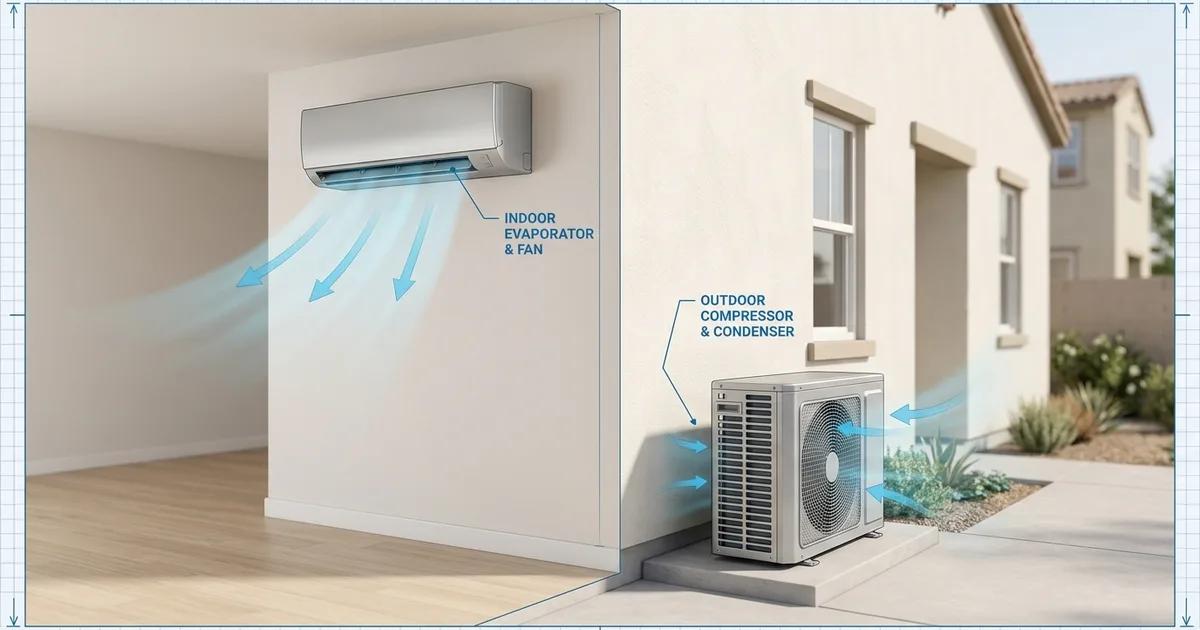
A mini-split system moves heat rather than generating it — the same basic principle as your refrigerator, just applied to a room. The outdoor unit compresses refrigerant, which flows through a small conduit to one or more indoor air handlers mounted on the wall. In summer, the indoor unit absorbs heat from the room and sends it outside. In winter, the cycle reverses: it pulls heat from the outdoor air and moves it inside.
That reversal is why a mini-split heat pump is different from a standard window AC. It handles both heating and cooling with a single unit, and it does so far more efficiently than electric resistance heat (the kind that runs coils the way a toaster does).
According to the U.S. Department of Energy, duct losses account for more than 30% of energy consumption in homes with forced-air systems — particularly when ducts run through unconditioned attic spaces. Mini-splits have no ductwork at all. That 30% isn't lost.
Indoor Unit Options
The indoor air handler comes in several styles. Wall-mounted heads are the most common — quiet, compact, about seven inches deep. Ceiling cassette units flush-mount into drop ceilings for a cleaner look. Floor-standing units work in spaces where wall mounting is awkward. For a garage or ADU, the wall-mounted head is almost always the practical choice.
The Conduit: Simpler Than It Sounds
Connecting the indoor and outdoor units requires only a three-inch hole through an exterior wall. The conduit running through that hole carries the refrigerant lines, power cable, and condensate drain. The outdoor unit can sit up to 50 feet away, which gives installers flexibility in routing without a major construction job.
Single-Zone vs. Multi-Zone: Which Do You Need?
The right configuration depends on what you're trying to condition — one room or several. A single outdoor unit can power between one and eight indoor air handlers, each operating independently.
Single-zone systems pair one outdoor unit with one indoor head. They're the right choice for a detached garage, a backyard ADU, a sunroom addition, or a specific bedroom that the central system never reaches properly. Installation is straightforward, and costs stay low because there's no complexity in routing multiple line sets.
Multi-zone systems connect one outdoor unit to two to five (or more) indoor heads, each with its own thermostat and controls. One indoor unit in the master bedroom can be set at 72°F while another in a home office runs at 68°F. The outdoor compressor shares capacity across zones dynamically.
Multi-zone doesn't mean multi-compressor. One outdoor unit handles everything, which simplifies the exterior installation and reduces the number of electrical circuits needed. But additional indoor heads do add cost — plan on $1,800 to $3,500 per additional zone, not counting the shared outdoor unit.
What Does a Mini-Split System Cost in Sacramento?
Cost is where homeowners most often get surprised — usually because early online estimates don't reflect local labor rates or electrical work. Here's a grounded 2026 breakdown.
| Configuration | BTU Range | Typical Installed Cost |
|---|---|---|
| Single-zone (1 room/garage) | 9,000–18,000 BTU | $2,000–$6,000 |
| Dual-zone (2 rooms/ADU) | 12,000–24,000 BTU | $4,500–$7,500 |
| Three-zone | 18,000–36,000 BTU | $6,500–$9,500 |
| Four-zone | 24,000–42,000 BTU | $8,000–$12,000 |
| Five-zone | 30,000–60,000 BTU | $10,000–$15,000 |
Sources: HomeGuide, Filterbuy, 2026
What Drives the Cost Up
Labor typically makes up 30 to 50 percent of the total project, according to HomeGuide (2026). Longer line-set runs, second-floor installations, and homes with 100-amp electrical panels that need upgrading all push the number higher.
Brand and efficiency also matter. Premium brands like Mitsubishi, Daikin, and Fujitsu run 20 to 40 percent more than mid-tier brands — but they tend to carry better warranties and have established parts availability in the Sacramento area.
SMUD Rebates in 2026
In February 2026, SMUD boosted its heat pump rebate levels after federal Section 25C tax credits expired on December 31, 2025. The current SMUD rebate structure:
- Gas-to-electric conversion (heat pump replacing gas system): up to $3,000
- Electric-to-electric upgrade (replacing older electric system with high-efficiency heat pump): $1,000
- Go Electric Panel Bonus: up to $2,000 for qualifying panel upgrades tied to a conversion
Mini-splits that service the entire home can qualify under these rebates. Installation must go through the SMUD Contractor Network. Rebate amounts are subject to availability, so confirm current figures with SMUD or your contractor before purchasing.
Note from A-CLASS: We're part of the SMUD Contractor Network and can walk you through the rebate paperwork as part of the installation. Call us at (916) 342-9108 to find out what your home qualifies for.
Mini-Split vs. Central AC vs. Window Unit: Which Makes Sense?
Sacramento homeowners generally have three options when central ductwork isn't in the picture. Here's how they compare honestly.
| Mini-Split System | Central AC | Window Unit | |
|---|---|---|---|
| **Upfront cost** | $2,000–$15,000 | $5,000–$15,000+ (plus $2,000–$10,000 for new ducts) | $150–$800 per unit |
| **Heats and cools?** | Yes (heat pump) | Cooling only (standard) | Cooling only (standard) |
| **Efficiency (SEER2)** | 15.2–35 | 14.3–25 | 8–15 CEER |
| **Duct losses** | None | 20–30% energy lost in ducts | None |
| **Typical lifespan** | 15–20 years | 15–20 years | 8–12 years |
| **Best for** | Additions, ADUs, ductless homes, garages | Whole-home with existing ducts | Renters, single small rooms, tight budgets |
| **Noise level** | Very quiet (indoor unit) | Moderate | Moderate to loud |
| **Zone control** | Yes — per room | No (one thermostat) | One unit per room |
Sources: Rewiring America, U.S. Department of Energy, Filterbuy, 2025–2026
The honest summary: central AC with existing ductwork wins on whole-home consistency and familiar installation. Window units win on upfront cost and portability. Mini-splits win on efficiency, zone control, and retrofit flexibility — especially for spaces the existing system was never designed to reach.
Where Do Mini-Splits Fit Sacramento Homes Best?
Mini-split systems aren't the right answer for every situation. They're the right answer for specific ones — and Sacramento has more of those than most cities.
Garages and Converted Spaces
Attached garages present real HVAC challenges. Concrete floors, large overhead doors, minimal insulation, and high ceilings all make central-system ductwork a poor fit. A single-zone 12,000 BTU mini-split handles a typical two-car garage conversion cleanly, and installation usually takes one day.
ADUs and Room Additions
California law requires ADUs to have their own dedicated heating. Extending ductwork from the main house creates sizing problems (the existing system was never designed for the extra square footage) and can complicate permitting under Title 24 energy compliance rules. A separately metered mini-split sized specifically for the ADU sidesteps those issues and keeps the utility bills separate between owner and tenant — a practical benefit for rental ADUs.
Older Sacramento Homes Without Ducts
Homes in Midtown, East Sacramento, and Oak Park built before the 1960s often have radiant heat or gas wall heaters — no ductwork at all. Installing a full ducted central system requires opening walls and ceilings, adding tens of thousands in renovation cost. A multi-zone mini-split can condition an entire three-bedroom home in those situations for less than the cost of the ductwork alone.
Rooms That Never Quite Feel Right
Even in homes with central AC, there's often one room the system can't keep up with — a bonus room over the garage, a converted attic, or a west-facing master bedroom that the afternoon sun turns into a sauna. A single-zone mini-split added to that room costs less than $3,000 in most cases and eliminates the problem without touching the existing system.
How Efficient Are Mini-Splits Compared to Other Systems?
Efficiency is where mini-splits genuinely pull ahead. According to ENERGY STAR, certified mini-split heat pumps use up to 60% less energy than standard electric resistance heating — because they move heat rather than generate it.
The key rating is SEER2, the updated efficiency standard that took effect in 2023. For context:
- Entry-level mini-splits: around 16 SEER2
- Mid-range systems: 18–22 SEER2
- Premium units (Mitsubishi, Daikin, Fujitsu): up to 30–35 SEER2
- Federal minimum for southern states (as of January 2025): 15.2 SEER2
For more on how SEER2 ratings work and what number makes sense for Sacramento's climate, see our guide to SEER ratings explained.
The Inverter Advantage
Most modern mini-splits use inverter-driven compressors, which adjust output continuously based on demand rather than cycling fully on and off. That's the efficiency mechanism. Instead of running at 100% capacity and shutting down, an inverter system might run at 40% for hours, maintaining temperature without the energy spikes of start-up cycles.
ENERGY STAR estimates that a qualifying mini-split heat pump can prevent over 4,500 pounds of greenhouse gas emissions across its lifespan compared to standard systems — a credible number because the efficiency advantage compounds over years of use.
What to Watch Out For Before You Buy
A few things Sacramento homeowners consistently underestimate or overlook:
Sizing matters more than brand. An oversized mini-split short-cycles — it hits the thermostat setpoint quickly, shuts off, and never fully dehumidifies the room. Proper sizing starts with a room-by-room BTU calculation (called a Manual J load calculation). Don't accept a quote that skips this step.
Insulation first. A mini-split in a poorly insulated space works harder than it should. In Sacramento garages, adding insulation to the walls and garage door before installation often reduces the required BTU capacity and cuts the equipment cost.
Electrical capacity. Each indoor zone needs its own dedicated circuit. A home at 100-amp service running a multi-zone system may need a panel upgrade — budget $1,500 to $3,000 if that's a possibility.
Refrigerant transition. In 2026, most new systems use A2L refrigerants — R-32 or R-454B — which are mildly flammable and require installers certified to handle them. Verify your contractor is current on this. A licensed HVAC contractor in California will be; unlicensed handymen handling refrigerant are both illegal and genuinely risky.
Outdoor unit placement. Mini-split outdoor units need airflow clearance and a stable, level mounting surface. In tight Sacramento backyards or ADU situations with setback restrictions, placement options can be limited. Confirm the location before you commit to a system.
Should You Get a Mini-Split or Stick With Central AC?
The answer almost always comes down to two questions: Do you have existing ductwork, and does it reach the space you're trying to condition?
If you have working ducts and need whole-home cooling, central AC is usually the right path — especially for systems replaced or extended within an existing duct layout. If the ductwork is there but in poor shape, get a duct inspection before deciding, because leaky ducts can erase most of the efficiency gap.
If you're conditioning a space without ductwork — garage, ADU, older home, room addition — a mini-split is almost certainly the better call. It's faster to install, requires no major renovation, delivers both heating and cooling, and qualifies for SMUD rebates that reduce the upfront cost.
For Sacramento homeowners with specific spaces that need independent control, a mini-split added to a home that already has central AC is often the cleanest, cheapest fix. You get zone control without replacing the whole system.
Our ductless heating and AC services page has more detail on what a typical Sacramento installation looks like, including the brands we carry and what the process involves start to finish.
Frequently Asked Questions
How much does a mini-split cost in Sacramento?
A single-zone mini-split system typically runs $2,000 to $6,000 installed in Sacramento, depending on brand, BTU capacity, and line-set length. Multi-zone systems that condition two to four rooms range from $4,500 to $14,500. Labor often makes up 30 to 50 percent of the total project cost, so get at least two itemized quotes.
Are mini-splits worth it for Sacramento homes?
For Sacramento homes without existing ductwork — garages, room additions, ADUs, older homes with radiant heat — mini-splits are almost always worth it. They avoid the $2,000 to $10,000 cost of adding ductwork and deliver both heating and cooling from a single system. The break-even on energy savings versus a window unit typically lands at three to five years.
Can a mini-split heat and cool my home?
Yes. A mini-split heat pump both cools in summer and heats in winter using the same refrigerant cycle run in reverse. That makes it a true two-in-one system. Most Sacramento-area mini-splits perform well down to temperatures well below freezing, though pairing with a backup heat source is worth considering for unusually cold nights.
How many zones do I need for a mini-split?
One zone per space that needs independent temperature control. A detached garage or ADU needs one zone. A two-bedroom addition usually needs two. A whole-home replacement in a three-bedroom house without ducts typically calls for three to five zones. Oversizing the number of zones adds cost without adding comfort, so sizing should be based on a room-by-room BTU calculation.
Do mini-splits qualify for SMUD rebates?
Yes. SMUD offers rebates up to $3,000 for gas-to-electric heat pump conversions that include qualifying mini-split systems. As of February 2026, SMUD boosted its rebate levels after federal tax credits expired on December 31, 2025. The system must service the entire home and meet minimum efficiency requirements. Installation must be done through the SMUD Contractor Network.
A mini-split system is a practical, efficient answer for a specific set of Sacramento situations — ductless spaces, older homes, ADUs, garages, and rooms that the main system never reaches properly. It's not the right answer for every home, but for the ones it fits, it's hard to beat: one system for both seasons, no ductwork required, and SMUD rebates that can knock $1,000 to $3,000 off the upfront cost.
If you're trying to figure out whether a mini-split makes sense for your home, the quickest path is a free phone call — (916) 342-9108. We can usually tell you in ten minutes whether ductless is the right direction, or whether a different approach fits your situation better.
Frequently Asked Questions
How much does a mini-split cost in Sacramento?
A single-zone mini-split system typically runs $2,000 to $6,000 installed in Sacramento, depending on brand, BTU capacity, and line-set length. Multi-zone systems that condition two to four rooms range from $4,500 to $14,500. Labor often makes up 30 to 50 percent of the total project cost, so get at least two itemized quotes.
Are mini-splits worth it for Sacramento homes?
For Sacramento homes without existing ductwork — garages, room additions, ADUs, older homes with radiant heat — mini-splits are almost always worth it. They avoid the $2,000 to $10,000 cost of adding ductwork and deliver both heating and cooling from a single system. The break-even on energy savings versus a window unit typically lands at three to five years.
Can a mini-split heat and cool my home?
Yes. A mini-split heat pump both cools in summer and heats in winter using the same refrigerant cycle run in reverse. That makes it a true two-in-one system. Most Sacramento-area mini-splits perform well down to temperatures well below freezing, though pairing with a backup heat source is worth considering for unusually cold nights.
How many zones do I need for a mini-split?
One zone per space that needs independent temperature control. A detached garage or ADU needs one zone. A two-bedroom addition usually needs two. A whole-home replacement in a three-bedroom house without ducts typically calls for three to five zones. Oversizing the number of zones adds cost without adding comfort, so sizing should be based on a room-by-room BTU calculation.
Do mini-splits qualify for SMUD rebates?
Yes. SMUD offers rebates up to $3,000 for gas-to-electric heat pump conversions that include qualifying mini-split systems. As of February 2026, SMUD boosted its rebate levels after federal tax credits expired on December 31, 2025. The system must service the entire home and meet minimum efficiency requirements. Installation must be done through the SMUD Contractor Network.