
Fall Furnace Tune-Up Checklist for Sacramento Homes
Sacramento winters are short, but they're not soft. The Central Valley sees its first cold nights in late October and early November, and when temperatures dip into the 30s, your furnace has to work without warning. If it sat idle for seven months without anyone checking it, that first call for heat is when problems show up.
A fall furnace tune-up — part professional service, part homeowner prep — takes a few hours spread over a couple of weeks and costs far less than an emergency repair call. This checklist covers both sides: what you can do yourself today, and what a licensed tech handles during a proper service visit.
Key Takeaways
- ENERGY STAR states that airflow problems can cut heating system efficiency by up to 15 percent — a dirty filter is the most common culprit (ENERGY STAR)
- The CPSC recommends a professional inspection of all fuel-burning heating equipment every year — a cracked heat exchanger can allow CO to enter living spaces without any smell or visible sign (CPSC CO Information Center)
- Sacramento's first furnace calls of the season concentrate in late October and early November — scheduling in September means faster appointments and lower risk of a cold-night breakdown
- A tune-up runs $89–$250; a missed heat exchanger crack can mean emergency CO evacuation and a $2,000+ repair
What Does a Furnace Tune-Up Checklist Actually Cover?
A proper tune-up splits into two lanes: tasks a homeowner handles in about 30 minutes, and tasks that require a licensed HVAC technician with calibrated tools. ENERGY STAR's maintenance checklist for heating systems requires that a professional verify gas connections, burner combustion, and heat exchanger condition — all three of which carry direct safety consequences if missed. The table below lays out both lanes clearly.
| Task | DIY or Pro? | Notes |
|---|---|---|
| Replace air filter (1" filter: every 1–3 months; 4–5" media filter: every 6–12 months) | DIY | Most impactful single step — clogged filters trigger limit switch shutoffs and force the blower to work harder |
| Test CO detectors; replace batteries | DIY | CPSC recommends CO alarms on every level and outside sleeping areas |
| Clear 3-foot clearance around furnace | DIY | Remove boxes, stored items, and any flammable materials from the furnace area |
| Check all supply and return vents are open and unobstructed | DIY | Closed vents raise system pressure and stress the heat exchanger |
| Test thermostat: switch to HEAT, raise setpoint, confirm furnace starts | DIY | Do this before cold weather hits — not on the first cold night of the year |
| Inspect and clean burners | Pro | Carbon buildup on burners causes incomplete combustion and yellow flame |
| Inspect heat exchanger for cracks | Pro | A cracked heat exchanger can allow CO into living air; requires specialized inspection tools |
| Clean and test flame sensor | Pro | A coated flame sensor shuts the furnace down after a few seconds as a safety measure |
| Test hot surface igniter | Pro | Igniters become brittle with age; technician checks draw and visual condition |
| Measure gas pressure | Pro | Must match manufacturer specification; deviations affect combustion efficiency and safety |
| Service blower motor (clean wheel, lubricate bearings, test amp draw) | Pro | ENERGY STAR: lubrication reduces friction and electricity use; high amperage signals the motor is overworking |
| Tighten and inspect electrical connections | Pro | ENERGY STAR: "faulty electrical connections can cause unsafe operation of your system" |
| Test safety limit switches | Pro | Confirms the furnace shuts off properly if it overheats |
| Run combustion analysis; check for CO leaks | Pro | Calibrated instrument measures flue gas composition and ambient CO — the definitive safety test |
| Inspect condensate drain (high-efficiency furnaces only) | Pro | Blocked drain causes lockout on 90%+ AFUE furnaces |
| Calibrate thermostat | Pro | Verifies temperature readings are accurate and schedules are active |
| Inspect venting, flue pipe, and chimney connection | Pro | Blocked or cracked venting sends combustion gases backward into the home |
Why Fall Is the Right Time in Sacramento
Schedule your furnace tune-up in September or early October — not November. Sacramento's heating season runs roughly late October through February, but the first real cold stretch typically arrives in early November. HVAC companies across the region get slammed with emergency calls the moment temperatures drop, which means longer wait times and higher after-hours rates.
Booking in September gives you three advantages. First, you get your pick of appointment slots and can usually schedule within a week. Second, if the technician finds something that needs a part — a cracked igniter, a worn blower capacitor — there's time to order and install it before you actually need heat. Third, a mild fall day is a much better time to discover your furnace doesn't start than a 35°F night in mid-November.
What we see every year: Our busiest emergency heating call window in Sacramento is the first week of November. Most of those calls are furnaces that would have been a simple tune-up fix in October — a dirty flame sensor, a clogged filter that tripped the limit switch, or a thermostat that lost its settings. A $99 fall visit turns into a $250 emergency call plus a same-day rush fee.
What Happens During the Professional Side of a Furnace Tune-Up?
The pro portion of a furnace tune-up follows the components in sequence — from gas supply to airflow to safety — and takes a trained technician one to two hours to complete properly. Here's what that looks like in practice.
Burners and Combustion
A technician removes the burner assembly and inspects it for carbon buildup, rust, and debris. Dirty burners produce an incomplete, inefficient flame — often visible as a yellow or orange color instead of steady blue. After cleaning, the tech runs a combustion analysis to measure how efficiently the furnace is burning fuel and verify the air-to-gas ratio is within spec.
According to the U.S. Department of Energy, furnace AFUE (Annual Fuel Utilization Efficiency) ratings run from 56 percent on older systems to 98.5 percent on the highest-efficiency modern units. Dirty, unmaintained burners pull a furnace away from its rated efficiency over time.
Heat Exchanger Inspection
The heat exchanger is the metal partition that keeps combustion gases — including carbon monoxide — separated from the warm air circulating through your home. Over thousands of heating cycles, this component can develop cracks. Because CO is colorless and odorless, a cracked heat exchanger often goes undetected without a proper inspection using mirror, camera, or combustion analysis tools.
The CPSC recommends annual professional inspection of all fuel-burning heating systems specifically because heat exchanger cracks are not detectable by homeowners doing their own visual check. Gas furnaces are among the top contributors to home CO incidents in the United States.
According to the CDC, more than 20,000 people visit emergency rooms each year due to accidental CO poisoning, with home heating equipment among the leading sources. The only reliable protection is a combination of annual professional inspection and working CO alarms on every floor.
Flame Sensor and Igniter
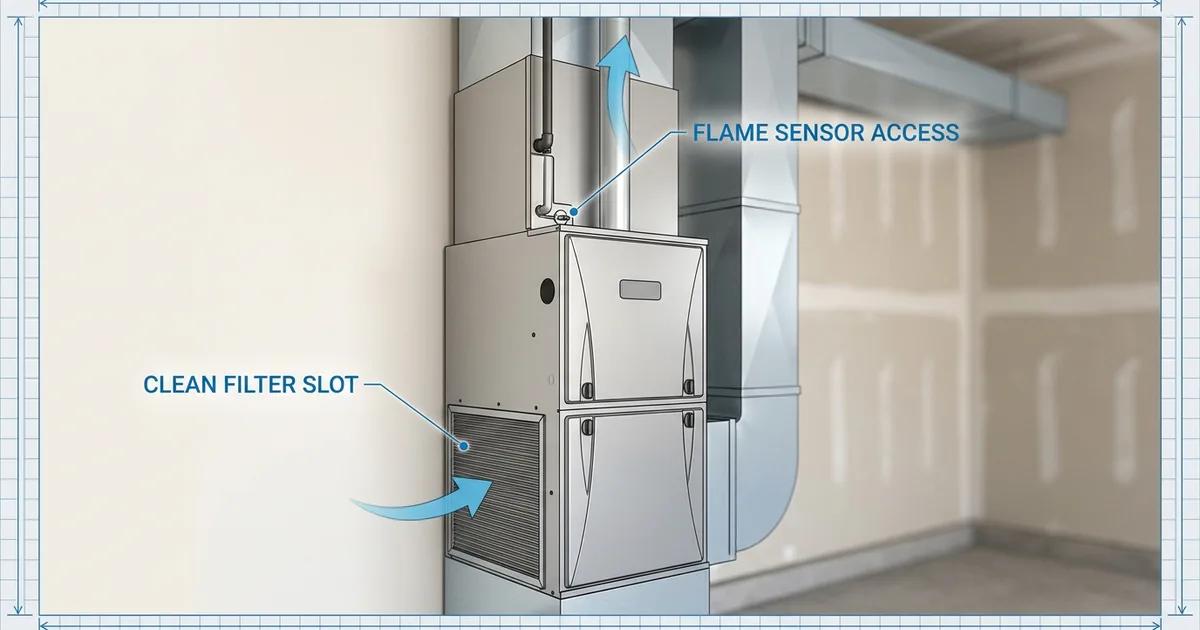
The flame sensor is a thin metal rod that sits in the burner flame. It passes a tiny electrical current through the flame to confirm combustion happened. When residue builds up on the rod over a heating season's worth of cycles, the sensor can no longer reliably prove flame — so the control board shuts the furnace down after three to ten seconds as a safety measure. This results in the furnace "short-cycling": starting, running briefly, shutting off, and repeating three times before locking out.
Cleaning the flame sensor takes a technician about five minutes and costs almost nothing when it's part of a tune-up. Left alone, it typically causes a no-heat service call in November. See our gas furnace troubleshooting guide for the full list of symptoms and what each one means.
Blower Motor and Electrical
The blower motor moves conditioned air through your ducts. A technician cleans the blower wheel (dust buildup can reduce airflow significantly), lubricates the motor bearings, and measures amperage draw. High amp draw means the motor is working harder than it should — an early warning sign of a motor heading toward failure.
In 2025, ENERGY STAR confirmed that airflow problems can reduce heating system efficiency by up to 15 percent (ENERGY STAR Maintenance Checklist). A blower wheel caked with dust is one of the two main causes of that efficiency loss; the other is a dirty filter.
Something worth knowing: In Sacramento's climate, furnace blower wheels collect more dust than in wetter climates because the Central Valley's dry summer air carries high particulate loads. A blower that looks clean enough in a humid market often has significant buildup here after a full summer of running the AC.
Safety Controls and Venting
The final check covers the components that keep the furnace from hurting anyone. The technician tests the high limit switch — which shuts the furnace off if it overheats — and verifies that the pressure switch and rollout switch (if present) function correctly. The flue pipe and venting are inspected for blockages, corrosion, or disconnected joints that could allow combustion gases to spill back into the home.
Your DIY Checklist: Four Tasks to Handle Right Now
You don't need to wait for the tech appointment to start. These four tasks cost nothing or close to it, and they're all safe for homeowners to handle.
Replace the air filter. A standard 1-inch filter needs replacing every one to three months; a 4–5 inch media filter every six to twelve months. Check yours now. If it's gray and you can't see light through it, replace it before you run the furnace at all. ENERGY STAR lists this as the highest-impact homeowner maintenance step. A clogged filter restricts airflow, causes the heat exchanger to overheat, and can trigger repeated safety shutoffs.
Test your CO detectors. Press the test button on every CO alarm in the house. Replace batteries in any detector that's more than six months old. If any detector is more than seven years old, replace the unit — CO sensors degrade over time. The CPSC recommends CO alarms on every floor of the home and outside each sleeping area, with interconnected alarms so that one sounding triggers all of them.
Clear the area around the furnace. Furnaces need three feet of clear space on all sides. Remove boxes, stored items, holiday decorations, or anything else that's accumulated near the unit since last winter. Keep the area clear throughout the heating season — items stored close to the furnace are a fire hazard and can restrict combustion air.
Open every supply and return vent. Walk through the house and make sure every floor register and wall vent is open and unobstructed by furniture, rugs, or curtains. Closed vents don't save energy — they increase system pressure, reduce airflow, and stress the heat exchanger. This is a common misconception that leads to a surprising number of limit-switch trips.
Is a Furnace Tune-Up Worth the Cost?
A standard tune-up in Sacramento runs $89 to $175 for a basic visit and $150 to $250 for a comprehensive service with combustion analysis and a written report. Annual maintenance plans that bundle a spring AC visit with a fall furnace visit run $199 to $349 and often include priority scheduling and a parts discount.
Compare that to what deferred maintenance actually costs. A dirty flame sensor that causes a no-heat call in November runs $150 to $250 just for the diagnostic and repair — on top of whatever after-hours premium applies. A failed igniter runs $200 to $350. A cracked heat exchanger discovered mid-season, rather than during a fall inspection, means either running a furnace with a known safety issue or replacing the heat exchanger (or the furnace) on an emergency timeline with no time to shop prices.
The math works clearly in favor of the tune-up. But the safety case is the stronger argument: a professional tune-up is the only reliable way to catch a cracked heat exchanger before it becomes a CO problem.
For context on whether your furnace is worth servicing or approaching replacement age, see our guide on heating system maintenance in Sacramento. If you're comparing against a new install, our fall furnace tune-up post pairs well with AC system guidance in the warm-season checklist.
Frequently Asked Questions
What is included in a furnace tune-up?
A professional furnace tune-up covers burner cleaning, heat exchanger inspection for cracks, flame sensor cleaning, igniter testing, gas pressure measurement, blower motor service, lubrication of moving parts, electrical connection checks, safety limit switch testing, thermostat calibration, and a carbon monoxide leak test. Most visits take one to two hours and follow a standardized checklist.
How often should a furnace be serviced?
ENERGY STAR and the CPSC both recommend a professional furnace inspection once a year. Early fall is the best window for Sacramento homeowners — before the first cold nights arrive and before HVAC companies get slammed with emergency calls in November.
Can I service my own furnace?
Homeowners can safely handle four tasks: replacing the air filter, testing CO detectors, clearing the area around the furnace, and checking that all vents are open. Gas system work, heat exchanger inspection, burner cleaning, electrical testing, and flame sensor service all require a licensed HVAC technician.
How much is a furnace tune-up in Sacramento?
A standard visit runs $89 to $175. Comprehensive service with combustion analysis and a written report typically costs $150 to $250. Annual plans covering both seasonal visits run $199 to $349 and often include a parts discount. Call A-CLASS Heating and Air at (916) 342-9108 for current pricing and availability.
Sacramento's cold season is short but unforgiving when your heat doesn't come on. Scheduling a furnace tune-up in September — combined with the four DIY tasks you can handle any afternoon — means you go into November with a system that's been inspected, cleaned, and confirmed safe. That's a much better position than hoping it works on the first cold night.
Call A-CLASS Heating and Air at (916) 342-9108 to schedule your fall furnace tune-up. We've been serving Sacramento-area families since 2016, and we'll tell you straight what we find — no upsells, no pressure.
Sources:
- ENERGY STAR Maintenance Checklist — energystar.gov/saveathome/heating-cooling/maintenance-checklist
- U.S. Department of Energy, Furnaces and Boilers — www.energy.gov/save
- CPSC, Carbon Monoxide Fact Sheet — cpsc.gov/safety-education/safety-guides/carbon-monoxide/carbon-monoxide-fact-sheet
- CDC, Carbon Monoxide Poisoning Data — cdc.gov/carbon-monoxide
- Carrier, Furnace Tune-Up Guide — carrier.com/us/en/residential/hvac-resources/furnaces/furnace-tune-up/
Frequently Asked Questions
What is included in a furnace tune-up?
A professional furnace tune-up covers burner cleaning, heat exchanger inspection for cracks, flame sensor cleaning, igniter testing, gas pressure measurement, blower motor service, lubrication of moving parts, electrical connection checks, safety limit switch testing, thermostat calibration, and a carbon monoxide leak test. Most visits take one to two hours and follow a standardized checklist from the technician's training and manufacturer specs.
How often should a furnace be serviced?
ENERGY STAR and the CPSC both recommend scheduling a professional furnace inspection once a year. Early fall is the best window for Sacramento homeowners — before the first cold nights arrive and before technicians get slammed with emergency calls in November. A yearly visit covers safety, efficiency, and catches worn parts before they fail mid-winter.
Can I service my own furnace?
Homeowners can safely handle four tasks: replacing the air filter, testing CO detectors and replacing their batteries, clearing the area around the furnace, and checking that all supply and return vents are open and unobstructed. Gas system work, heat exchanger inspection, burner cleaning, electrical testing, and flame sensor service all require a licensed HVAC technician with the right tools and training.
How much is a furnace tune-up in Sacramento?
A standard furnace tune-up in Sacramento runs $89 to $175. A more comprehensive visit that includes combustion analysis, duct inspection, and a written report typically costs $150 to $250. Annual maintenance plans covering both a spring AC visit and a fall furnace visit generally run $199 to $349 and often include a parts discount. Call A-CLASS Heating and Air at (916) 342-9108 for current pricing.